
Today's Top 10 is a guest post from economist, author and commentator Shamubeel Eaqub.
As always, we welcome your additions in the comments below or via email to david.chaston@interest.co.nz.
And if you're interested in contributing the occasional Top 10 yourself, contact gareth.vaughan@interest.co.nz.
See all previous Top 10s here.
1. Bear market.
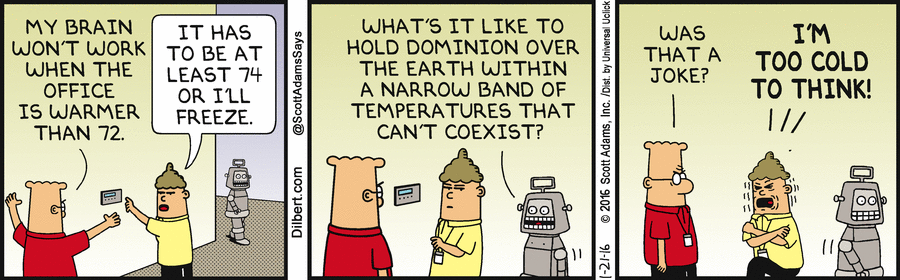
The FT reported that many global bourses are now officially in a bear market. While we are enjoying a lazy summer start, the rest of the world has begun on a gloomy note.
Fear rippled through global markets, taking the UK, French and Japanese stocks to more than 20 per cent below their 2015 highs — the common definition of a bear market — and compounding equities’ worst start to a year on record.
Gold is often talked about as a defensive asset. There are many reasons for this, including that it is often done as a physical purchase. But a 2013 analysis of historical data suggests the rhetoric may not match reality.
…Professor Robert Barro of Harvard and his co-author Sanjay Misra point out that gold investments significantly underperformed the stock market on an annual basis by a factor of seven during the period 1821 to 2011 and all more recent sub periods with substantial volatility. Indeed, in the period 1975-2011 the return on the stock market (in constant dollar terms) has experienced almost twice the return on gold with only two thirds the volatility.
They go on to warn that:
The standard prescription for troubled times is to do nothing. It is very dangerous to your financial health to make major portfolio reallocations in times of market turmoil. If you are considering an investment in gold, why not consider the pokies?
Markets are falling and questions are being asked, is it a repeat of the GFC? The warning from BIS is stark – we have no ammo this time. I reckon 2016 will be more about emerging markets and the global economy will slow, rather than the sudden stock we saw in 2008. This is because emerging markets' financial markets are not nearly as deeply embedded as in advanced economies.
William White, a former chief economist of the Bank for International Settlements (BIS), the central bankers club, who now chairs the OECD’s review committee warned that central bankers had “used up all their ammunition”.
“The situation is worse than it was in 2007. Our macroeconomic ammunition to fight downturns is essentially all used up. Debts have continued to build up over the last eight years and they have reached such levels in every part of the world that they have become a potent cause for mischief,” he said on the eve of the event.
The BIS was one of the few organisations to warn during 2006 and 2007 about the unstable levels of bank lending that eventually led to the Lehman Brothers crash.
At the beginning of the year, there are all kinds of forecasts by all kinds of people. They range from sanguine to doom. In the Economist, there was a great article about economic forecasts. They are inevitably wrong. But also, forecasts never predict downturns accurately.
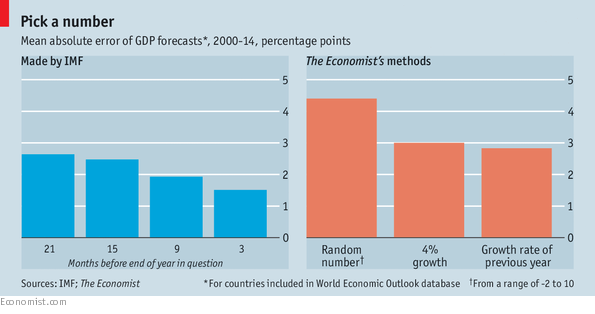
“Forecasts of all sorts are especially bad at predicting downturns. Over the period, there were 220 instances in which an economy grew in one year before shrinking in the next. In its April forecasts the IMF never once foresaw the contraction looming in the next year. Even in October of the year in question, the IMF predicted that a recession had begun only half the time.”
5. Oil and downturn.
Oil prices have been falling sharply. Global demand is not strong enough for the increase in supply. With risks to growth, lower oil prices will provide some relief to embattled households and business, but don’t expect it to boost global growth.
Bloomberg had this great chart of inventory and the price of oil.
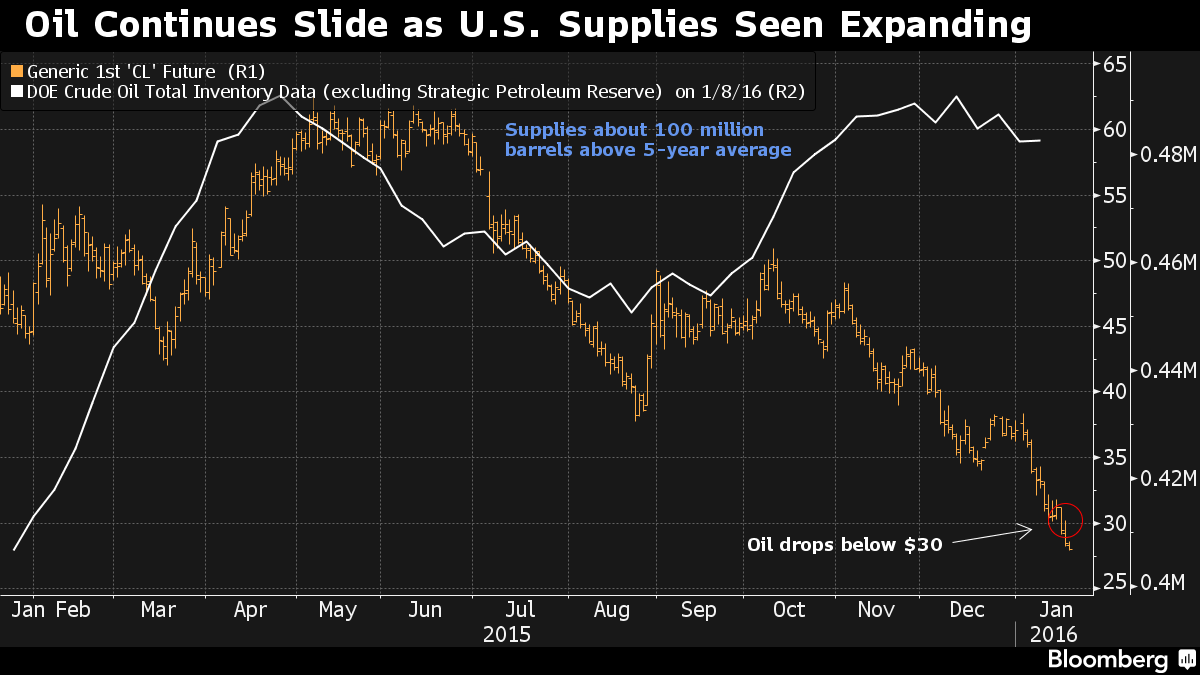
“[Oil] Markets could “drown in oversupply,” sending prices even lower as oil demand growth slows and Iran boosts exports, the International Energy Agency said Tuesday. A "lower-for-even-longer" scenario is forcing companies’ budget planners to trim spending even further.”
The latest data for NZ shows there is little or no inflation. Some of this is due to lower global commodity prices, particularly oil. But there is a much wider theme of low and subdued inflation across the economy, with only a few hotspots that show no indication of spreading. It hasn’t been just consumer prices that have barely grown, it's also wages.
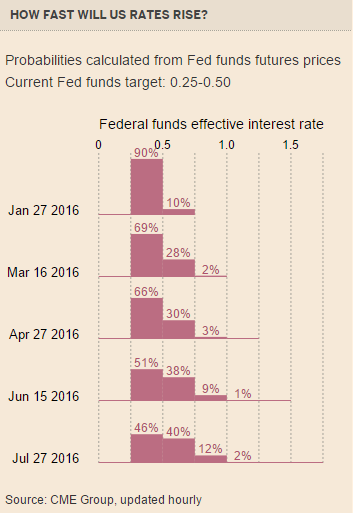
The weakness in inflation is a global story, not just local. US interest rate predictions have been scaled back from gradual increases to just a 10% chance of another hike in coming months.
The FT writes that interest rates are unlikely to rise soon and not to pre-GFC highs.
Will [interest rates] return to pre-crisis levels? Not for the foreseeable future, according to Fed policymakers’ own projections. The Fed believes the rate compatible with stable growth and prices has sunk sharply because of the lingering effects of the crisis and will increase only gradually. In this subdued post-crisis world, the central bank will need to keep its foot on the accelerator for some time to come.
7. Capital fleeing emerging markets.
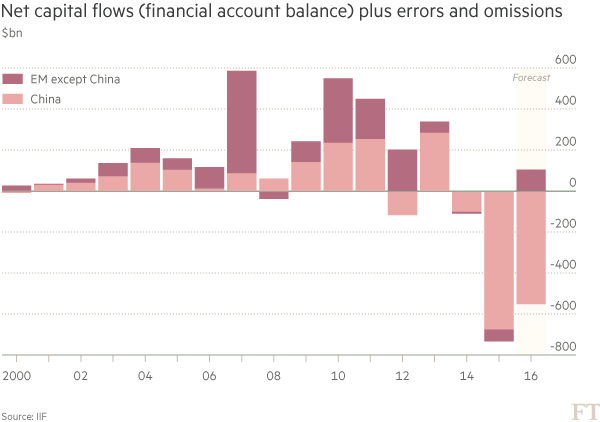
Capital fled emerging markets faster than earlier expectations, according to the Institute of International Finance (IIF).
Capital inflows boosted investment and economic activity, as well indicating confidence in emerging markets. But last year, capital fled the region and China was most affected.
The bulk of these outflows relate to China, driven in part by repayment of corporate FC liabilities in the face of concerns about a weakening currency. We estimate total capital outflows from China amounted to $676 billion in 2015.
With the latest clampdown on capital outflows in China and changes in the foreign exchange regime, its unclear if that outflow can continue in 2016. NZ could be a recipient of these funds for businesses and real estate if the IIF’s forecasts for 2016 are correct.
Recent research from Canada shows that students with PhDs do not always go on to get good jobs. After decades where tertiary education has been used as a shorthand for lifting skills, employability and incomes – it is time for a rethink. Not all tertiary qualifications will get good jobs.
A study from Canda shows that:
40% of young Canadian graduates are overqualified for the work they do
some fields are worse affected than others: with business, management, law, and humanities being the worst hit
labour mismatches are worsening across subnational regions
struggling with a “new normal” of economic growth, wherein the difficultly of creating high quality jobs commensurate with an educated young workforce increases considerably.
The story could just well be about New Zealand. We have to think seriously about getting our young people into the right skills paths that will give them a lifetime of employability. Provinces need even greater care, which have been lagging cities for many decades.
9. Davos: Issues facing the world.
In Davos, the who’s who of the business and political world has gathered to talk about the economy. Their main concerns are not that different from NZ:
Automation:
“Increasing numbers of humans may disappear from the workplace with the arrival of mass automation”
China:
“[…] spooked by the past six months, from last August’s exchange rate gyrations and first stock market crash, to the second bout of stock market panic that opened this year. Beijing’s communiqués have come too little, too late to soothe investors’ anxieties.”
Emerging markets:
“During the past year, money flowed out of emerging market investments into dollar-denominated ones, in anticipation of a stronger dollar and better interest rates in the US. Net investment portfolio inflows to emerging markets became negative for the first time since during the global financial crisis in 2009.”
10. Believe China GDP numbers?
China’s economic growth is moderating, or is it slumping? Financial markets suggest the latter, but some academics suggest things aren’t as bad as they are made out to be.
GDP was up 6.9% in 2015, right in line with survey expectations. Any talk about this being the slowest pace of growth in 25 years is off the mark.
No doubt some commentators will be quick to dismiss today’s official figures as being made up by the Chinese government and to suggest that the real situation is much worse.
But that’s not the conclusion reached by those who have made it their academic career to study the quality of Chinese economic data.
[…] take a look at how China’s economic growth shows up in some of the numbers closer to home. More than one million Chinese tourists arrived in Australia last year, up 22% on a year earlier. Spending by Chinese tourists totalled $7.7 billion, accounting for more than one-fifth of total international visitor spending, and more than double that of second placed, UK.
New Zealand tourism is riding the same wave. But can we shrug off plunging commodity prices and slowing exports to just naysaying?
We welcome your comments below. If you are not already registered, please register to comment
Remember we welcome robust, respectful and insightful debate. We don't welcome abusive or defamatory comments and will de-register those repeatedly making such comments. Our current comment policy is here.