

By Bernard Hickey
Should we all celebrate?
Or sink into a great depression?
Or run for the nearest bunker?
It's hard to know how to react to this week's declaration by Quotable Value and Homes.co.nz that Auckland's average house value rose to over NZ$1 million in August.
Auckland's home-owners should in theory be celebrating their good fortune and be voting for more of the same. Anyone who invested just over NZ$53,000 of their own money in 2011 to buy an average Auckland house with a 90% mortgage would now be sitting on tax-free capital gains of NZ$485,000.
Indeed, some are celebrating. New car sales are at record highs and spending in Auckland's cafes, bars and restaurants is growing at double-digit rates. But it's not the sort of go-for-broke debt-fuelled spending binge like the one we saw from 2002 to 2007 when mortgage lending grew at an annual rate of 15%. Mortgage debt grew 9% in the last year and most people think it has peaked at that rate, given the Reserve Bank's latest restrictions on low deposit lending and a limit on debt to income multiples expected next year.
Most Aucklanders don't believe the manna from the great housing gods in the heavens is real enough to go withdrawing from their household ATMs, which is why the lending growth is relatively subdued.
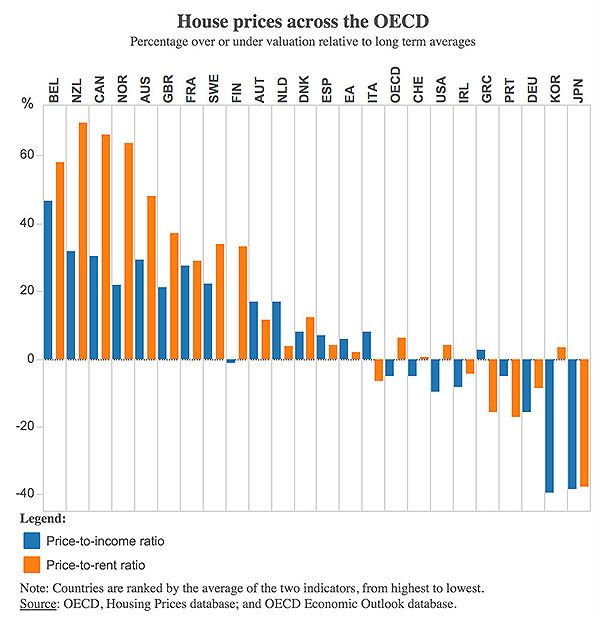
They also can feel in their bones that house prices at 10 times incomes are hyperventilated, if not downright over-valued. New Zealand's house price to income multiple is the second most expensive relative to long run averages in the OECD (behind Belgium), and is the most expensive relative to rents in the OECD. That over-valuation has grown more than any other country in the OECD over the last six years. This is not the sort of world champion tag we want.
The $1 million milestone is clearly a moment of despair for those young Aucklanders aspiring to own a home and start a family, particularly those ones whose parents were also renters. The combination of the price rises and the new LVR rules mean they face decades of saving for a deposit, let along being able to afford to borrow the hundreds and hundreds of thousands dollars needed to buy a home. All they can hope for is to win Lotto or to marry into a rich family.
Another response is to hunker down and prepare for an implosion, which means saving madly to repay debt ahead of the housing market end-times and to diversify into other types of assets. This isn't so much a celebration as a preparing for the party to be shut down.
There are two other ways to think about the magic million number. Firstly, there is the Stockholm Syndrome response where the hostage starts to identify and sympathise with the hostage taker. The home owner knows they're being forced against their will to stick with the over-valued asset, but they also think any attempts to end the siege only risk harming both hostage and kidnapper. Our political debate over housing affordability has appeared a lot like a hostage crisis lately, often boiling down to: 'Nobody moves or the home equity gets it!'
Secondly, there is the pass the parcel approach, which is best played with The Wiggles' 'Hot potato, hot potato' blaring in the background. If you really think that one day the music will stop and you don't want to be holding the bad loan parcel when it does, then the best approach is to flick-pass the parcel as fast as you can and then hope the music stops for someone else. You could even sit a few rounds out of the game.
That's what a few of the banks are now doing. ANZ CEO David Hisco said in July he thought the Auckland housing market was 'over-cooked' and he called on banks to tighten their lending criteria. He even called for the Reserve Bank to force rental property investors to have a 60% deposit.
"The current situation will see ANZ implement even tougher criteria for investment loans as house price inflation spreads from Auckland to other regions," Hisco said.
And the nation's biggest bank has been true to his word since then. It stopped lending to landlords wanting to buy apartments and house-and-land packages off the plan. Developers and brokers also report ANZ and other banks have pulled back from lending to developers in Auckland in recent weeks. The Reserve Bank also noted this week that some banks were being more restrictive than even the latest Reserve Bank restrictions on low deposit lending. The Australian banks know the words and actions for 'Hot potato, Hot potato' by heart.
Bizarrely, I have even heard cabinet ministers worry about the valuations for houses on the Government's balance sheet. The Government owns houses (or more importantly the land under them) worth NZ$19 billion at current prices. The implied worry is that if the Government built a lot more with these inflated prices, then it would face big (paper) losses on that housing equity if there was a correction. This is, of course, ludicrous thinking. Auckland desperately needs more houses and the only player with a big enough balance sheet and a long enough investment horizon to ride out the quarterly ebbs and flows of the housing market is the Government.
The risk is that the developers and banks, who are beholden to much tighter funding requirements and have to report quarterly to impatient and anxious shareholders, choose to step back from lending to build the tens of thousands of houses that Auckland needs over the next five years.
There is one step the Government could take to circumvent this game of pass the parcel. It could restrict its KiwiSaver HomeStart grants to new homes. That would guarantee developers and their bankers that there was a pipeline of funding and demand for their more affordable apartments and townhouses, given the Reserve Bank's LVR rules don't apply to new builds. If the banks and the Reserve Bank are determined to stop landlords from funding all these new homes, then the least the Government could do is step up to ensure they help first home buyers fund these homes.
Now is not the time to give in to the hostage takers' demands. Let's take the long term view and use the Crown's balance sheet to negotiate our way out by funding and building those homes that will be there for many decades and housing cycles to come.
A version of this article also appears in the Herald on Sunday. It is here with permission.
We welcome your comments below. If you are not already registered, please register to comment
Remember we welcome robust, respectful and insightful debate. We don't welcome abusive or defamatory comments and will de-register those repeatedly making such comments. Our current comment policy is here.