

By David Chaston
After Wednesday's low wage change data, the question becomes how does that stack up on an after-inflation basis?
And how does it stack up compared with the longer term?
In the five years to June 2017, we are ending a period of the strongest real wage gains since 1989 when the current data series began.
That will surprise many readers (and analysts like me).
| Straight | Overtime | Total | change | CPI | Real | |
| year to ... | $ | $ | $ | 5yr% | av%pa | av%pa |
| June 1992 | 541 | 29 | 568 | +15.9 | +7.4 | +0.2 |
| June 1997 | 611 | 24 | 635 | +11.4 | +2.1 | +0.1 |
| June 2002 | 698 | 21 | 718 | +14.2 | +1.6 | +1.1 |
| June 2007 | 846 | 23 | 869 | +20.0 | +2.6 | +1.1 |
| June 2012 | 1,013 | 25 | 1,038 | +18.9 | +2.9 | +0.8 |
| June 2017 | 1,142 | 26 | 1,168 | +12.5 | +0.9 | +1.5 |
The bounce this quarter from a period when pay gains have slowed keeps going a period of real gains that started in September 2011.
It is true that nominal wage gains have been higher in the past quarter of a century, but inflation was even higher for much of that period, so those gains were illusory.
The data is important because the claim of "low wages" and "low wage growth" will be part of the election rhetoric.
It seems clear that inflation, which has been historically low, is about to get even lower. Monetary policy officials don't seem to know how to raise it with their traditional tools.
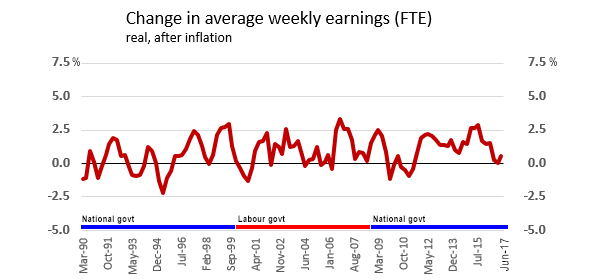
If we have real wage gains, the question can be asked about what is the problem with low inflation and why should the Reserve Bank try to lean against the trend.
Rising real incomes should be enough, you might think.
The Reserve Bank however may want higher inflation and higher interest rates in "the good times" so that it has some traditional firepower should the economy need some stimulus. If rates are very low when the economic cycle turns down, they are left contemplating the use of "unconventional" tools, like money printing ("quantitative easing").
Low inflation makes pay packets go further.
In New Zealand, there is no evidence yet that many people are being hurt by prices that don't change higher. It is more a policy issue for the Reserve Bank than the rest of us.
Low interest rates in response to low inflation has had the perverse effect of driving up asset prices, especially for land. (But recent housing data maybe unstitching that idea a little.) It has also fuelled our housing debt, and twisted out debt levels toward more housing exposure.
But back to wages. Any gains higher than inflation add to people's purchasing power.
To get a fair share of the economic pie, these real gains should be as much as the economy grows in real terms.
Here is the same data with the real GDP growth data added.
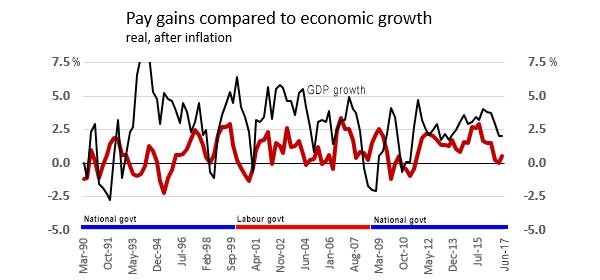
So the argument should not be that workers' pay packets are not making gains. The real argument is that they are not gaining as fast as the economy has been growing.
That is true now.
But it seems to have been the case for much of the time over the past 25 years as well. Pay has kept up as well in the past five years as in any previous period. But it has not kept its share of the economic growth all the same.
Data for this story has been sourced from Statistics NZ's Infoshare resource, QES (Table: Average Weekly Earnings (FTEs) by Industry (ANZSIC06) and Sex (Qrtly-Mar/Jun/Sep/Dec)) for the wage data, and from the RBNZ for the real GDP growth series (M5).
We welcome your comments below. If you are not already registered, please register to comment
Remember we welcome robust, respectful and insightful debate. We don't welcome abusive or defamatory comments and will de-register those repeatedly making such comments. Our current comment policy is here.