
The following article is the second chapter from Progressive thinking, ten perspectives on housing, a Public Service Association (PSA) publication. Interest.co.nz is publishing all 10 chapters from different authors on various aspects of housing.
By John Tookey*
Housing in New Zealand is in trouble in so many ways. Quality, cost and sustainability all have roles in the discourse. The critical issue, both locally and nationally, is the Auckland affordability crisis creating economic instability.
How did we get here and where next? The culprits have all been paraded before the demos - builders overcharging, lack of competition in materials, foreign investors, property speculators. Everything up to and including “A big boy did it and ran away”. So why this mess?
Technology
In 1965, Intel co-founder Gordon Moore noticed the number of transistors per square inch on integrated circuits doubled annually, whilst the price reduced. The eponymous “Moore’s Law” has become our benchmark expectation for product performance ever since. The phone or computer you use gets ever more capable, and our performance expectations grow in lockstep. Your phone now does email, photography, storage and route finding with GPS.
By contrast, what has been happening in the building industry over the last 50 years? Not much. Houses are built as they were, using the same materials, trades and taking the same amount of time.
Construction productivity flatlines at $34/hr added value compared to a national average of $48/hr, with innovation 10 per cent below the national average. Consequently building new is growing in expense, irrespective of economies of scale. We build approximately 7,200 dwellings per annum against demand of 14,000 per annum for the next 30 years.
The only way to meet housing needs would be to double labour productivity through innovation, or double our total workforce in house building. Since we do not have a transient labour force of skilled workers as in Europe, productivity through technology is where we need to invest.
Housing types
‘Affordable’ houses are more expensive to build pro rata than larger properties. Typically, affordable homes are two or more storeys and attached rather than detached.
The scaffolding and other technical requirements (thank you Health and Safety Act 2016!) lead to a cost of around $3,400/m2. Conversely large single storey houses are $2,000/m2. The result? Affordable homes are affordable to the end purchaser, not the builder in the value chain.
Why would a builder build lower margin housing for the public good if not compelled to do so? New homebuyers tend to specify the largest possible house on their section in order to incorporate the maximum residual value for themselves.
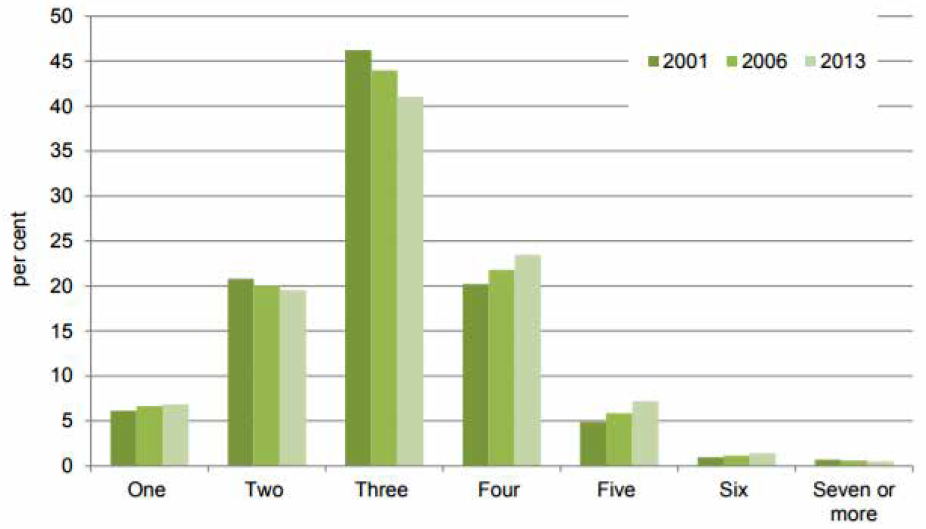
Thus we see census trends in house building showing increases in four to five bedroom properties being constructed, while affordable two to three bed units are in decline (Figure 1). In short, the market is driving the wrong outputs at the wrong end of the market.
Special Housing Areas (SHA) fail to change these trends, with standalone sections developed first and affordable housing developed last. Indeed, 56 per cent of SHAs have been de-established.
Fragility
Our housing industry is literally a cottage industry: 98.5 per cent are single person, ephemeral companies subsisting from invoice to invoice, using credit lines to stay liquid.
Their risk profile requires spreading their effort over several projects simultaneously to maintain turnover.
This industry corpus increases production scale without recruiting more tradies and increasing their risk – hence costs climb with demand. They are inefficiently organised with poor bargaining power compared to group builders.
Figure 1: Bedrooms per dwelling in Auckland 2001-2013 (StatsNZ, Census 2013).
Most therefore fear the boom-bust cycle. Altruism for homebuyers is inconsequential amongst their priorities. Builders take only the work they can manage to limit exposure to the ‘bust’ cycle, thinking in terms of three to five years until the downturn – but indicators are already appearing.
Land
Land supply is core to unaffordability, but the assumption that more land being released and consented more cheaply and rapidly equals more housing more quickly is fundamentally flawed.
This is only true if industry capacity is scalable to demand and the market operates perfectly. ‘Material availability’ doesn’t automatically deliver higher production rates. Land improvement/preparation capacity is as constrained as housebuilding.
Doubling available land will not double the number of land developers or their capacity. Imagine a car producer received an additional million tonnes of sheet steel at their factory at zero cost. Will more cars be produced? No.
A more likely scenario is optimised production to factory capacity, retaining the current selling price, margin and brand value. The problem is exacerbated because before land is ready for housebuilding, costly infrastructure, drainage and improvement is required - consequently it is a tough, cash-intensive, industry to enter. Once again we expect industry to absorb the cost and risk of delivering societal needs when increasing production forces down sale prices for all producers. Is it reasonable to expect markets to deliver societal needs then be shocked when they function in their own interests?
The future
Einstein said: “We will not solve the problem by using the same reasoning that created the problem”. By contrast, current government thinking on land availability is the equivalent of Captain Blackadder anticipating the plan for the next offensive: “It’s the same plan as last time and the seventeen times before that.”
Blackadder economics from government will not cut it this time. Land release and Special Housing Areas (SHAs) are not solving affordability issues since social outcomes are not compelled through ‘use it or lose it’ clauses, or incentivised through additional profit.
Compulsion (or profit motivation) in land development is required if we take affordability seriously. We need incentives to use prefabrication to increase productivity.
Why not specifically fast-track consenting for prefabricated housing? Why not make consents zero cost for two to three bedroom housing and double or triple current rates for four to five bed housing?
If this is a national crisis, why not create a national prefabrication plant producing inexpensive kit-set housing with preapproved building consent for generic designs?
How about incentivising landlords to sell off their buy-to-let investment properties? Imagine a scheme where landlords agree to divest their portfolio so they can place their capital gain tax free into KiwiSaver - provided they commit to not owning directly or indirectly investment property in the future.
Imagine genuine state housing (not mortgage assistance schemes) delivering the two to three bedroom housing we need, rather than expecting industry to deliver this category of homes with lower profits and higher risk?
Ultimately government should accept the seriousness of affordability. Blackadder economics and wishful thinking will not magically change what is and is not profitable for the housing industry to build.
We are at a tipping point for the New Zealand economy. The electorate knows it. The question for government is whether laissez-faire ideology or pragmatic intervention will win the debate.
Either way, decisive action is required now.
-----------------------------------
*Professor John Tookey is Director CUBE-NZ, at Auckland University of Technology’s School of Engineering.
Note: The views expressed in Progressive thinking, ten perspectives on housing belong to the authors and do not necessarily represent the view of PSA members or the organisation.

We welcome your comments below. If you are not already registered, please register to comment
Remember we welcome robust, respectful and insightful debate. We don't welcome abusive or defamatory comments and will de-register those repeatedly making such comments. Our current comment policy is here.