
By Chris Trotter*
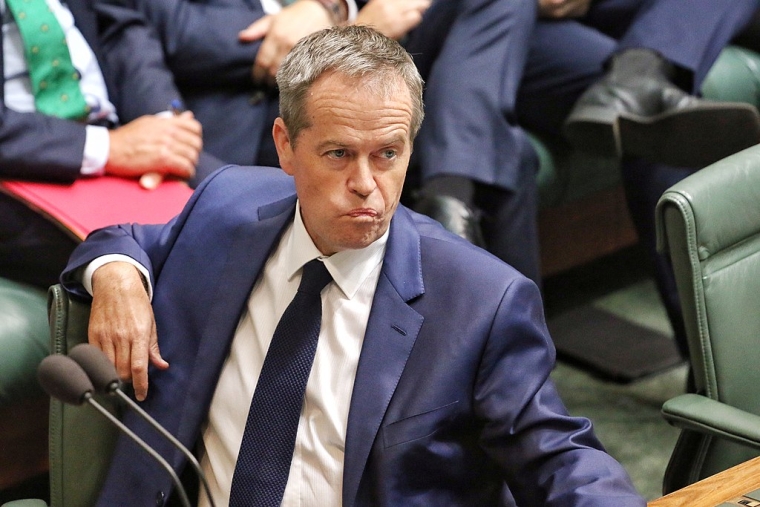
It's a lesson that no Centre-Left politician can afford to forget. If you go after the “big end of town”, then the Big End of Town will come after you. Bill Shorten will go down in Australian political history as the Labor leader who lost the unlosable election by underestimating the extraordinary defensive power of the Big End of Town (BEOT).
It’s amazing that he did such a stupid thing. Especially when the evidence – both Australian and international – is there for every Centre-Left strategist to evaluate and absorb.
The advice which the Labor Party should have been given, or, if it was given, chose to ignore, hardly constituted rocket science. The Liberal-National Coalition Government has lost its way. It is beset by a number of extreme ideological obsessions, such as climate scepticism, which are highly detrimental to Australia’s long-term economic and environmental interests. Labour’s political mission was, therefore, straightforward and simple: to restore the requisite measure of rationality, reasonableness and decency to the business of governing Australia.
That was all that was needed. Because, in very large measure, that was also the conclusion which a comfortable majority of Australians had arrived at all by themselves. Crucially, it was also a position which the BEOT could easily accommodate. Not least, because a substantial number of business leaders not involved in the mining industries shared it.
Had Shorten and his Labor colleagues limited their pitch to restoring good government to Australia, Scott Morrison and his colleagues would have had bugger-all to shoot at. In their six years at the helm, they could hardly claim to have presented Australia and the world with a sterling example of rationality, reasonableness and decency. To the contrary, for most of their time in office, the Liberal Party appeared to be channelling the morals, strategy and tactics of the five New York Mafia families during the 1980s. The bloodletting may have been a little less, but the body count seems about right.
It was this recklessness; this inward focus; that offended so many Australians, who, not unreasonably, expected the politicians they had elected to run the country to do so sensibly and in their interests. That was what the polls were telling the Labor Party all along: just convince us that you can run Australia in a grown-up and inoffensive manner, and we’ll give you a whopping great majority and let you get on with the job.
Simple enough, one might have thought, but one would have been reckoning without the extraordinary tone-deafness of the post-Hawke/Keating Labor Party. Instead of interpreting the poll data as evidence that, if they played their cards right, a win might just be possible, Shorten et al regarded it as proof that, since a loss was impossible, they could play their cards any damn way they pleased.
“We’ll never get a better chance to do all the things we’ve been promising ourselves for the past decade than this”, Labor told itself. “So, come on Comrades, this time we can quite safely bet the whole farm!” Which is pretty much what they did: promising to raise taxes and increase spending like it was going out of style. (Which, of course, it has been for the best part of three decades.)
Not only did they ignore the fact that the BEOT has untold billions invested in the farm, but they also thought it would be good politics to construct their campaign narrative around the idea of putting the inhabitants of the BEOT in their place. Unsurprisingly, the BEOT had a better idea.
Winning a general election requires a political party to achieve three critical objectives: 1) Convince the voters that, economically-speaking, your team has got the right solutions. 2) Convince the voters that your opponents haven’t got a clue what the right answers even look like. 3) Convince the voters that, unless they do something to stop them, your opponents have a better-than-even chance of winning the election. In just three words: Reassure. Undermine. Terrify.
Clearly, winning an election involves an awful lot of convincing. The only question that matters, therefore, is: by whom?
In the past, it was entirely possible for a winning percentage of the electorate to be convinced solely through the efforts of a single political party. Politicians stood on street corners, and the stages of small country halls, and spoke to the electors face-to-face. The party’s printing presses never stopped spewing out pamphlets, posters, and even newspapers. Activists delivered these to people’s mailboxes and argued for them on their doorsteps. For the parties of the Left, this level of organisation was essential, because most of the mass media was owned by and spoke for – you guessed it – the BEOT.
Alas for the Centre-Left, the mass parties that made it possible to get around the BEOT’s near monopoly of the means of mass communication are things of the past. In today’s media-saturated society any political party that enters a campaign without the serious and effective support of at least two or three major media entities will find itself at a major strategic disadvantage. Winning over those entities has thus become one of the most critical factors in a successful election campaign.
In the Australian context, convincing the Murdoch family-dominated News Corp to back anything other than the Liberal-National Coalition will always be a struggle.
A struggle, but, not impossible. In the run-up to the 1997 UK general election, Labour’s Tony Blair convinced Rupert Murdoch that he had nothing to fear from New Labour. Consequently, the Sun shone beneficently on Tony’s “Third Way”.
Had Bill Shorten’s Labour not given the BEOT’s most aggressive supporter the middle-finger would it have made a difference? Given News Corp’s position on climate change, probably not. What a less aggressive policy platform might have achieved, however, was the offsetting tolerance, even cautious support, of a number of other media entities in the service of the BEOT. As it was, Labor’s decision to bet the farm on its supposedly inevitable victory ended up uniting the BEOT’s principal media outlets in an all-out effort to head them off at the pass.
Just how vital the mainstream media is to the success of a modern electoral campaign was driven home to David Cameron and George Osborne in the run-up to the 2016 Brexit Referendum. For the whole of their political lives the Tory press had had these right-wing politicians’ backs. During the period of campaigning, however, practically all the right-wing red-tops and the Telegraph were aggressively touting the Leave cause. Cameron and Osborne very soon came to understand how it must feel to be on the Labour side during a general election.
Saturday’s astonishing win for the Australian Centre-Right was not, of course, entirely due to Labour’s self-defeating over-confidence. Full credit must go the Liberals’ leader, Scott Morrison, for sticking to the tried-and-true script of Reassure. Undermine. Terrify.
The failure of the punditocracy to grasp the ultimate impact on Labour’s chances of the proliferation of small, far-right parties – particularly in the ideologically volatile state of Queensland – was also an important factor in allowing the Liberal-National Coalition to pull off such a stunning victory. Vote Right was always a lot bigger than the polls – and the pundits - suggested, and Australia’s preferential voting system made every one of those votes count.
Then, there was Shorten himself. As Churchill said of Clement Attlee: “A modest little man, with much to be modest about.” If you’re going to bet the farm, best to do it under the leadership of a Gough Whitlam or a Bob Hawke.
Unfortunately, both of those great Australians are now dead. As dead as the hopes of the Australian Centre-Left for at least the next three years – and probably many more.
*Chris Trotter has been writing and commenting professionally about New Zealand politics for more than 30 years. His work may be found at http://bowalleyroad.blogspot.com. He writes a fortnightly column for interest.co.nz.


We welcome your comments below. If you are not already registered, please register to comment
Remember we welcome robust, respectful and insightful debate. We don't welcome abusive or defamatory comments and will de-register those repeatedly making such comments. Our current comment policy is here.