

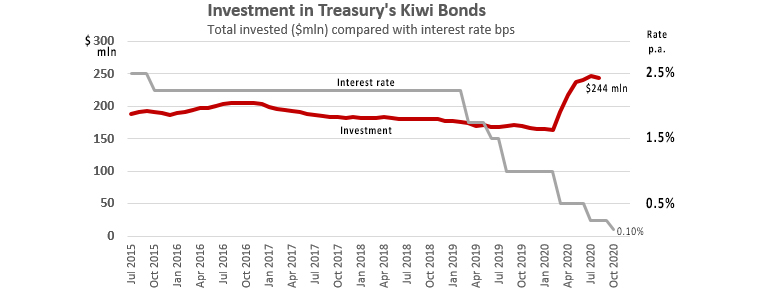
The interest rate offered by Treasury for their Kiwi Bond product has been cut sharply today (Monday). This is the third cut so far this year, effectively reducing the rates for these bonds by -80% or more in that period.
The perspective of today's change compared with rates that did apply over the last year, are:
| Maturity | 19-Jun-19 | 16-Aug-19 | 23-Mar-20 | 13-July-20 | change | New Rate |
| Term | p.a. | p.a. | p.a. | p.a. | p.a. | |
| 6 months | 1.50% | 1.00% | 0.50% | 0.25% | ( 0.15% ) | 0.10% |
| 12 months | 1.50% | 1.00% | 0.50% | 0.25% | ( 0.15% ) | 0.10% |
| 2 years | 1.50% | 1.00% | 0.75% | 0.50% | ( 0.30% ) | 0.20% |
| 4 years | 1.50% | 1.00% | 0.75% | 0.50% | ( 0.30% ) | 0.20% |
For retail investors, the rates for Kiwi Bonds are an effective risk-free return benchmark.
And they give an indication of where term deposit rate offers by banks may go when the Government rolls out its promised Deposit Guarantee.
These offers are also well below the current rate of inflation.
But they are higher than what wholesale investors bid in Treasury tenders for bonds of an equivalent duration. But as there is no effective secondary market, there is no easy way to sell these bonds and take the capital gain as yields fall. Holding them to maturity or "redeeming" early are the only options.
Kiwi Bonds are the main product available to individual investors from the Government. Kiwi Bonds are offered directly to the New Zealand public, but anyone who is not a New Zealand resident, even if they hold New Zealand citizenship, cannot invest in Kiwi Bonds. The definition of a New Zealand resident is that used by the IRD.
Kiwi Bonds are a simple form of investment, similar to a term deposit in that they offer a fixed rate of interest for a given term. Kiwi Bonds are denominated in New Zealand dollars with a fixed interest rate paid quarterly in arrears.
The minimum amount that can be invested is $1,000 with a maximum of $500,000 in any one issue. The maximum limit is probably there to discourage wholesale investors loading up on this retail offer because it pays more than the tender market.
The interest rates offered are generally lower than those offered by banks, reflecting the greater level of security associated with a government investment.
If you are a New Zealand resident and would like to know more about Kiwi Bonds, further information is available in the Product Disclosure Statement and the current application form.
And Treasury no longer uses Kiwi Bonds agents to facilitate the issuance of Kiwi Bonds. That means it has cut out banks, NZX brokers, chartered accountants, solicitors, investment advisers or investment brokers being able to offer them. You can only invest directly now.
This is the official announcement from the Debt Management Office of Treasury.
The Treasury today announced changes to the interest rates available on Kiwi Bonds, effective from 12 October 2020. The interest rates for the six-month and 12-month Kiwi Bonds have decreased from 0.25% to 0.10%. The interest rates for two-year and four-year Kiwi Bonds have decreased from 0.50% to 0.20%.
Kiwi Bond interest rates are set periodically from moving averages of domestic wholesale interest rates. The new Kiwi Bond interest rates have been set to better align to those available in wholesale markets.
The Kiwi Bonds rates are as follows:
For subscriptions of $1,000 - $500,000
Maturity Rate 6 months 0.10 percent per annum 12 months 0.10 percent per annum 2 years 0.20 percent per annum 4 years 0.20 percent per annum The Treasury also announces the cessation of Kiwi Bonds agents in facilitating the issuance of Kiwi Bonds. If you are an individual investor and would like to invest in Kiwi Bonds, please contact Computershare Investor Services Limited, New Zealand Debt Management's registrar for Kiwi Bonds.
We welcome your comments below. If you are not already registered, please register to comment
Remember we welcome robust, respectful and insightful debate. We don't welcome abusive or defamatory comments and will de-register those repeatedly making such comments. Our current comment policy is here.