

The Reserve Bank rolling out a Funding for Lending Programme (FLP), offering banks very cheap funding, should lead to lower floating mortgage rates, Kiwibank economists suggest.
The Reserve Bank last week said it would roll-out the FLP in December, with up to $28 billion of funding available to banks priced at the 0.25% Official Cash Rate. The announcement gave few specifics on the FLP, with details of operations, including terms and conditions, to be made available "in coming weeks."
Kiwibank's economists suggest, in introducing the FLP, the Reserve Bank has effectively told banks; "if you don't like negative [interest] rates, slash your deposit rates, mortgage rates and business lending rates."
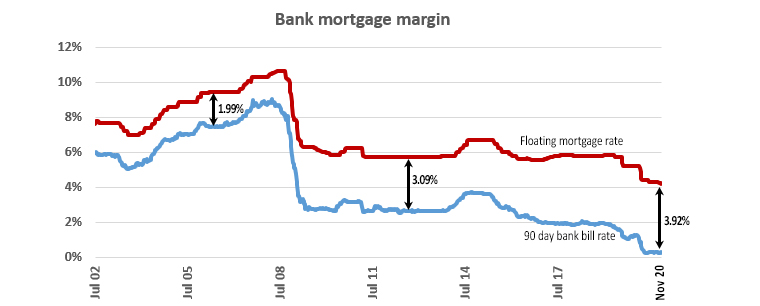
"Looking at residential lending rates, variable mortgage rates remain well above the rest. Variable mortgage rates are averaging [about] 4.5% across the system. Variable rates are well above the one-year fixed rate of [about] 2.5%, two-year fixed rate of [about] 2.7%, and five-year fixed rate of [about] 3%. Kiwis are not really given the option to go on variable. Fixing for one-year saves the average borrower 2% - nearly half the variable borrowing cost. If banks are to move on lending rates, variable rates have plenty of room. In an environment where interest rates are falling, a variable rate mortgage should be an option," Kiwibank's economists argue.
Kiwibank in June slashed its floating mortgage rates by 100 basis points in a move that also cut business variable loans, business revolving credit, and business overdraft rates. Kiwibank's floating mortgage rate is currently 3.40%. The big four Australian owned banks are yet to match Kiwibank, with carded, or advertised, floating mortgage rates ranging from 4.44% to 4.59%. (See all banks' carded, or advertised, home loan rates here).
The latest Reserve Bank statistics show that, as of the end of September, just 14%, or $41 billion, of residential mortgages were floating. Almost $251 billion, or 86%, were fixed.
*This article was first published in our email for paying subscribers. See here for more details and how to subscribe.
We welcome your comments below. If you are not already registered, please register to comment
Remember we welcome robust, respectful and insightful debate. We don't welcome abusive or defamatory comments and will de-register those repeatedly making such comments. Our current comment policy is here.