

Non-performing housing loans had a renewed surge in the month of April, rising by 7.7% to just over $1.9 billion, according to the latest Reserve Bank loans by asset quality figures.
In recent months the pace of rising loan non-performance had appeared to be slowing.
However, the $136 million rise in April 2024 was the second largest monthly rise since June 2020 at the height of the pandemic, beaten only by a $161 million jump between December 2023 and January 2024.
Since the start of this year the non-performing housing loans total has risen by $384 million, or 25.3%, while in the past 12 months the total has risen by $796 million, or 72%.
Non-performing loans are impaired loans plus loans at least 90 days past due but not impaired.
The latest monthly rise sees the percentage of non-performing loans rise from 0.5% as of March to 0.54%, which is a new peak during this current period of rising loan stress. The 0.54% non-performing loans ratio is the highest in around 10 years.
It is, however, still well down on the sorts of levels seen in the aftermath of the Global Financial Crisis, with the rate frequently hitting 1.2% between 2009 and 2011.
While the non-performing loans ratio has risen from a low level and it still not at an exceptionally high level on a historical basis, it has nevertheless kept steadily increasing as the higher mortgage interest rates prevailing since the second half of 2021 have started to take a toll.
In April 2023 the non-performing loans ratio was 0.32%. This rose to 0.43% by the end of 2023. And in the first four months of this year it has risen to 0.54%.
In looking at the finer detail of the latest figures, impaired loans rose by $20 million during April to $320 million. The impaired loans total is up $75 million, or 30.6% so far this calendar year and $185 million, or 137% higher for the past 12 months.
Loans that are 90 days past due but not impaired have pushed through the $1.5 billion mark, surging by $116 million, or 7.9%, to $1.581 billion in April 2023.
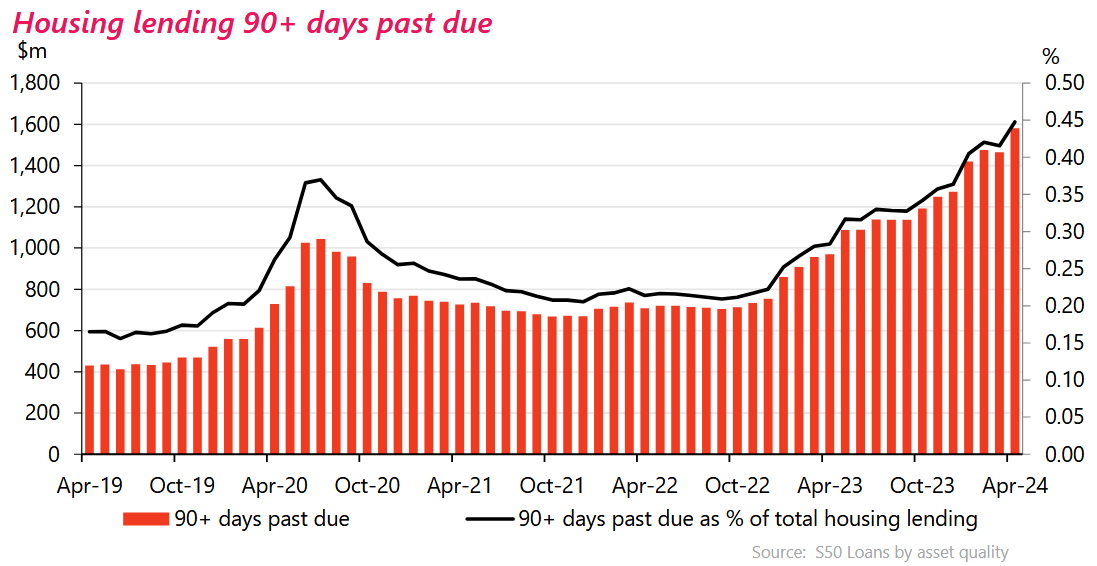
The 90 days past due total has increased by $309 million, or 24.3% so far this calendar year, while it is up $611 million, or 63%, in the past 12 months.
One of the factors that was seen as being helpful for home owners during this spike in interest rates (with, for example, average one-year fixed rates rising from 2.3% to 7.2% in the past three years) was the very low rates of unemployment.
However, unemployment rates are now starting to climb quite quickly, with the figure, according to Statistics NZ, having risen from 3.4% as of the March quarter 2023 to 4.3% as at March quarter 2024. And the RBNZ is forecasting that the unemployment rate will hit 4.6% by the end of the current (June) quarter.
Obviously rising unemployment rates are one significant factor that could lead to increases in non-performing loans.
Thus far the non-performing loans ratios are within the boundaries expected by the country's banks. According to the RBNZ's May 2024 Financial Stability Report (page 14) the banks expect the ratio to rise to about 0.7% by the end of this calendar year, and still well below those levels seen after the GFC.
But another major factor potentially in any future rises in mortgage stress is just how long the interest rates stay at around current levels (notwithstanding some marketing tweaks by the banks to their rates).
RBNZ monthly figures showing what terms people are refixing their mortgages for show that most are now fixing their interest rates now for 12 months or less. There's a clear expectation that rates will be coming down sooner rather than later.
The financial markets had till recently been heavily pricing in the potential for rate cuts in the latter part of this year. But the RBNZ, which is still seeing domestically-sourced inflation as being too high, has poured iced water over such expectations. And its latest set of forecasts don't have the Official Cash Rate (which has now been on 5.5% since May 2023) being cut till the second half of 2025.
So, homeowners expecting mortgage rate cuts within the next 12 months could yet be disappointed, although those ever-hopeful financial markets are still - regardless of what the RBNZ says - pricing in the first OCR cut in November.
Still, with the general flat state of the economy (GDP has contracted in four of the past five quarters - and that's despite a big rise in the population), rising unemployment and with interest rates not falling any time soon, it will be worth keeping eyes on how these non-performing loans do track.
Clearly, if the economy fares rather worse than currently expected, this could lead to further mortgage stress. Watch this space.
We welcome your comments below. If you are not already registered, please register to comment
Remember we welcome robust, respectful and insightful debate. We don't welcome abusive or defamatory comments and will de-register those repeatedly making such comments. Our current comment policy is here.