

ASB economists expect a "modest" household spending and housing market recovery in 2025 and hope that households "have learnt a thing or two" in recent years.
In an ASB Household Outlook publication for July, ASB senior economist Mark Smith says the hope is that households are now basing their future decisions "on a more realistic outlook" for household incomes, house prices and borrowing costs.
He said many of the current difficulties that have been faced by NZ households are "a hangover of the consumer spending and housing market binge" that occurred from late 2020 to early 2022 which artificially inflated the sector. This binge was a contributing factor behind the escalation in NZ inflation and the eventual 525 basis-points of hikes to the Official Cash Rate (OCR) by the Reserve Bank (RBNZ).
"Covid-related border closures reduced overseas spending options and contributed to an exceptionally tight labour market. Falling interest rates encouraged households to bring spending forward. The housing market surged, with house prices rising 45% from late 2019 to the end of 2021. Households had also built-up a large amount of savings during Covid-19 lockdowns," Smith said.
'The housing market is in the doldrums'
"The music had to stop sometime, and we are now in the midst of the post Covid-19 adjustment. Higher interest rates provided the circuit-breaker and have sharply cooled housing market momentum, house prices and household spending. In inflation adjusted terms, house prices are more than 20% below their late 2021 peak. Household saving buffers have been progressively run down as households struggle to stay afloat. Household spending volumes are 5% off their peaks on a per-capita basis and look set to fall further over 2024. Durable spending has seen much larger per-capita falls.
"The household sector has gone into hibernation. The housing market is in the doldrums. Consumers remain extremely cautious and are unwilling to extend themselves financially. Cost increases facing households are waning, but the sources of pressures are rotating. Firms have likely held on to labour in anticipation of a lift in demand but hiring plans are being reassessed as economic prospects sour and pressures on profitability grow," Smith said.
"The 2025 recovery in household spending and the housing market is unlikely to repeat the 2021 Covid-19 related surge but should prove to be more durable," Smith said.
He said while the household sector and the housing market were recovering from "the Covid-19 related excesses", there is still "some short-term pain ahead".
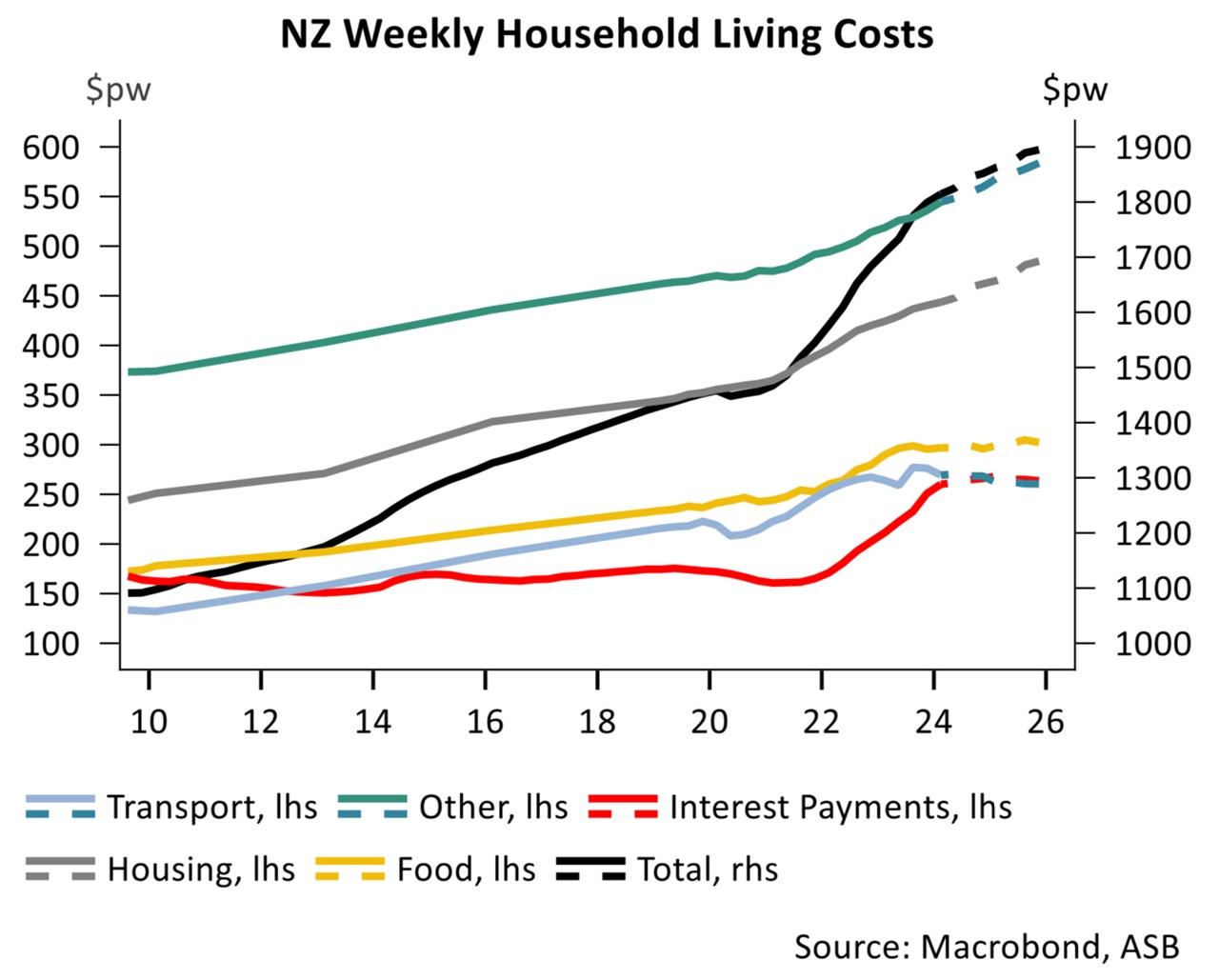
"We expect the household sector to stay in hibernation for the remainder of the year, with household sector activity and the housing market on ice. The NZ unemployment rate could hit 6% by mid-2025," Smith said.
"A retrenching household sector will mean there is more room for other parts of the economy to grow, without putting additional pressure on NZ inflation. The cooling labour market will help to further lower NZ core inflation. Annual CPI inflation is on track to fall below 3% in the second half of 2024, with core inflation rates set to shortly follow. Cost pressures should remain acute in pockets – insurance and local authority rates – but the flow through into wider wage and prices should be modest," Smith said.
The ASB economists officially changed their call on the OCR last week and now believe now believe the RBNZ will begin to cut interest rates in November, from an earlier forecast of February 2025, as the risk of damaging the economy and employment grows.
Smith said OCR cuts should help support consumer sentiment and overall household spending.
"The RBNZ will naturally be cautious but will want to move the 5.5% OCR closer to circa 3.5% neutral levels to avoid unduly scarring the labour market and broader economy. Nonetheless, we do not expect a conventional easing cycle to unfold after the OCR is cut."
Housing market fails to fire
Smith said household consumption looks set to "remain anaemic" over 2024, with spending volumes contracting on a per-capita basis. This should cool economy wide inflation pressures and enable the RBNZ to cut the OCR. This should help support consumer sentiment and overall household spending.
He notes that the housing market "has failed to fire" over 2024 despite a number of "tailwinds". Strong (but slowing) population growth, the prospect of growing dwelling shortfalls, tweaks to government policy towards residential housing investors, the prospect of lower borrowing costs and cheaper house prices compared to late 2021 peaks have failed to stir the market.
"Headwinds appear to be dominating. Housing affordability remains stretched despite the drop in house prices, with rental yields below the cost of funding. Higher debt servicing costs, plenty of unsold inventory, the cooling labour market backdrop (the unemployment rate looks set to top 5.5% by mid 2025) and slowing (but high) net immigration should cap a potential housing market upswing. A number of households who have bought at the peak may now be flirting with negative equity," Smith says.
"We have shaded down our house price view and expect NZ house prices to broadly flat-line over 2024 and modestly grow over 2025. Lower mortgage interest rates will help, but the modest growth in house prices will be because house price rises will be underpinned by rising incomes rather than being borrowing related. Ultimately, this is more sustainable. It will take until late 2025 to surpass 2021 record nominal house peaks, and much longer for new inflation adjusted peaks to be reached."
We welcome your comments below. If you are not already registered, please register to comment
Remember we welcome robust, respectful and insightful debate. We don't welcome abusive or defamatory comments and will de-register those repeatedly making such comments. Our current comment policy is here.