

Savers in New Zealand are very aware that interest rates being offered here are less than inflation even if they are generally higher than the Official Cash Rate (OCR). It makes for an uncomfortable position, one that will only get remedied if the inflation rate can be pulled back to its target range.
Readers of our companion service in Australia will know rates are "much higher" for savers there. In fact some banks there are offering close to 6%.
The contrast is emphasised because on Tuesday in New Zealand Rabobank raised its on-call PremiumSaver rate to 2.95% for balances to $100,000. That's a high for a savings account here, above the OCR and closer to the 3.7% Consumers Price Index (CPI) inflation rate.
But what are we giving up by being in New Zealand compared to Australia? They have a much higher OCR equivalent, with the Reserve Bank of Australia's cash rate at 4.85% versus the 2.75% OCR. They also have a higher inflation curse at 4.3%.
So it is time we looked again at our disadvantage and try to quantify it. Some readers may have options to arbitrage between the two countries.
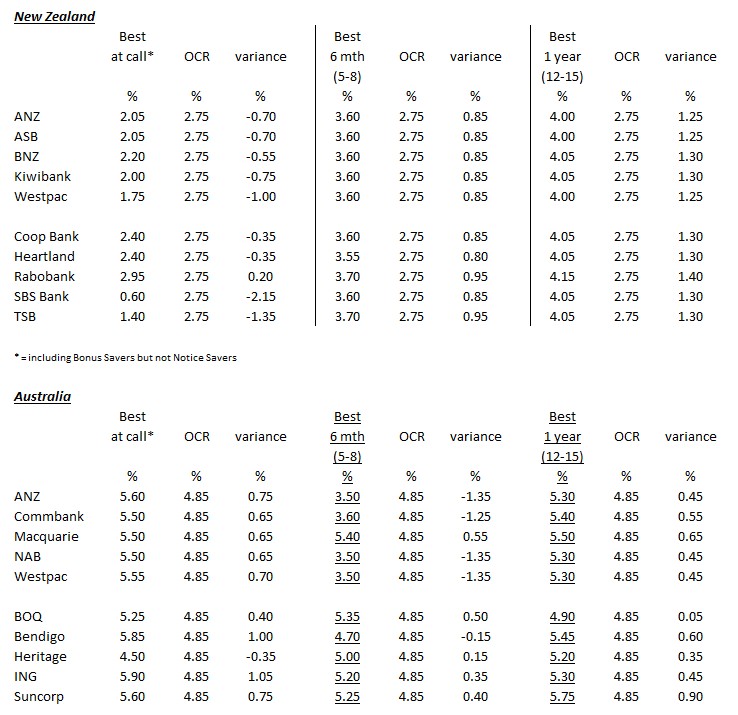
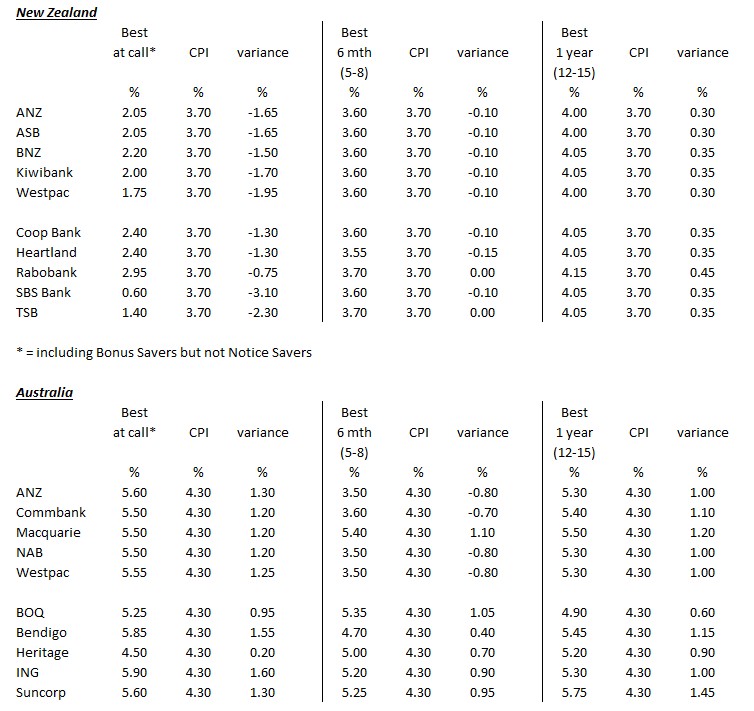
The data for these comparisons comes from the summary table at the foot of this review.
Aussies get offered much more for their on-call funds. But perhaps it is surprising that we compare quite well with most of the main Aussie banks for a six month term deposit (TD). This is the most popular term locally. However, there are substantial gains to be had in Australia if you shop around. Not so in New Zealand.
For a one year TD, offers here are a long way lower than in Australia.
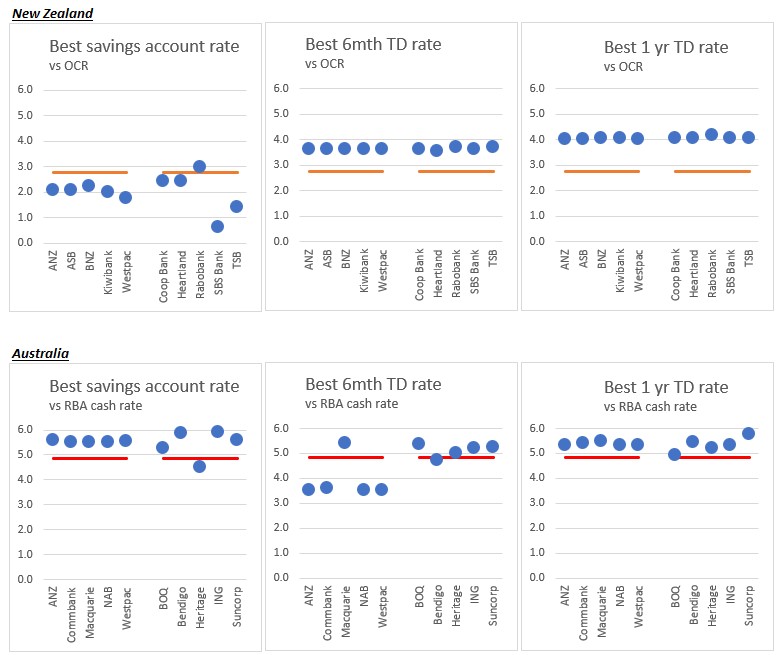
While Kiwi rates are well above the local OCR rate, they do not compare well with the CPI inflation rate. And worse, you only earn after-tax returns (not shown on these charts because tax rates vary based on your personal income level). The after-tax result will never cover inflation at current levels which is why it is crucial the Reserve Bank stops pussy-footing around with its inflation control mandate. Oil price rises, which they can't do anything about, have now 'leaked out into the wild' and are infecting general price movements and more importantly, inflation expectations. This is saver hell when rates are this low.
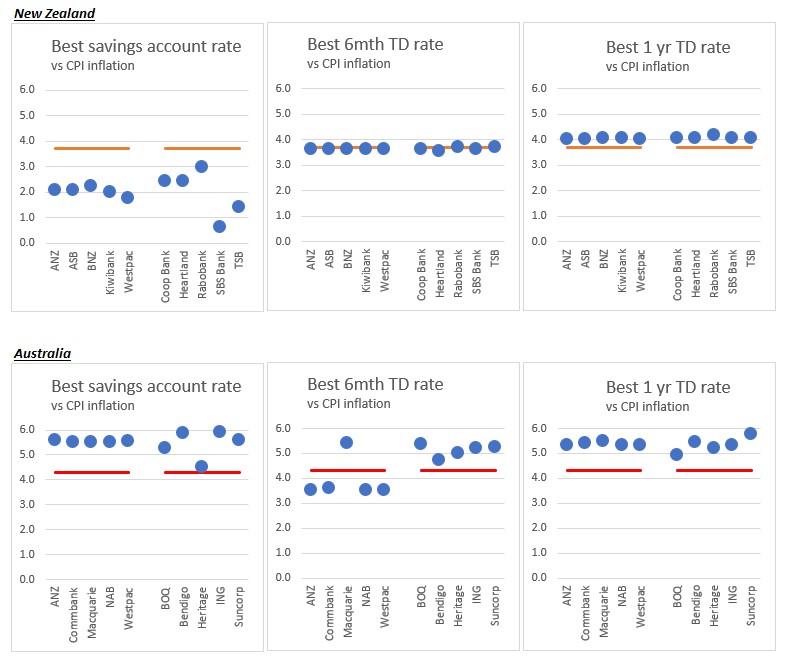
Although things are also uncomfortable for savers in Australia on an after-tax basis from inflation's pressure, there are options, and at least some of that inflation cost is paid for by higher-than-inflation face rates.
But in New Zealand, when inflation is running at the official 3.7% rate as it was in September, a saver would need to earn a 4.48% pa interest rate if they were on a 17.5% tax rate just to avoid savings repression. If you are on a 30% tax rate, you would need to get 5.29% pa on your savings to avoid repression. On a 33% tax rate, it is 5.52% pa. And then, you just break-even. All of these levels are unattainable here presently at a bank or many other institutions offering DCS (Depositor Compensation Scheme) protections. And that will tend to push some savers into more risky options, many with low liquidity features.
Here are the variations versus the OCR that sit behind the charts above.
And here are the variations versus the respective CPI inflation rates.
We welcome feedback in the comment section below.
We welcome your comments below. If you are not already registered, please register to comment
Remember we welcome robust, respectful and insightful debate. We don't welcome abusive or defamatory comments and will de-register those repeatedly making such comments. Our current comment policy is here.