

By Gareth Vaughan
Just 48% of New Zealanders have complete trust in banks to keep their money safe and protect their personal information.
That concerning statement comes from an EY consumer banking survey. In a world where cyber crime and cyber security are often in the news, it's perhaps not surprising that consumers are worried about the protection of their personal information. But that so many Kiwis appear concerned about banks keeping their money safe does seem surprising.
A phone survey of 2,000 New Zealanders was done earlier this year as part of a global survey by accounting and financial advisory firm EY.
Asked whether he was surprised by how low the NZ result to the trust question was at 48%, EY advisory partner Paul Roberts said he was.
"Yes. If you look at the lack of alternatives [to banks] in New Zealand. To only have 48% of people who completely trust banks, including keeping their money safe, that was a surprise. That was very similar broadly to what we've seen around the world," Roberts said.
He noted there are few alternatives to mainstream banks in comparison with other countries such as Britain, where there's the likes of supermarket group Tesco and now online banks providing banking services.
"If you look here what's the alternative if you don't trust the bank? Is it to put it [money] under your mattress?"
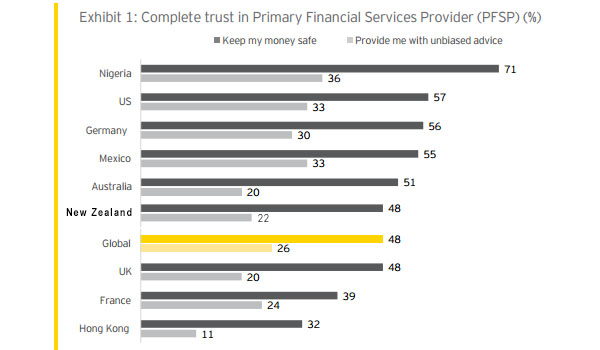
Other results from the survey show 22% of NZ respondents have little or no trust that banks will provide unbiased advice. Additionally, half those surveyed describe themselves as digitally savvy, with 44% of digitally and financially savvy NZ respondents saying they're less reliant on established financial services companies and banks, and 31% say they're excited about the emergence of online only financial service providers.
Key reasons for considering banking alternatives are more attractive rates and fees, access to different products and services, and the ease of setting up accounts.
Big banks 'quite surprised'
Roberts said EY has presented its survey results to NZ's big five banks.
"They were quite surprised, particularly on the trust element. Probably more in terms of keeping dollars safe, which I think they would consider their bread and butter. We go to banks because we actually trust that we're going to get our money back. They were less surprised in terms of the unbiased advice to customers," said Roberts.
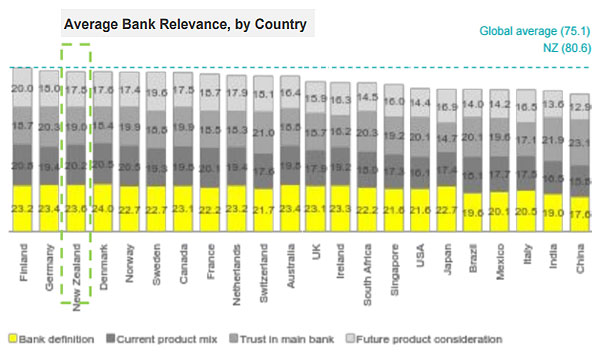
Meanwhile, in an EY bank relevance index of 32 countries, NZ came in third, behind Finland and Germany, with a score of 80.6. The global average was 75.1. Denmark, Norway, Sweden and Canada followed NZ, with Australia eleventh. But even with this high placing, Roberts said NZ banks shouldn't be too cocky.
"I think that New Zealand banks certainly can't sit on their laurels in terms of that ranking of third overall."
He points to Britain, Singapore and the USA who ranked fifteenth, nineteenth and twenty second, respectively.
"I believe that is actually due to the emergence of alternatives in some or all parts of what the banks do. Those customers that are most willing to try alternatives are those that are digitally savvy. So people that want to actually manage as many aspects of their life via digital channels as they can, and that approximately 50% of [NZ] people who are digitally savvy, these are also the customers who are more likely to consider alternatives, particularly those where alternatives can be made simpler," said Roberts.
"If you get a disruptor that comes in with a simpler product that has lower fees and offers a better customer experience, then I think the banks, the traditional [NZ] big five, are at risk of losing parts, or all of their business."
Watch out for banking's Uber or Airbnb equivalent emerging
Roberts suggested the key thing for local banks to focus on is remaining relevant to their customers.
"Because whilst we don't have a lot of alternatives in New Zealand at the moment to the big five banks, they are coming. And if you look to the likes of Uber and Airbnb, whilst we didn't actually have them initially, they did come and so these competitors are going to actually come in and target portions of their [banks'] business. So they need to actually start thinking like some of these more innovative companies, start ensuring that they are relevant to their customers by providing them with the types of experiences their customers want," said Roberts.
NZ does have a fledgling licensed peer-to-peer lending industry, plus a few finance companies and building societies offering an alternative to banks. However, Roberts is convinced additional new "fintech" challenges are imminent. Asked how soon and what type, he said answering this question would be a guess.
"If I look at the speed with which Uber and Airbnb emerged and went global, I don't think anyone would have actually picked that. So I wouldn't put a timeframe on it, but I think it will be sooner rather than later," said Roberts.
"We're at this point now where the banks are the only game in town for a number of these services, and as alternatives actually emerge, I think we'll actually see consumers choose for certain services to switch to some of these other types of provider."
*This article was first published in our email for paying subscribers early on Monday morning. See here for more details and how to subscribe.
We welcome your comments below. If you are not already registered, please register to comment
Remember we welcome robust, respectful and insightful debate. We don't welcome abusive or defamatory comments and will de-register those repeatedly making such comments. Our current comment policy is here.