
By Greg Ninness
A specialist real estate agency has been set up to help people pool their money to buy investment properties between them.
Real Estate Together Ltd (RET) is the brainchild of Martin Dunn, who founded and still runs City Sales, an agency specialising in the sale of Auckland apartments.
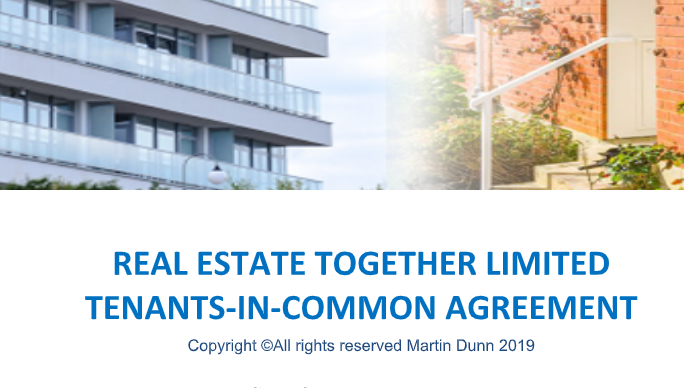
RET will source suitable investment properties, bring together groups of like-minded investors to buy them, arrange the finance, provide a standardised ownership structure and manage the properties on the investors' behalf.
Dunn says he developed the concept because he was aware of many people who wanted to buy investment property but either couldn't afford to do so by themselves, or weren't confident enough to do so.
RET will initially concentrate on the residential property market, particularly two bedroom brick and tile home units in selected suburbs. But Dunn says the concept could also be expanded into the commercial property market.
RET will charge the investors a buyer's fee of 4% of the purchase price plus GST (4.6%) for sourcing a suitable property.
There's a maximum of four investors for each property with each paying a one-off set up fee of $2300 (including GST) to cover the legal documentation for the purchase.
Once finance is arranged (properties can also be purchased without finance if the investors have the cash) and the purchase completed, RET will manage the property, including signing up tenants, collecting rent, arranging and paying the outgoings such as maintenance, rates and insurance and also making the mortgage payments.
Because RET is a real estate agency, payments will be handled through an audited trust account.
The management fee is 8.5% plus GST (9.775%) of the rent and outgoings.
Although the intention is to retain the property as a long term investment, it may be sold when a simple majority of investors vote to do so, or investors could sell their individual share of a property to their co-investors or a third party.
Although those arrangements appear relatively straightforward, there are a number of aspects to the way RET is structuring these deals that investors need to pay particular attention to.
- Investors will own each property as tenants-in-common, with their rights and obligations set out in a Tenants-in-Common Agreement and potential purchasers should seek appropriate legal advice about the implications of such an arrangement.
- One of the conditions imposed by the bank providing mortgage finance for these deals includes having the mortgage paid by the property manager (likely to be RET) instead of dealing with multiple investors for a single mortgage. As part of its management contract, RET will charge 8.5% plus GST (9.775%) on the interest portion of the mortgage payments, as well as on normal outgoings such as rates, insurance and maintenance.
- Another condition imposed by the bank for providing mortgage finance is that the investors will be "jointly and severally" liable for the mortgage payments. That means if one or more investors has trouble meeting their mortgage payments, the others will need to stump up with the shortfall. This risk is mitigated by the fact that at current interest rates and based on RET's estimates of likely purchase price and outgoings, the investments should be cash flow positive, but only just.
Dunn believes the home units RET is aiming at are likely to cost around $600,000 and should rent for around $550 a week.
Figures he has supplied show estimated annual outgoings for rates of $1500, insurance $300,and maintenance $500 which is $2300 altogether.
If there was a mortgage for $300,000 fixed for five years at 4.23%, the payments would be around $678 a fortnight or $17,628 a year, and RET's management fee would be about $4000.
Once all of those payments are deducted from the rent it would leave $4672 a year or $89.85 a week (pre-tax) before allowing for vacancy or contingencies.
So although it would be cash flow positive there's not a lot of money to play with. And it may only take an extended period of vacancy or an unexpected blow out in costs and investors might need to be dipping into their own pockets to pay the mortgage.
Which is probably why RET's promotional material focuses mainly on the potential capital gains rather than income generating ability of the arrangement.
The examples used in RET's brochures show a unit costing $500,000 today could be worth $1.3 million in 10 years time, based on 10% capital growth per annum.
Investors will need to form their own view on how realistic those projections are, but some may find them a bit too bullish for comfort.
Which of course raises the question of tax.
Many people mistakenly believe that the introduction of the Bright Line Test for capital gains means that any capital gains are automatically tax free as long as the property is sold more than five years after it was purchased, but that is not the case.
The Intent Test, which stipulated that capital gains are taxable if a property was purchased with the intention of reselling it, still applies.
Given the emphasis on capital gains in RET's promotional material and the relatively low income returns the investment may generate, potential investors could find that consulting an accountant with appropriate experience in property investment matters, especially in regard to tax, could be money well spent.
The comment stream on this story is now closed.
We welcome your comments below. If you are not already registered, please register to comment
Remember we welcome robust, respectful and insightful debate. We don't welcome abusive or defamatory comments and will de-register those repeatedly making such comments. Our current comment policy is here.