

First home buyers in almost all parts of the country have benefited significantly from the sharp fall in mortgage interest rates since the COVID lockdown in March, particularly in Auckland, according to interest.co.nz’s latest home loan affordability analysis.
That’s because the drop in interest rates has had a bigger impact on mortgage payments than it has on house prices at the bottom end of the market.
In March the average of the two year fixed mortgage rates offered by the main banks for buyers with a minimum 20% deposit was 3.31% and by August that had fallen to 2.72%.
Lower interest rates generally help to push up housing prices and that has been the case over the last five months, with the REINZ’s national lower quartile house price increasing from $480,000 in March to a record high $492,000 in August.
The lower quartile price is the price point at which 75% of homes sold in a month are above, and 25% are below.
It is a proxy for the lower end of the market, which is generally of most interest to first home buyers on average incomes.
Around the country, record high lower quartile prices were also set in seven regions in August – Northland, Waikato, Hawkes Bay, Wellington, Canterbury, Otago and Southland.
However a closer look at the lower quartile price rises over the last five months suggests they have been more tepid than they might appear.
The national lower quartile price increased by $12,000 (+2.5%) between March and August.
Of the seven regions that also achieved record lower quartile prices in August, two of those, Hawkes Bay and Southland only achieved record equalling prices, matching record prices achieved earlier in the year.
The lower quartile price of one region, Southland, was unchanged between March and August, and lower quartile prices actually declined between March and August in three regions – Auckland (-1.0%), Taranaki (--1.1%) and Nelson/Marlborough (-4.8%).
The decline in the lower quartile price in Auckland was particularly significant because it is the country’s largest market and the most expensive region in the country.
So how have first home buyers fared overall in all of this?
Firstly, where prices have increased, the size of the deposit and the size of the mortgage needed to buy a lower-quartile home would both have increased.
In places such as Auckland, where the lower quartile price declined, the size of the deposit and the size of the mortgage needed would both have declined.
Overall, a 10% deposit for a home at the national lower quartile-price would have increased by $1200 between March and August.
Over a five month period that should be reasonably achievable for first home buyers on average incomes.
In Auckland, where the lower quartile price declined by 1% between March and August, the amount needed for a deposit declined by the same amount.
However, falling interest rates don’t just push up prices, they also push down mortgage payments.
As well as lowering interest rates, the Reserve Bank has removed Loan to Valuation Ratio (LVR) restrictions on new mortgage lending, making it easier for first home buyers to get a mortgage with just a 10% deposit, rather than the standard 20% deposit, although they will pay a premium interest rate for it.
Interest.co.nz estimates that the average mortgage interest rate for low equity loans has fallen from about 4.61% in March to about 3.77% in August, although there can be significant variations in low equity rates between banks.
According to interest.co.nz’s calculations, the mortgage payments on a home purchased with a 10% deposit at the national lower quartile price of $480,000 in March, would have been $511 a week (at the average two year fixed rate of 4.61% for low equity buyers, on a 30 year term).
But at the August lower quartile price of $492,000, the mortgage payments would be just $474 a week, down 7.3% compared to the March figure, due to the fall in the average low equity mortgage interest rate from 4.61% % to 3.77%.
That’s a saving of $37 a week, even though the lower quartile price increased over that period.
Falls in mortgage payments on the lower quartile price occurred in all but one region of the country between March and August, with the biggest falls occurring in Auckland, where they were down by a whopping $82 a week, followed by Nelson-Marlborough -$78, Wellington -$52, Waikato -$47 and Bay of Plenty -$44.
Those were substantial reductions in the amount typical first home buyers would net to set aside each week to service the mortgage on a lower quartile-priced home and more than made up for the slight increase in the amount they would have needed for a deposit in the areas where prices have increased.
The one exception was the Hawkes Bay.
Hawkes Bay had the biggest increase in the lower quartile property price between March and August, rising from $399,000 to $441,000, an increase of $42,000, pushing it up by 10.5% over the five months.
That pushed the amount of money needed for a 10% deposit up by $4200, which could have proved problematic for first home buyers on average incomes.
And the amount of the price increase in Hawkes Bay cancelled out the benefits of falling interest rates on mortgage payments.
So typical first home buyers in Hawkes Bay were likely worse off in August than they were in March.
But apart from Hawkes Bay, typical first home buyers in the rest of the country appear to be better off overall in August than they were in March, even though prices have risen in many regions.
That is particularly true in Auckland, where typical first home buyers are substantially better off thanks to the fall in interest rates that’s occurred since March.
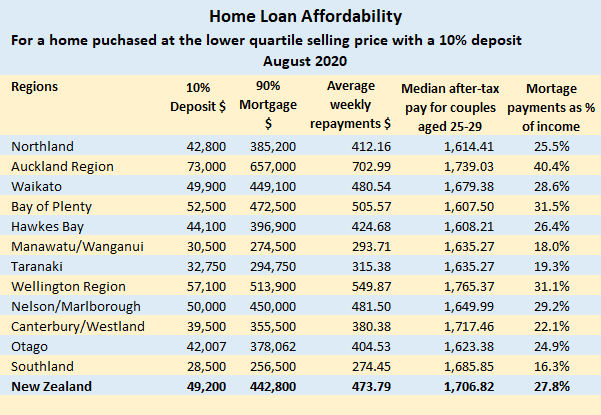
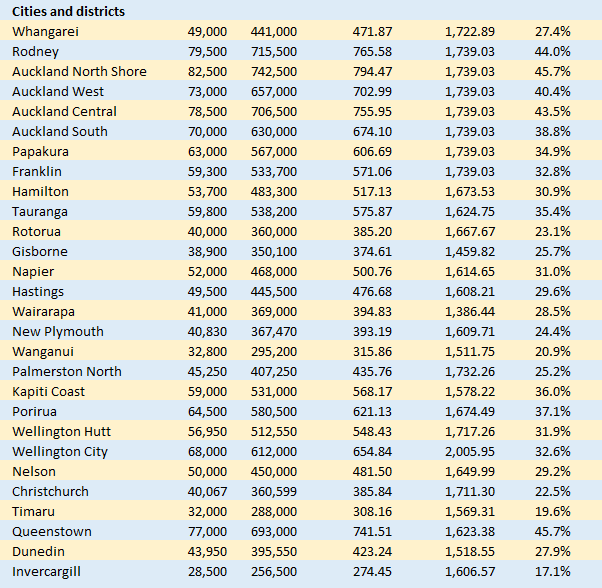
The table below shows how much would be required for a 10% deposit on a lower quartile-priced home in all regions and main urban districts throughout the country, as well as the amount of the mortgage that would be required with a 10% deposit, what the mortgage payments would be (weekly for a 30 year term), as well as the median take home pay for couples aged 25-29 (working full time) in each region and the percentage much of that money would need to be set aside for mortgage payments each week.
The comment stream on this story is now closed.
*This article was first published in our email for paying subscribers. See here for more details and how to subscribe.
We welcome your comments below. If you are not already registered, please register to comment
Remember we welcome robust, respectful and insightful debate. We don't welcome abusive or defamatory comments and will de-register those repeatedly making such comments. Our current comment policy is here.