

By Greg Ninness
It became slightly easier for aspiring first home buyers to get into a home of their own in many parts of the country in January, thanks to a modest drop in prices at the bottom end of the market and an even smaller fall in mortgage interest rates.
According to the Real Estate Institute of New Zealand, the national lower quartile selling price dropped back from its record $550,000 in December to $525,000 in January, ending seven straight months of price increases.
Around the country lower quartile prices declined in six regions - Northland, Waikato, Hawke's Bay, Wellington, Canterbury/West Coast and Otago, while lower quartile prices reached record highs in five regions - Bay of Plenty, Taranaki, Manawatu/Whanganui, Nelson/Marlborough and Southland.
In the country's largest market, Auckland, January's lower quarter price was unchanged from December, with both months being down very slightly from the record high set in November.
Mortgage interest rates also fell marginally, with the average of the two year fixed rates charged by the major banks declining from 2.58% in December to 2.56% in January.
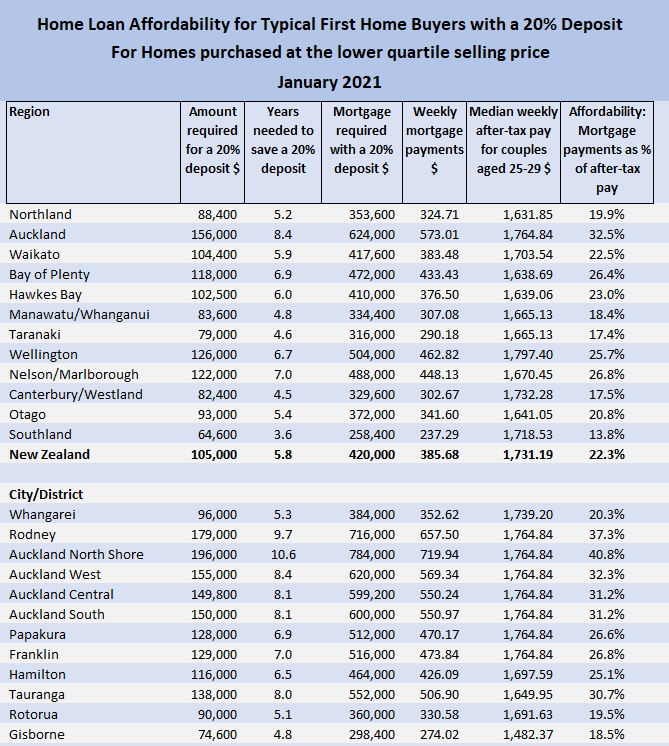
The dip in prices meant the amount that would need to be stumped up for a 20% deposit on homes purchased at December's national lower quartile price, dropped from $110,000 in December to $105,000 in January.
While that's a welcome step in the right direction it may be of little comfort to many aspiring first home buyers, because the amount needed for a 20% deposit on a lower quartile priced home has still increased by $16,000 over the last 12 months, rising from $89,000 in January last year to $105,000 in January this year.
That means that over the last 12 months, the amount needed to be saved for a 20% deposit has increased by an average of $308 a week.
In Auckland, where the lower quartile price has increased from $688,000 in January last year to $780,000 in January this year, the amount need to be saved for a 20% deposit has risen from $137,600 to $156,000 over the same period.
That's an extra $18,400 a year or $354 a week first home buyers would need to have saved just to maintain the purchasing power of money they had already saved for a deposit.
That makes it likely that even those saving hard out for a deposit would have gone backwards over the last 12 months, with the extraordinary rise in prices pushing their dream of home ownership even further out of reach.
Interest.co.nz estimates a couple working full time at the median wage for 25-29 year olds, would need to save 20% of their combined after-tax pay for 5.79 years before they would have enough for a 20% deposit for a home at the national lower quartile price.
That's up from 4.95 years in January last year.
In Auckland the time needed to save a deposit has increased from 7.51 years to 8.44 years over the same period.
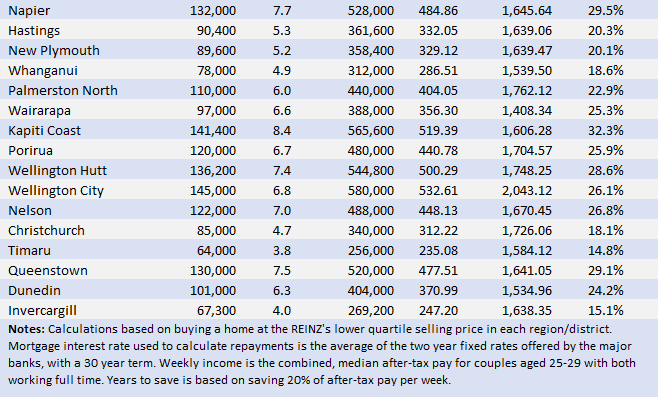
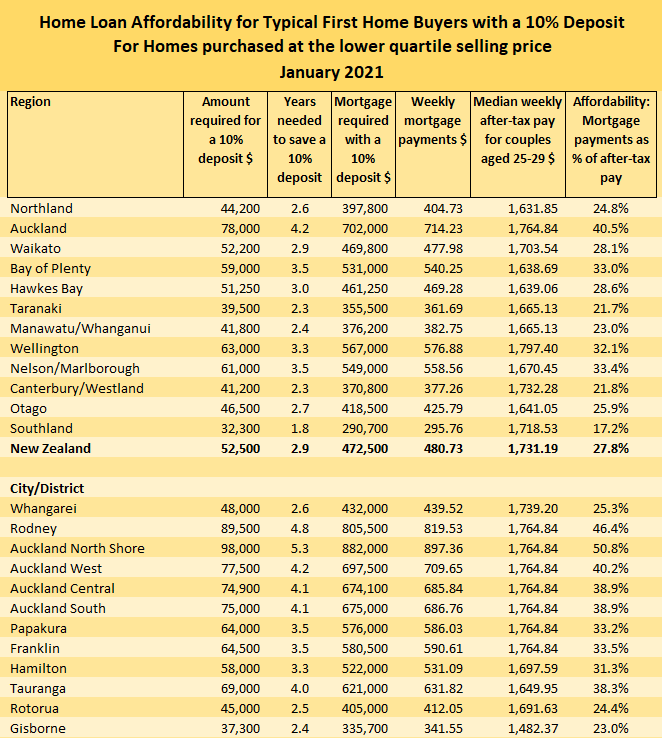
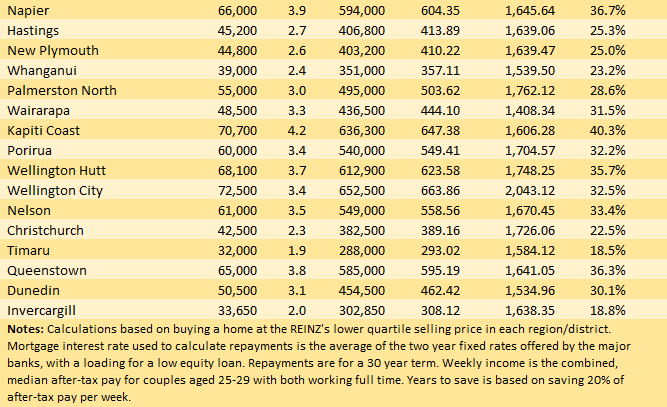
The tables below show the main affordability measure for typical first home buyers, with a 20% deposit and a 10% deposit.

We welcome your comments below. If you are not already registered, please register to comment
Remember we welcome robust, respectful and insightful debate. We don't welcome abusive or defamatory comments and will de-register those repeatedly making such comments. Our current comment policy is here.