

There was some relief for hopeful first home buyers at the start of 2022, with lower housing prices at the bottom of the market and a slight decline in mortgage interest rates making it easier for them to climb onto the first rung of the property ladder.
According to interest.co.nz's Home Loan Affordability Report, the Real Estate Institute of New Zealand's national lower quartile selling price declined to $650,000 in January.
That was the second month in a row that the national lower quartile price has declined since it peaked at $670,000 in November and means it has now retreated back to where it was in October last year.
Around the country lower quartile prices declined in eight regions in January - Auckland, Hawke's Bay, Manawatu/Whanganui, Wellington, Nelson/Marlborough, Canterbury, Otago and Southland, and rose in four regions - Northland, Waikato, Bay of Plenty and Taranaki.
The biggest declines in prices were in the main centres. This was led by Otago where January's lower quartile price was down by $60,000 from October's peak of $580,000 and in Canterbury, where January's lower quartile was down by $48,000 from December's peak of $548,000.
In Auckland the lower quartile price was $922,000 in January, down $44,000 from November's peak of $966,000.
First home buyers also received some slight but welcome relief from recent falls in mortgage interest rates.
The average of the two year fixed rate offered by the major banks declined from 4.21% in December to 4.19% in January.
The decline was due to banks adjusting their competitive positions rather than the start of an easing trend and the downward move in average rates is not expected to last.
However the fact that mortgage rates did not go up in January meant buyers would have received the full benefit of lower prices.
Unfortunately prices are already so high that the improvement in affordability was marginal.
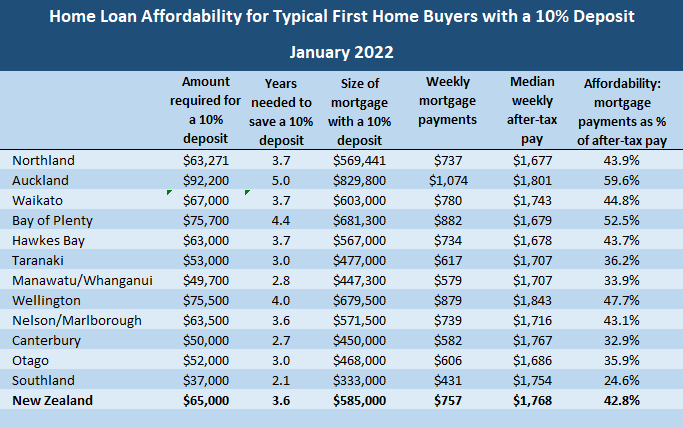
The $20,000 decline in the national lower quartile price that has occurred since November would have reduced the amount required for a 10% deposit by just $2000.
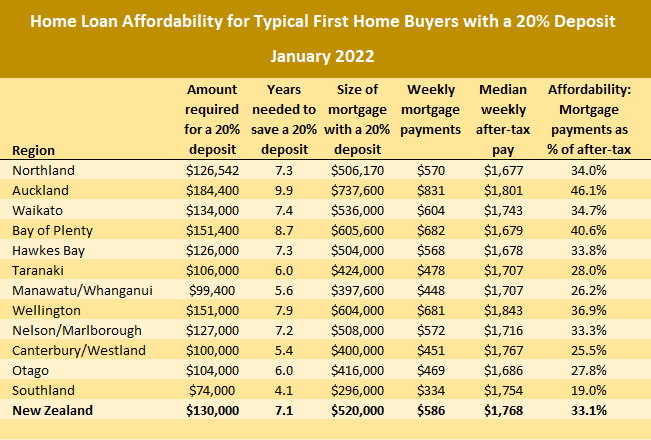
While any reduction is useful, potential first home buyers would still need to stump up with $65,000 for a 10% deposit and $130,000 for a 20% deposit to buy a home at the national lower quartile price.
In Auckland, the country's most expensive region, a 10% deposit on a lower quartile-priced home would be $92,200 and a 20% deposit would be $184,400.
And even if they could scrape together enough for a deposit, the mortgage payments would likely be prohibitively expensive for typical first home buyers on average incomes.
Mortgage payments are considered unaffordable if they take up more than 40% of the home owners' take home pay.
The mortgage payments on a home purchased at the national lower quartile price with a 10% deposit would be $757 a week, which would be 42.8% of the after-tax pay of a couple if both work full time at the median rate of pay for 25 to 29 year olds.
That's down from 43.7% in November but still in unaffordable territory.
In the highly priced Auckland market, the mortgage payments on a lower quartile-priced home purchased with a 10% deposit would eat up $1074 a week, which would be 59.6% of the after-tax pay of couples on average wages for typical first home buyers.
That's pushing home ownership squarely out of reach for people on average wages in Auckland.
But it's not just first home buyers in Auckland who are suffering.
Mortgage payments would also be in unaffordable territory for buyers with a 10% deposit in Northland, Waikato, Bay of Plenty, Hawke's Bay, Wellington and Nelson/Marlborough.
So although the fall in prices at the bottom of the market over the last couple of months will be welcome news for aspiring first home buyers, they would need to fall by considerably more before they would be back in affordable territory.
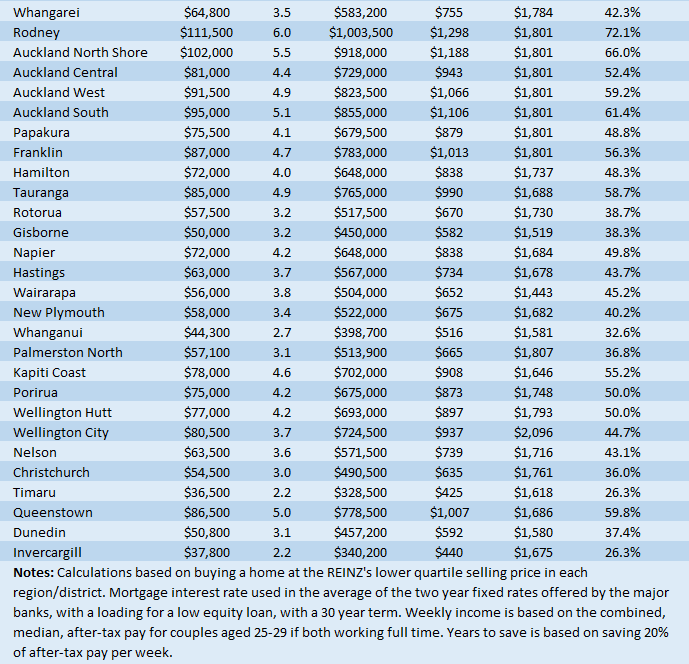
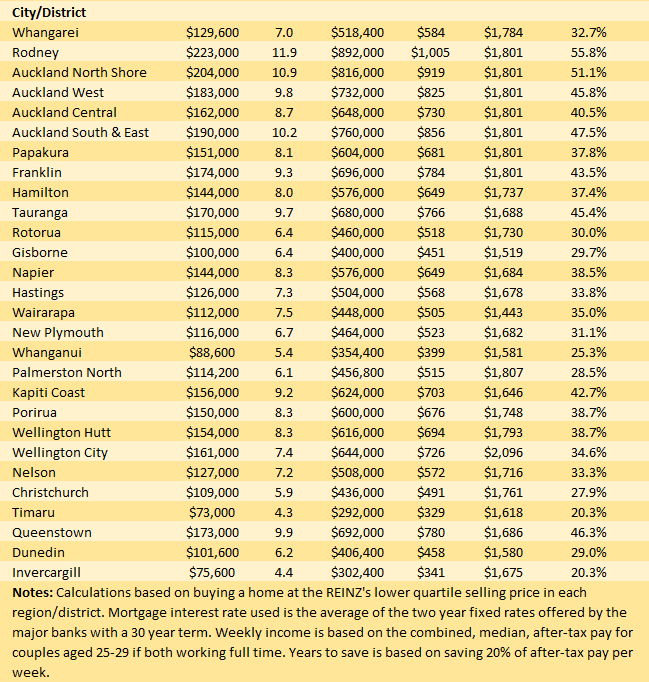
The tables below give the main affordability metrics for typical first home buyers with either 10% or 20% deposits in all regions and main urban districts throughout the country.
The comment stream on this story is now closed.
*This article was first published in our email for paying subscribers. See here for more details and how to subscribe.
We welcome your comments below. If you are not already registered, please register to comment
Remember we welcome robust, respectful and insightful debate. We don't welcome abusive or defamatory comments and will de-register those repeatedly making such comments. Our current comment policy is here.