

The ability of aspiring first home buyers to scrape together a 20% deposit is probably now the key determining factor of whether they can afford a home of their own.
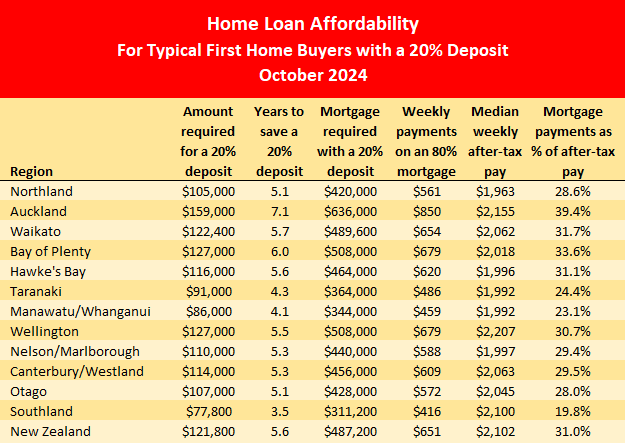
The latest home ownership calculations by interest.co.nz show the amount required for a 20% deposit on a home purchased at the Real Estate Institute of New Zealand's national lower quartile selling price in October, would be $121,800.
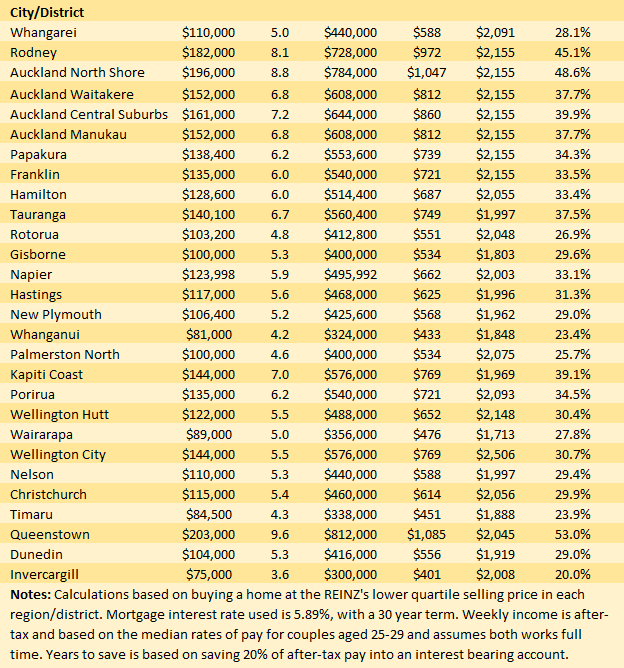
Around the country the amount required for a 20% deposit at October's lower quartile selling price would range from $75,000 in Invercargill, closely followed by Whanganui at $81,000, to a massive $203,000 in Queenstown.
Around the regions, you would need $159,000 for a 20% deposit on a lower quartile-priced home in Auckland, $127,000 in Wellington, and $114,000 in Christchurch.
The lower quartile price is the price point at which 25% of sales are below and 75% are above, representing fairly modest dwellings at the bottom end of the price scale.
Interest.co.nz also calculates what the mortgage payments would be on the resulting 80% mortgage and compares that with the after-tax income for a young couple (based on the median rates of pay for 25-29 year-olds) to see how much of their income would be eaten up by mortgage payments.
Mortgage payments are considered unaffordable if they take up more than 40% of after-tax pay.
The latest mortgage calculations are based on the average two-year fixed rates offered by the major banks in October (5.68%) with a 30-year term.
Using that formula, the mortgage payments on a lower quartile priced home purchased with a 20% deposit would range from $401 a week in Invercargill to $1085 a week in Queenstown.
Within the Auckland region they range from $739 a week in Papakura to $1047 on the North Shore.
When you compare the mortgage payments with after-tax pay for the aspiring first home buyers, this shows there are only three urban districts in the country where the mortgage payments would be considered unaffordable for young couples on average pay. They are Rodney and the North Shore in Auckland, and Queenstown.
Mortgage payments everywhere else would be below the 40% of income threshold that would make them unaffordable for young people on average incomes. However, Auckland at 39.5% overall is on the cusp of becoming unaffordable even for buyers with a 20% deposit.
So for the ever-hopeful first home buyers, the main obstacle they face in gaining home ownership is not being able to afford the mortgage payments, it's being able to get a 20% deposit together.
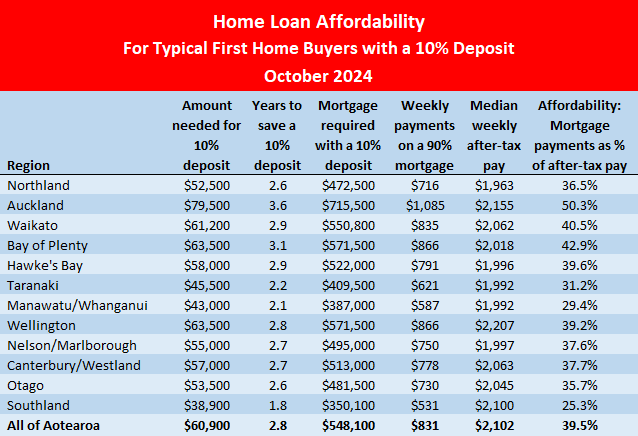
Of course they would have the option of buying a home with less than a 20% deposit and a low equity mortgage.
The problem with that option is that not only would they need to borrow more to cover the shortfall in the deposit, they would also be paying a premium for a low equity loan, which would significantly push up their mortgage payments.
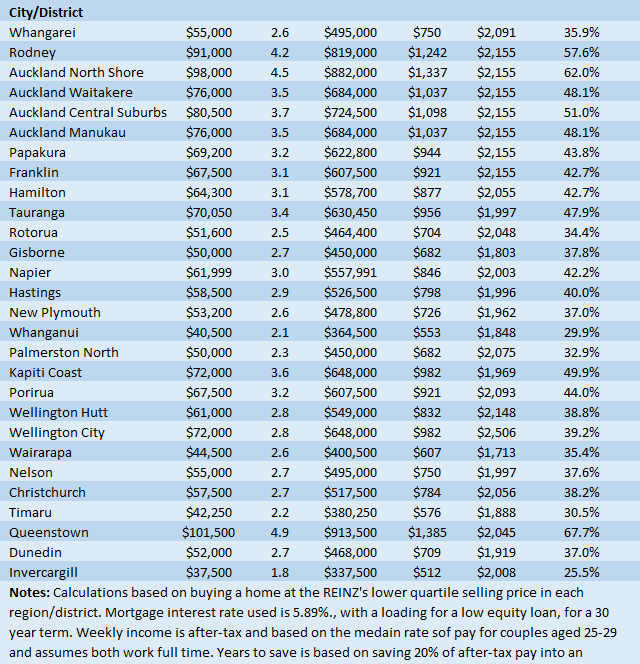
For example, the mortgage payments on a lower quartile-priced home in Hamilton would jump from about $687 a week if it was purchased with a 20% deposit (affordable), to about $877 a week. That's an extra $190 a week, although the exact amount will vary from bank to bank, pushing it into unaffordable territory.
That would mean all of Auckland, Hamilton, Tauranga, Napier, most of the Wellington Region, Nelson and Christchurch would join Queenstown in the unaffordable basket for typical first home buyers with less than a 20% deposit.
The two tables below display the main affordability measures discussed above, for typical buyers with either a 10% or 20% deposit, in all of the country's main urban districts.
The comment stream on this story is now closed.
You can have articles like this delivered directly to your inbox via our free Property Newsletter. We send it out 3-5 times a week with all of our property-related news, including auction results, interest rate movements and market commentary and analysis. To start receiving them, register here (it's free) and when approved you can select any of our free email newsletters.
We welcome your comments below. If you are not already registered, please register to comment
Remember we welcome robust, respectful and insightful debate. We don't welcome abusive or defamatory comments and will de-register those repeatedly making such comments. Our current comment policy is here.