
This is the executive summary from the Motu working paper Housing and child development: Trajectories of child wellbeing by tenure type in Aotearoa New Zealand.
By Jaimie Monk & Arthur Grimes*
Housing provides a central foundation for family life, particularly during the crucial early years of a child’s development.
While the effects of housing on children’s physical health are becoming well-understood, comparatively little attention has been given to its role in children’s psychological wellbeing.
This study investigates how public housing support during a child’s early years affects children’s socioemotional development and wellbeing in Aotearoa New Zealand, using longitudinal data from nearly 6,000 children in the Growing Up in New Zealand (GUiNZ) study. The research focuses on children who lived in public housing during the critical early years period from pregnancy to 9 months and tracks their wellbeing outcomes through to age 12
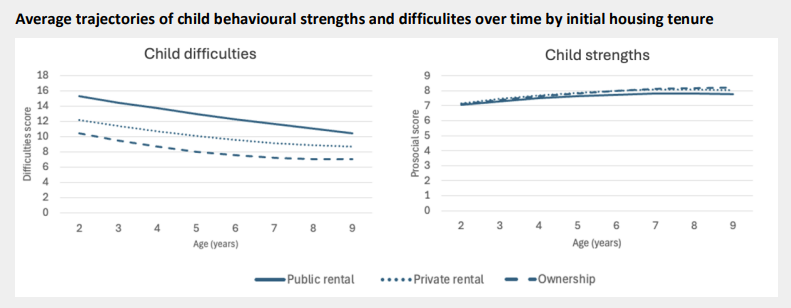
The study uses growth curve modelling of Strengths and Difficulties Questionnaire (SDQ) data collected from 2-9 years of age, alongside a childreported quality of life measure at age 12. The key finding is that children who began life in public housing were the group facing the most disadvantage and they exhibited higher levels of behavioural difficulties in early childhood than those in other housing tenures. However, their difficulties scores declined more steeply over time, getting closer to their peers by age 9. The difficulties score covers conduct, hyperactivity, emotional and peer relationship problems. Prosocial behaviour scores, in contrast, were similar across all tenure types across childhood. When statistical models were run with only the tamariki Māori sample, results were similar to the whole sample across all outcomes.
Importantly, the study highlights the role of extended family living arrangements. A quarter of children lived with relatives, in addition to their parents, during infancy and this rose to nearly half of children in public housing. Children in the group living in wider-family households initially presented with higher behavioural problem scores than those in single-parent households, but their scores declined more rapidly over time. This suggests that families are likely to be sharing housing to save money during a period where earning potential is limited (when a baby is born). While there are welldocumented problems associated with household crowding, the emotional and practical support of extended family members may also provide some long term benefit. These findings reinforce the importance of culturally and contextually appropriate housing support that considers living situations beyond a typical nuclear family.
At age 12, children who started life in public housing report quality of life (QoL) that is similar to, or better than, those from private rentals. Factors such as strong relationships with important adults like parents and teachers and reduced exposure to bullying were found to be more strongly associated with quality of life at this age than housing tenure or residential mobility.
The study also found that residential mobility had a smaller impact on wellbeing than expected. Frequent moves were only weakly associated with lower QoL after more than four residential moves over childhood. School changes had a more noticeable impact, although this may reflect other confounding factors. Notably, children in public housing experienced only slightly fewer moves as those in private rentals.
The findings highlight the importance of early housing support, especially during a child’s formative years. They also suggest that public housing may provide a protective effect over time, helping to reduce initial disadvantage. Nevertheless, targeted early support remains essential to prevent early behavioural difficulties from affecting long-term educational outcomes.
This research provides a unique contribution to the research on child wellbeing and housing by including strengths-based wellbeing measures, incorporating child perspectives, and focusing on the early housing experiences of children in New Zealand.
The full working paper is here; Housing and child development: Trajectories of child wellbeing by tenure type in Aotearoa New Zealand.
*Arthur Grimes is a senior fellow at Motu Research, and Professor of Wellbeing and Public Policy at Victoria University of Wellington’s School of Government.
*Jaimie Monk is a fellow at Motu Research and the Research Lead at Home Foundation. Her work focuses on family wellbeing, housing, child poverty and children’s technology use in Aotearoa.
The project was funded by the Ministry of Business, Innovation and Employment.
We welcome your comments below. If you are not already registered, please register to comment
Remember we welcome robust, respectful and insightful debate. We don't welcome abusive or defamatory comments and will de-register those repeatedly making such comments. Our current comment policy is here.