

The housing market is starting the year with some very mixed signals on how it will fare over the key months of February to April, usually the busiest time for residential real estate.
The first clue on likely market activity is that sales levels in December were reasonably buoyant.
The Real Estate Institute of New Zealand (REINZ) reported 6644 residential sales in December 2025. That was up 10.6% compared to December 2024, and was the highest level of sales in the month of December since 2021.
So sales in 2026 will be following a reasonably strong finish to 2025.
However prices remained largely flat overall, with predictions that falling interest rates would lead to a sharp upturn in prices coming to nothing.
The REINZ House Price Index finished last year down 0.4% compared to December 2024, with prices in the key markets of Auckland and Wellington remaining particularly soft.
That fact that prices bounced along around recent lows even as mortgage interest rates hit the bottom of their current cycle was particularly significant.
Usually, lower interest rates feed through to rising house prices, but by and large, that hasn't happened in this cycle.
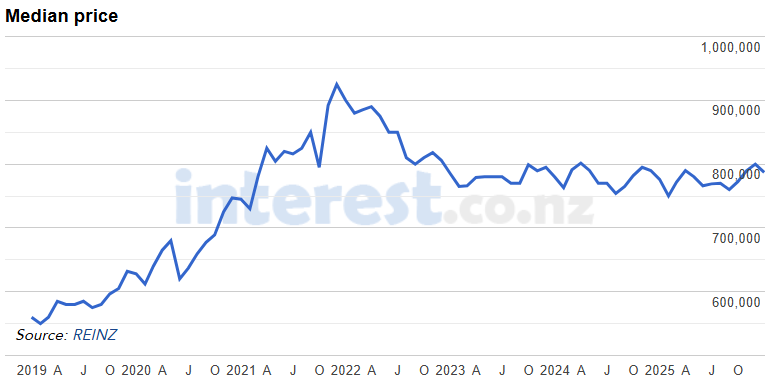
The graph below shows the monthly movements in the REINZ's median price. This clearly shows that while there were movements up or down from month to month, the overall price trend has been largely flat for the last four years.
One of the biggest influences on the market in 2025 was the high stock levels of residential properties available for sale.
Many of the vendors that took their properties to market had unrealistically high price expectations, probably fuelled by falling interest rates and the expectation this would lead to a surge in prices.
When the price surge didn't eventuate, many properties were left languishing on the market, creating an overhang of unsold stock.
Vendors in that situation face a difficult choice - either to take their property off the market or reduce their price expectations to a more realistic level.
Effectively this helped to create a buyer's market, where buyers have plenty of properties to choose from, can take their time finding the property that best suits their needs and can bargain hard on price.
The latest figures suggest those conditions are continuing into 2026.
Interest.co.nz defines an overhang as the number of properties that remain unsold after being on the market for more than a month.
Interest.co.nz estimates there was an overhang of almost 25,500 residential properties on the market at the end of December last year.
That was up by 5.4% compared to December 2024 was the biggest overhang for the month of December since 2014.
However, there are signs that the high level of unsold properties on the market could be about to change as the number of dropouts declines.
Dropouts are the number of properties being taken off the market after failing to sell.
They can either be removed from the market completely, or remain technically for sale but are no longer being actively marketed.
Interest.co.nz estimates there were about 3200 dropouts in December last year, which was down 14.5% compared with December 2024.
Fewer homes being taken off the market sits well with anecdotal evidence that vendors are starting to become more realistic in their price expectations, which was likely feeding into the higher sales levels evident at the end of last year.
If that trend continues, it should help to erode the overhang of unsold stock sitting on the market, but that would likely take quite some time.
The big unknown hanging over the market at the moment is the future movement in mortgage interest rates.
The sudden turnaround in mortgage rates from falls to rises at the end of last year took many by surprise.
While there aren't currently expectations of substantial increases in the short to medium term, the change in the interest rate outlook from easing to rising will start to weigh on the housing market.
As the housing market heads into 2026 and the peak selling season, the key drivers are likely to remain relatively high levels of stock for sale, giving buyers plenty of choice, with an overlay of expected mortgage rate rises, both of which should keep a lid on prices.
Vendors will need to ensure their properties are presented at their absolute best and their price expectations are realistic in order to achieve a sale.
- The comment stream on this story is now closed.
We welcome your comments below. If you are not already registered, please register to comment
Remember we welcome robust, respectful and insightful debate. We don't welcome abusive or defamatory comments and will de-register those repeatedly making such comments. Our current comment policy is here.