
By Alex Tarrant
The Reserve Bank of New Zealand says households will not increase spending as much as bank economists expect as households seek to reduce high levels of debt.
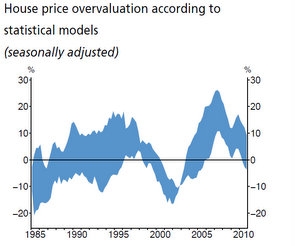
Meanwhile the RBNZ said house prices still appeared to be overvalued by up to 10%, and that house price increases were likely to be at or below inflation over the next couple of years.
Subdued consumption growth and weak housing demand could mean funds flowing into New Zealand may be directed more to investment rather than consumption, meaning a current account deficit over 5% could be sustainable, if borrowed capital from the rest of the world was invested for future New Zealand economic growth, Bollard said.
The RBNZ made the comments in its June Quarter Monetary Policy Statement, where it left the Official Cash Rate on hold at 2.5%. See more on the OCR here in Bernard Hickey’s article.
Households learn their lesson
Over coming years households were not expected to increase spending at a rapid pace, the RBNZ said.
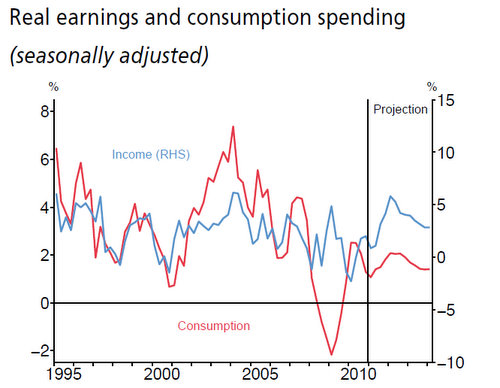
“Households have accumulated a significant amount of debt over past decades, and are expected to undertake a period of consolidation. This implies that consumption growth is likely to be modest, both relative to recent history and when compared to the projected increase in real labour incomes,” the RBNZ said.
The judgement around household spending was a key difference between the Bank’s projections and that of many external forecasters, it said.
Real consumption was expected by the RBNZ to return to the share of the economy seen prior to the years of strong consumption growth in the mid-2000s. As a share of the economy this would mean consumer spending returning to about 60% of GDP, rather than the 63-64% levels seen in the mid-2000s.
“Such an adjustment in household behaviour is needed to see household debt stabilise, but whether it eventuates remains uncertain. The Bank will be monitoring this closely,” the RBNZ said.
“Recent fiscal policy changes may increase the likelihood of conservative household spending. In addition, projected rate increases will tend to reduce consumption,” it said.
“Consistent with subdued consumption, house prices are likely to increase only modestly over coming years. A number of in-house statistical models suggest that house prices continue to be overvalued when compared to metrics such as nominal GDP or rental yields. As a result, house price increases are expected to be at or below the rate of inflation over the projection.”
Current account deficit sustainable if capital invested for growth
Asked whethere the Reserve Bank's track for a current account deficit rising over 5% would be sustainable for the New Zealand economy, Bollard replied it would depend on where incoming funds were allocated.
"If, as Australia has increasingly been doing, we are borrowing in order to invest in future growth, then absolutely it’s sustainable and you could see that continuing for a very long time," Bollard said.
“If, on the other hand, it’s borrowing for consumption, then more question marks get raised and you’d have to say, ‘will the market support that sort of borrowing,’ and that really depends on how benign those international markets are going to be in the future,” he said.
Currently, borrowing was for a mixture of consumption and investment.
“But we are expecting to see investment pick up this year and next year as the business sector regains confidence and starts to recover," Bollard said.
"We’re not expecting to see consumption pick up in a very marked way over the next couple of years. Now we might be wrong about that – that is a particular forecasting stance we are taking. We’re judging that New Zealanders have learnt from the global crisis, have been surprised and in some cases concerned by it, they have decided their debt is too high and they want to get that debt down," he said.
"Consequently they’re prepared to go through a rebalancing where they don’t increase their consumption to levels we might have seen in the past, and in addition [we would see] that house prices remain reasonably muted through that period as well.
“But that’s something we’re going to have to test. If we’re right on that, then yes you might see more going into investment and relatively less going into consumption,” Bollard said.
The Reserve Bank was keeping in close contact with the banks over their lending policies at the moment, with some banks again offering 95% home loans as they sought to reignite lending growth while households were cautious about taking on more debt.
“Net growth in lending into the household sector is very, very low. So we don’t have broad concerns from a financial stability point of view, or from the point of view of households overloading their own balance sheets with debt," Bollard said.
The Reserve Bank would not be slow in telling the banks about its concerns if it thought households had resumed overloading their balance sheets with debt, he said.
(Updated with comments on current account deficit, with charts)
We welcome your comments below. If you are not already registered, please register to comment
Remember we welcome robust, respectful and insightful debate. We don't welcome abusive or defamatory comments and will de-register those repeatedly making such comments. Our current comment policy is here.