

Labour's pending capital gains tax policy will cover more than just investment properties, with the sale of businesses, shares and other individual assets to be included as well, Radio New Zealand reports.
Meanwhile, 3News reported tonight sources said farm sales would also be covered by the capital gains tax Labour would introduce if it led a government after the November 26 election.
The tax will exclude the family home, and would not be retrospective, meaning the value of a capital gain would be assesed from when the policy was implemented, Radio NZ reported this morning, citing Labour Party sources.
Labour is tipped to introduce a tax of 15% on capital gains.
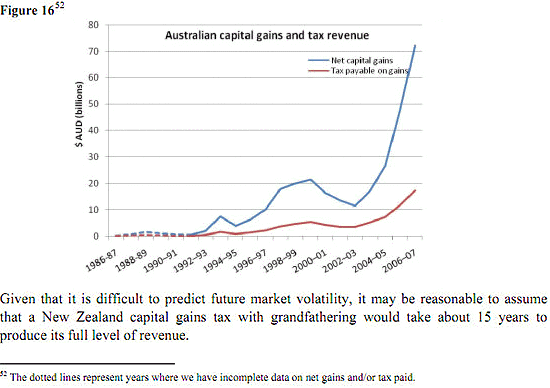
Tax Working Group figures from 2009 show a capital gains tax of about 30% on all assets other than owner-occupied housing would raise about NZ$4.5 billion a year once revenues peak. Evidence from Australia showed it took about 15 years for revenues to peak. A 15% tax would therefore be raising just over NZ$2 billion a year at its peak.
Greens pipe up on long-standing policy
Meanwhile, the National Government’s "tinkering" with the rules around investment properties was a job creation scheme for tax accountants and lawyers but did not address the underlying problem of the tax system’s preference for investment property, Green Party Co-leader Russel Norman said on Thursday morning.
“Bill English has created a tangle of new rules around investment properties in an attempt to fix the tax-incentives for housing speculation. But it won’t work as well as comprehensive tax on capital gains. In fact, it’s likely to create jobs for tax professionals to get around more complex rules,” Norman said in a media release.
“Introducing a tax on capital gains (excluding the family home) is a much simpler solution than adding more complexity. And overseas experience shows it actually works,” Norman said.
New Zealand investors currently faced a tax incentive to invest for tax-free capital gains, rather than investing in areas where their money is going to be the most productive, as elsewhere throughout the OECD.
“A capital gains tax is a critical component of rebalancing our economy that no amount of tinkering by Bill English will fix. It would help shift investment out of property speculation and into the productive sector,” Norman said.
“A capital gains tax would restore the right incentives for investment in our economy. That’s why the OECD, Treasury, the IMF, and the Government’s own Savings Working Group support a tax on capital gains. Nearly every other country in the OECD has a capital gains tax. South Africa successfully adopted one in 2001 disproving many of the criticisms currently being raised by the Key Government," he said.
“By defending the status quo, John Key and Bill English are looking increasingly out-of touch. They are playing politics with what should be a serious national policy issue. Rod Donald called for a capital gains tax in 2003 and it’s heartening now to see Labour adopt good economic policy that will boost our productive economy.”
See John Key's comments on the supposed Labour policy here.
See background on Labour's upcoming economic policy here.
See Tax Working Group chair Bob Buckle discussing CGT here (published Thursday morning).
From the Tax Working Group
The TWG's 2009 background paper on capital gains taxes included this table and comments on pages 46-47 of possible revenue that could be raised by such a tax in New Zealand:
We estimated the potential revenue by doing a high level analysis of the likely revenue to be generated from the assets most likely to produce revenue – land and shares.
The following table illustrates projected revenues from capital gains taxes applied to land and shares assuming those assets continue to appreciate at their historical real rates, and inflation is 2%.
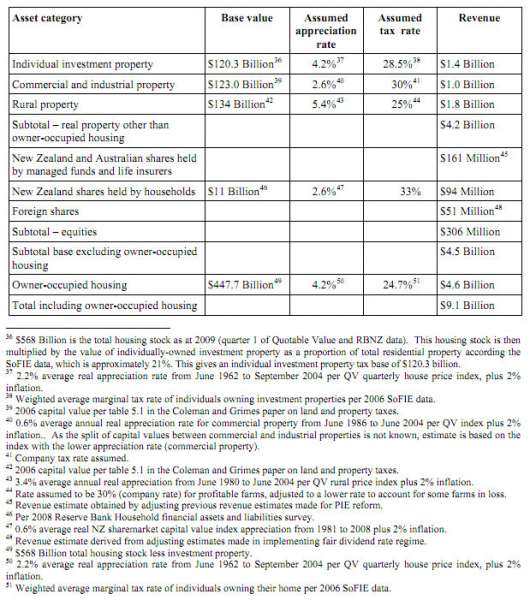
Appreciation rates were taken from QV indexes for real property and NZX and other share market capital indexes for shares. Appreciation rates were taken for the longest possible period up to the most recent valuations. In the case of real property, the index was taken for the longest period up to the most recent valuation or up to September 2004 if less, as QV changed its index methodology at that time in a way which may not have controlled for changing quality of stock as well as the earlier methodology.
The revenue estimate was calculated by forecasting the tax on capital gains as they accrue. A realised capital gains tax would earn something near this but less than this (even after accounting for the fact that realised gains may include multiple years of appreciation).
The total forecast revenue should be reduced by amounts we tax now as disposals of revenue account property that are included in the above table, such as real property. Unfortunately, we do not have the information to make that adjustment.
It should be noted that the revenue estimate is highly sensitive to the assumed appreciation rate. A one percentage point change in the assumed rate of appreciation of real property results in an approximately $1 billion effect on revenues. It also appears that in many cases most of the expected appreciation is the result of inflation.
Significantly, this estimate does not account for the effect of any transition. If existing assets are grandfathered it could take some time before a large asset base is subject to the regime.
Australia introduced its capital gains tax from 1985/86 and grandfathered existing assets. The following graph shows how it took about 15 years after introduction before revenues peaked, and it also shows how volatile the revenues are even after 15 years.
(Updates with 3News reporting farms to be covered too, Green Party comment, charts, comments from TWG paper, link to TWG report on cap gains tax)
177 Comments
Well, what a bonanza for the accounting and legal professions.
One of the most relevant criticisms of any tax is the amount of unproductive bywash it may generate, as people scramble to insulate themselves from the latest attack on property rights.
If this CGT:
- fails to account for inflation
- includes asset classes for which little or no case tax law exists
- is pitched at a high enough rate to cause avoidance
- introduces arbitrage possibilities by re-describing 'assets' as e.g. Inventory
- and I could go on but y'all get the drift
then it fits the frame nicely: a tax which will cause an absolutely massive amount of economically unproductive expenditure, and will produce a disappointingly low take, as the result of the legitimate avoidance (which will act to reduce the tax base).
Now if only there were a tradeable instrument via which one could invest in the aforesaid professions....and, of course, a suitable description of that instrument for CGT purposes...I thinkl I may need an Accountant.
Watch closely as Goofy cunny and crew refuse to see how dumb their CGT policy really is...
They will hammer away and layer promise on top of promise and then...in a few weeks time...the whole sorry load of stupidity will be swept under the carpet.
What this shows is just how weak Labour are when it comes to economics and finance. Just because cunny has 'goosed up' his presentation, does not mean he is talking any sense.
Wallace, so dumb even University Professors from the tax working group are weighing in on it:
http://www.stuff.co.nz/business/5245917/Warning-on-capital-gains-tax
Perhaps you should try and judge policy on its merits rather than its colour. Splitting everything into blue and red is just so cold war darling...
Wolly, do you have anything constructive to say about the merits of CGT for or against, especially from an economic perspective? No?
Well how about putting a sock in it then.
Truth is opening up every thread and reading your default diatribe, aka how much you hate Labour, is getting really really really dull. Quite frankly it's dragging down the tone of the site, which is otherwise very informative both from left and right perspectives.
Why not do the polite thing: when you've got nothing to say, say nothing.
Ditto,,, Its like reading Dilbert every day.... Keep it up,,,,Nice with the Marconna
Real estate agents might benefit as well as PIs sell down to avoid such a tax...
regards
Andrew King ( RE Property Investors Ass) "It will drive people away from owning rental properties, and put rental property prices up...". So: There will be sellers of existing renters hitting the market, but somehow, even though they are selling because whatever new rules come in are a penalty to owning them... the price will go up, in the face of that reduced demand! What a laugh....Prices go down when people don't want to buy something, Andrew! (PS: If you don't know that, Andrew, then what are you worried about ?) - Oh, and just in case he impied it will be the rents that rise: When property prices do fall, rents will be lower, as the B/E to owning a property to rent is lower with a reduced entry price.
Nicholas- your making me desperatley hope this comes about- then I might be able to finally afford to buy my first home, instead of watching my over inflated rent payment fund my babybommer landlords lifestyle.
This is the right move, but not for the reasons which the entrenched will exchange with each other.
Simply, the profits/gains claimed (by anybody, doing anything) are a proxy for the purchasing of goods and services. Real stuff.
Artificially increasing that proxy via 'capital gains', bears no relation to the ability of the physical planet to underwrite - ie to supply the real stuff. That's what happened in 2007-8 (no underwrite, no dollar) and will continue from here on.
Clearly, $ have to be tagged to 'the real'.
One way to do this (it's only a start, fiat loaning is the bigger distortion) is to limit the actions which do the extending and pretending.
Sure, there will be howls from the folk who can't rise past calling people silly names.
Sure, there will be vested-interest lobbying - and the media will lean that way.
Doesn't change the rightness of the action though - the fellow from Sydney had it right on Morning Report - a buck is a buck is a buck. I'd add - and a buck has to be underwritten to be worth anything........and any move to recognise a more rigid relationship between $ and reality, has to be good.
Is that your best waffle PDK...oh dear how sad National wins and Labour loses...again!
I write my posts with the aim of making people think.
Naturally, that has less relevance as the gamut of the intellectual spectrum is traversed.
... A " gamut " is a male duck , isn't it ?
Silly me ! ..... a male duck is a drake . A gamut is a type of crane .......
So , what is an " intellectual spectrum " , then ....... is it a pair of spectacles belonging to someone who is smart ?
Isnt waffle.....Those $5 bills are a debt, or a claim on future energy consumption.
Its simple, the piece of paper with a 5 on it in your pocket has to be under written by something real, ultimately energy.....making something more valuble in terms of those $5 notes when there isnt the energy to support their creation isnt sustainable.
regards
That was waffle, with some triviality added by you. And what does it all have to do with CGT discussion?
Energy a triviality? if you think that, then you are not going to very happy in the future energy constarined world.
I have explained what I mean, PDK also has you obviously cant as yet link in how important energy and cheap energy is to everyone's world....
regards
The economics makes me scared...
Our entire global economy / society needs cheap energy. On top of that our entire economy has to grow to keep un-employment low that has to be at 3%+ Say 4% that in turn means our energy consumption has to grow at 2.5%...every year.. Using 4%, this means that every 17 years the global economy has to double.....so the energy consumption has to do what?
Once past peak oil we go into irreversable energy decline, probably at least 4% per year less when in fact we need 2.5%.....so a net short fall of 6.5%+....what will taht do to our economy and our un-emloyment? and in turn our welfare costs? and in turn our taxes?
The best by far person with the strategic or big picture view I have seen by far is Nicole Foss and automatic earth.....
http://theautomaticearth.blogspot.com/
Some good videos where she lays it out....
http://www.youtube.com/watch?v=eKMnBeZzLqk
http://www.youtube.com/watch?v=MhtG85Fu2CA
http://www.youtube.com/watch?v=BJKZT5TNjYw
This lady all by herself makes me very worried.....then there is a lot more supporting work and evidence.
In terms of oil/energy,
http://www.energybulletin.net/
Then with 7billion ppls you have to realise the link between fossil fuels and food....we eat oil and natural gas.....
regards
WTF?
I rest my case. :)
You own a case?..."Hey Goofy, what was it you said about a tax on cases"....people who own cases must be in the filthy rich class...serves you right PDK.
yep, open and shut, I'd say.
Yeah and no doubt it's made of leather....higher rate of tax on leather cases. Only spiffs and lawyers have leather.
Read his lips.."it will not be retrospective"....but Labour will be forced to make it so anyway because the tax simply does not harvest enough to cover the cost of their pork slices on offer.
But apparently it's not the only new tax they're considering Wolly...
..... oh , goody goody gummy-bears ..... there's more taxes to come ....... joy !
No chance of cutting some government spending then ? ........ sober up Gummy , no more rum for breakfast !
Seems fair enough if a CGT is assessed by any Labour-led government at values in 2012, but that of course doesn't mean it isn't a desperate attempt by Labour to win power. Which of course they won't, unless there is a huge collapse of support for JK, so probably it's all a bit academic at present. The legal and accountancy fratenity will be no doubt rubbing their hands at the prospect of increased business if and when it was to proceed.
Any policy that stops us going bankrupt I support, however I think the answers are still unpalatable to the majority of the electorate. Labour is trying to increase spending as a bribe to the voters, its worked in the past, in the process we are being driven closer to bankruptcy.
We need to have policies that stop bubbles i suspect that we could have controled the property bubble with some tweaking by the RB but for some reason it never happened, once you get the bubble how do you avoid the pain of debt destruction as prices return to affordable levels. In the last few months milk prices are back %20 that will eventually filter through to the rural sector, taxes will fall and the government will have to borrow more. How long do we go on pretending, its getting an awfully boring.
If anyone thinks the BRICK countries are going to be the winners should read this
http://globaleconomicanalysis.blogspot.com/2011/07/credit-crisis-in-bra…
Brazil risks tumbling from boom to bust
Cash Flow Burden Astronomical and Rising
- Average rate of interest on consumer loans 47%, up from 41% in 2010
- Consumer debt service burden was 24 per cent of disposable income in 2010, slated to rise to 28 per cent in 2011. This compares with 16% for an “overburdened” US consumer and a mid-single digit reading for other emerging markets such as China and India.
- Debt service burden for the so-called “middle class” in Brazil has now breached 50% of disposable income
- Delinquencies in Brazil (defaults in excess of 15 days) have begun to move up rapidly, from 7.8 per cent to 9.1 per cent of total loans between December 2010 and May 2011.
- Delinquencies are now rising at a very hectic rate. They have risen at 23 per cent in the first five months of this year in absolute terms or at an annualised rate of 55 per cent.
- Normally credit indicators cyclically lag the economic cycle. When they begin to deteriorate before any economic weakness it usually represents a structural problem relating to underlying cash flow or underwriting weakness in the quality of credit – Brazil has both problems.
Increased spending? as in new? or maybe they recognise the reality that you cannot cut public services or starve them to death with lack of $.?
Tis simple for me, I want Public health services, education and other core services to remain functional....if tax has to increase to do that, so be it and frankly I dont think there is a choice.
If also the extra income is used to reduce the rate at which our debt is increasing , Im all for that as well.
However, yes I am greatly concerned that Labour will just tax more so it can spend more....and it wont be productive tax increases....
ie I think increasing prices are a good signal to ppl to change their lifestyle.....nothing else seems to work....so subsidising ppl on low incomes to continue doing as they are doing a little while longer is frankly nuts IMHO. This more than anything worries me about Labour's governing....god I may have to vote National! (not that ist teh first time ive voted to the right).
regards
Come on in steven...joint the land of the free worker able to determine 'his' own future and not need a bloody politician to say how when why and where.
A little more help and you will see the sound reasoning behind honest National policies...and yes you will also see the rorts scams bailouts and general stupidity...
Labour suffers from the need to ensure a viable voting base of unhappy envious brain dead voters are always on hand to stand in line and vote them frontline seats at the pig pen. They have a Little rising star on the way..which will not please cunny as he has his sights on Goofy's seat post the defeat...
National is little different to Labour Wolly......the difference is like trying to put rice paper between closed fingers.....
"Labour suffers" ditto National, only probably more so....why do you think JK took National to the centre ground? because that is where the votes are.....no one wants right wing policies, or I should say not enough ppl do, ditto left wing policies.... So both parties, indeed all parties have to have a front that shows them as moderate and central to the essential centre voting block, the devil is what goes on in the back rooms.
A classic and overused analogy is the way the libertarians/far right describe the Green's as watermelons.....really the same applies to all the others.....the skin is what ppl are voting for, but that isnt what they find they get to eat. ACT maybe a lemon, inside bitter and full of pips to choke on....National an eggplant, inside tasteless needing lots of something to make palitable and over-priced......
regards
That piece of rice paper makes all the difference steven. QED the associate Minister telling the bureaucrats and police to leave Charlaine Hodgson alone..that she is a Kiwi..end of bloody story.........not the sort of ending you would have had with a Labour Govt minister of immigration....and you know it.
OMG what Woolly headed thinking - "...honest National policies"
Give us a break!
You are on your own Goron...it's been up for yonks and nobody else said boo.
Oh how sad that anyone who has worked hard.. studied.. got themselves a career.. built a business...borrowed against the family home... is such an easy target. We already pay huge tax, employ people, stimulate the economy, take huge risk with red tape laws.. but because we are few... the politics of envy are easy.. Give me an incentive and ill employ more people you idiot politicians.. Tax me more and ill just shut up shop and work for someone else (oh wont be anyone to work for).. the government will pay for my digital sky tv if i choose not to work... FFS
Welcome to the land of fools Jomosapian...heaps think it's a great idea to do eff all and rely on a bunch of liars to hand out money stolen from the real working Kiwi...all it costs them is a few 'rent a mob demos' and a vote for Labour once every three years.
If you pay huge tax then you can't be in New Zealand because we know New Zealand is one of the lowest taxed countries in the "developed" OECD.
Some of the reson for that is because we have been encouraged to take on more debt, especially farmers, so we pay more interest but less tax. We have transfered our future earnings to the banks and by-passed the tax department. There is not enough money for the banks and the government to both get a slice so take your pick.
Any property bubble is not because of an absence of a CGT, otherwise how come all the countries that have one had a bubble too? The only reason to have a CGT is to get more taxation revenue to fund more government spending. Suspect JK will have a field day on that one come election campaign
Are you that black and white in your outlook?
No, A CGT has a cooling effect on a property bubble...it does not stop bubbles.....what has caused the biggest bubble since tulips is the US's cheap credit/OCR rate. This was an external fact or to NZ....and yes our Govn failed to act....
There are two issues here to the "field day",
One, more Govn spending depends on what the more is....if its essential to keep existing public services functioning then yes tax has to be raised, or services cut....
Two, taxation needs to be across the board and fair, so if one sector of the economy is paying 30% of their profifts to have a neutral scenario all sectors must pay 30%. Sorry but if Im paying 30% PAYE or run a business that pays 30% tax I expect that everyoe else is also paying tax on their profits. Especially if that means that that 30% becomes say 28% across the board that to me is fair.
JK may well have a field day, Goff is being brave I think and showing some signs of leadership/backbone.....unlike Jelly Key.....who flops which ever way the wind blows.. So yes it will be interesting to watch and see if voters are so shallow that they cant see JK is screwing them over with his wild growth predictions etc. The outcome will be what the voters wanted, if they wanted to be screwed over, well they only have themselevs to blame when they are, grin and bear it time.....better hope its a good condom.....
regards
me - that may well be what Labour think.
It doesn't matter, they're both ignoring the elephant in the room.
I suspect (hope) that Tindall, Withers, Fyfe and Co, are not. This is not a case of 'more in it for me me me vs Govt spending, this is a case of adapting to the limits to growth, and morphing a fiscal system which was cooked up during the 'growth' period.
The tax - as I mentioned further up-thread - does the right thing, even if for the wrong reasons. This isn't about the upper-deck vs steerage anymore, this is about the sinking.
I doubt we'll have the debate, though - it has to be had above the level of calling people 'Cunny'. That just indicates (to anyone who has indulged in debating) that the speaker is out of real info.
THE FOLLOWING WOULD ALSO REDUCE DEBT
If you smoke you must have health insurance
If you drive a car you must have third party insurance minimum
if you are 18 to 28 and dont work you must do a trade apprentiship for the dole
If you have a student loan you pay it off before relocating overseas
no student loans for bar tendering and fasion etc
If you commit crime you dont have a seven week family conference you go to jail
if you dont pay your own way you have 3 years max of welfare
If you live in NZ youre a NZer
If you have a baby at 16 you live with your parents and they pay
I like your policies, I'll vote for you.
The family of anyone who is gaoled must pay the full cost of the inmate's food & accomodation !
Ever wondered how home detention works? I think you will find the inmate is on unemployment .....................not to mention what they family recoup for playing warden!!
You get my party vote.
Me too...If you have never considered a political career, now might be the time :) Maybe we'll be a little less stuffed then.
Hahaa I like you martyb..
and goodbye NZ if found guilty of serious crime if here on visa
Here's a plan. Instead of increasing tax, stop spending so much! Instead of paying "wages" to the "customers" of the Dept welfare pay their rent directly to their landlord, their powerbill (up to a limit) directly to the power company, negotiate a great deal with local supermarkets to provide them a food parcel made up of fruit, vegetables and healthy food each week. Give them free passes for public transport (with photo id). That covers most of their needs. Then pay a small amount of cash to their bank account to cover other needs. To get this they would need to work out a budget with a budget adviser to cover eg clothes, haircuts etc. If they want to buy alcohol, drugs, cigarettes, SKY, consumer items they would have to try and find some work to get cash. That would solve many other social issues at the same time, and we'd know our money is being spent well. They then wouldn't be able to get into debt borrowing money at outrageous rates to buy consumer goods as they couldn't service the loan. We need to make sure people are sheltered, warm, educated, have medical treatment, and are not hungry, anything else should not be paid for by the taxpayer. If people then choose to trade their food for cigarettes etc and let their kids go hungry I'm afraid there is no helping them.
I'm sure Hone would agree with you, the people of te tai tokerau are going hungry and that would solve all their problems.
No one should go hungry in NZ and no one would if spending was prioritised- ie food, shelter power paid first.
I agree, but with current benefit levels, you'd say the money we are spending should easily cover food expenses, unfortnately ciggies seem to come first.
How many people are actually on an unemployment, domestic purposes or sickness benefit these days? What percentage is it of the general population? We are constantly told of this "army" of bludgers that is fatally throttling the New Zealand economy, but just how many of them are there, and how many of them have been on a benefit for longer than, say, one year?
Great idea -- will it apply to corporate welfare recipients also?
What LAJ said
http://www.reuters.com/article/2011/07/06/oil-guild-idUSL6E7I61MW20110706
LONDON, July 6 (Reuters) - The price of physical crude oil will hit $150 a barrel this year in the United States due to unrest in North Africa and the Middle East, despite the emergency oil stock release coordinated by the International Ene
rgy Agency (IEA), a U.S. fund manager said.
Monty Guild, the chief executive of Guild Investment Management, said the IEA's move did not change oil's fundamentals.
Sell, sell, sell http://www.trademe.co.nz/Browse/CategoryAttributeSearchResults.aspx?search=1&mcat=0001-0268-&sidebar=0&5=&14=&18=0&18=0&24=0&24=0&searchregion=100&15=belair&searchbar=1&generalSearch_keypresses=6&generalSearch_suggested=0
I dont think $150 is far fetched, but $80 is just as likely IMHO. If Saudi goes kaput, it wont be $150....it will be $400+ and not even gettable at that price I suspect....ie severe shortages.....10% of the world's daily supply would have gone bye bye....
regards
Since the increasing deficit I have been of the opinion that increasing tax is the right way to go. The consequences of this are that more money is taken out of the money supply, which slows down the economy. People would see this as a bad thing but I do not. We need house prices to come down, so that everyone can afford them, we need a slowdown in the economy, so that people can understand that life is not just about money, its about the relationships that we form, these are things which have TRUE value.
Muppet... Dont increase tax.. stop gov waste.. you cant keep taking from one sector of the community and giving to another.. that will only fill a temp gap and will run out when we are all poor.. better spending decisions are required by less govenment and better incentives are required to get people of the bottom line.. stop dragging everyone down and get the bottom to come up...
Muppet King,
With your thinking we should change our anthem to God helps New Zealand...
btw, greed is good!
Unfortunate view.. Greed is not good.. it's ok to want to be wealthy but respect for all others is good.. it leads to society taking care of itself and less government..
I believe greed is good, but too much of it is a sin. Greed has led the human race to make amazing things and has progressed us as a species. Greed for power, money, and other things is a common human emotion, but there is a time for greed, and a time to stop being greedy and be more socially responsible, its all a matter of moderation.
And for the record, I did not do a BA, or took philosophy at university lol
right enuf talkin, just show me the money!
Don't belive what they taught you ... Money can buy happiness (many times over!)
Contrary to popular belief, money does not make you happy, it causes a lot of problems. Do you really think that mega-wealthy people are more happy than you and me? They might have a lot of money, but they are human, and mostly have the same problems. And excessive greed is a terrible beast, because whatever you have will never be enough. I would rather not live my life continually wanting, but would rather be content with what I have and want a little more. Its not the money that makes the man, its the man that makes the money.
" Money cannot buy you happiness , but it can buy you the kind of misery you prefer . "
Happiness is the psycological and physiological response to the unconditional acceptance of that which is, was and ever could be. Things are as they are because they were as they were and will be as they will be. At the moment one accepts this they get a nice big free burst of the only three things humans can actually enjoy: dopamine, seratonin and noradrenaline. And I unconditonally accept the fact that most people think this is a load of old boots, (so I'm still getting my free drugs.) Must go, time for my medication.
Or , join Brian Tamaki's church .... they'll gladly relieve you of the burden of money .....
..... eftpos terminals at the entrance , the alter , they're in the vestry & the apse ...... the good Bish. has them all over the bloody joint .
.... and it's all tax-free ( to him ! )
Go in peace , my friend . The Lord be with you , as indeed your life-savings are now with me ... Bless !
Actually if you ever find yourself in a situation where giving money could literally save a life, then you may find who you are. Yes without it you can't make the choice , that is for sure, but it's more about having to realize what is important. Money is part of the systems which are not natural & have been designed to intentionally entrap us into false realities. Stop & think about how controlled & enslaved you are in every aspect of life, then ask yourself if this is what it is to be a human being. Once you understand yourself , & the external traps, life develops very different colours. Only once people get their heads around these basic confines can real progress even start. Think about it
Money , just like the computer you mention is a man made entity Marty. Think about it clearly, what is money , where did it come from, how did it develop and where is it leading us to and who controls it? As a start Marty
Marty of course people are natural , some are more aware Of what this means than others, and that is where debate become very interesting.
Money is a medium of exchange not a form of trade , it is a tool used to facilitate trade inside the systems you can't seem to think outside of. I agree that operating inside current systems it could prove difficult to get that plane built , but with the right people , a can do attitude & thinking outside of the box , far from impossible, unlikely but not impossible. Try to stop seeing everything as being so fixed , it limits the mind & Holds us all back
Man I really opened a can of worms here, some pretty profound $%^& going on here. Its true though, people need to think outside the box, financially, economically and philisophically. For example, everyone thinks that you need to get a mortgage to own a home, in years to come this won't be the case.
Marty I can tell you are keen to understand more , hence you question which is good. Respecting others is what its all about. We are having the same convo in two threads by the looks of it. So I'll focus on this one for now. Current economic , monetary , political systems etc have been built with one aim so far as I can see , and that is to allow those at the top to stay there and to keep hose who are not at the top ,as far as possible from them. All of the current systems must evolve , notice I said evolve , sudden dramatic change is not practical , although we may find it forced on us as the final part to the problem , reaction , solution garbage we see throughout history , I digress. Always looking to improve is the best way and you see from here that some people have good ideas , but no way of making them noticed , policy change comes from continued public pressure , real visible pressure , not blog sites. So in short yes I am putting myself on the line and have projects in motion as we speak, for me I have to try to impact change , not just talk about it. Know the systems , find a way to use it for the greater good , then put a plan I to action using lots of clever friends who believe in the plan.
Mk it will take some deep @&$! to help those who will be shocked by coming change. Many people will have their thoughts and safety zones blown out of the water. It will require depth to work through it all.
Agree...
regards
Good on them. The Aussie guy on the radio this a.m. summed it up for me. A buck earned is a buck earned regardless of the source and should be taxed at the individual's marginal rate. I would add that for real estate speculation, this is especially so as it adds absolutely nothing to the ecconomy and impoverish a large section of it.
Poor speculators, let them have their little tantrums and run off overseas. Sad thing for them is that they will find practically all other countries have CGT; we are the odd ones out. As Labour seem unlikely to get back in, this time, they are safe for a little while longer. The wise ones will use this opportunity to get out of the market.
However this issue will not go away and sooner or later Labour will get into Govt and impliment change. If they don't we will keep on heading in the same direction as Greece and end up begging on our knees to the World Bank. Judging by their past comments, one of their first instructions will be to introduce a GCT. We might as well accept the envitability of this.
C M - Not all property investors or those with share portfolios are speculators, by the way, even if you presumably think so.
But rents will go up!!! It's not like PIs know the relationship between market and rent anyway:
http://www.nzherald.co.nz/property/news/article.cfm?c_id=8&objectid=107…
MIght put a few of the greedy buggers out of business and free up some homes for first-home buyers.
Have updated with comments from the Greens. I think they're happy their policy is finally front and centre of the national policy debate
Cheers
Alex
Tax policies with exclusions always cost more to administer and always seem to have unintended consequences.
With CGT on shares and businesses, and having the family home excluded:
-
People might be tempted to upgrade their homes, rather than buy shares or businesses.
- Also people may be tempted to invest in finance companies rather than shares. Although the same could be said for bank deposits?
So CGT would be paid on KiwiSaver and superannuation investments? - hmmm that bigger family home is looking better and better as a vehicle for providing for my retirement...
Until people stop thinking about only themselves the dirty game of envy policitics will continue. How many more failed electoral terms does Nz have up it's sleeve before thr country walks off a cliff. Think about it in terms of three year blocks, then think about future generations who will have to live in the mess we allowed to happen. Greed is not good , it has never & can never be good. Greed is a negative , selfish state of being , and the more people who practice it the worse this place will become. Want a future or country to be proud of and happy to inhabit , then it's time to stop falling for the divide & conquer crap & start thinking as a unit. Oh and don't just assume people will be able to get abroad because that is not certain either. Let's build this country , demand better , not just wave a white flag and roll over.
The best example of envy politics one can find is ACT membership. Those who didn't have the natural talent to make it in the higher rung and so spend their lives moaning about how taxation kept them down and away from the elite where they belong. Jeez, do these guys ever want what they don't deserve....
Please try to stop seeing things in a box with a nice easy to read label, it only makes it easier to control. Party politics must end , and soon because it is dying along with with the planets resources. There is no difference between the parties , just a degree of difference in the people seeking to hide reality from us. You need to look beneath what you think you understand , then keep searching for the truth. It's there , but it's very hard to accept it at first, keep at it , it gets easier after a while, until eventually it is so obvious , that the status quo becomes unacceptable. Then change will come!
With respect marty your logic is flawed. People had to step out of a box & simple people's redicule to learn the world was not flat & that they could fly. Staying in the box is killing human progress , and if you researched more then you would know what I meant. The current monetary systems are failed Marty , and because of in the box thinking like your own it is making it hard for human beings to move forward.
Marty I don't like to turn blogs into a personal debate. I understand what you are saying but all the systems you mention have been designed to stop you thinking. The advancement for humanity is not some large group or sudden change to current arrangements. It's about people using current systems to enforce accountability on those asleep at the wheel. Why would you have to analyze everthing Marty , your words are restricting your inate abilities to listen to yourself. You don't need to read someone else's view on life to form your own picture , just listen inside. Challenge everything, because the lies are the enemy of freedom. The big secret kept from people Marty is that life is simple, don't go looking for the hard answer as you won't find it because it's not there , not for what we need. Basic human emotions of the positive variety will play a major part inthe change you think you have read about in a book.
Marty economics is not evena science , it's a load or crap. To analyze economics is to restrict your thinking. So actually this blog is the right place because it's not all about statistics & now I see what PDK is referring to. Actually Marty I assume you are young and feel that something is wrong with the world , and you want to fond out what that is. Ecomonics can't tell you though dude
LloydM1 - interesting troll, eh? Act, you reckon? Playing the innocent q'er, but obviously too full of self to really be querying. Paid, too, unless I miss my guess. Those kind don't waste good money-making time just posting for intellectual furtherment.....
PDK please clarify. Not easy to read where you are coming from with this post. Some fairly hard words I here which read as assumptions about people Excuse me if I read this wrong , hence askin for clarity.
Who is troll ? Full of self belief ?
I suspect our newcomer is not all he/she seems,,,,,,,,,,,, that's all..... :)
martyb keeps asking the same thing over and over Lloyd.
The subjects then tend to drift to where the troll leads subjects away from the original subject.
The posts become alot of meaningless dribble of opinions from that time forward....
I wondered that myself seems the paid trolls are changing tactics ?
Ill take it as it comes Ive dealt with trolls before Trolls usually get personel like that westminster avatar a while back!
Ha! I'm starting to understand the way alternative mindset works to any factual questioning
Ha! I doubt that!
Since you assume all individuals are exactly same.
Factual questioning ? huh huh you recieved answers and pointers!
Cheers.
I don't think marty is a troll ,I think Marty is looking for answers that the Nz education system has not allowed him to find yet. As frustrating as this site can be , there are some who come to learn & understand , crazy as it sounds.
BORING!
As a New Zealand citizen
1. Go live in Australia
All of your income, gains etc earned from outside Australia incurs absolutely NO tax FOREVER
2. Pick up your equivalent of your transferred NZ Super if you are eligible
That's partly true only if you are in AUS and still holding NZ Tax payer status.
Like myself, I am working in AUS but because of our house being rented out in NZ while we are here, I will be NZ Tax payer and liable for tax returns in both countries but only paying my tax once. But in the case if I applied for PR in AUS and then sell our house in NZ. I will be up for Australian CGT
Yep, it's double tax agreement.
We've just completed our income tax returns in NZ. Once we got it assessed we will have to include the income figures for our tax returns in Australia. Our tax amount will be assessed with the tax amount we paid in NZ taking into account - I am not an accountant but have been explained by our accountants in both sides. And we have to bear in mind our residency status if we sell our house in NZ. Hope that helps.
Thats right you pay about 10 times over and then one more time for good measure!
I gave you the link you want yesterday but Im not ya mother so you will have to click around to find it and as LloydM1 has posted and myself do your research and form your own opinion. Research means more than one source or guru on the net or government stat site.
Many here have excellent opinions and many are in the same set of books on different pages and chapters but no one has the all encompasing perfect answer you seem to want.
Hey perhaps PDK and Stevens stuff on peak oil is more you or perhaps you should dig up Ian Parker stuff or just have a good laugh at wolly and gummy stuff all of it is accurate assesments from our OWN persepectives - perceptions - life experiences....
This is a blog site not a library! Blogging is opinion its great you wanna know but again none of us have the perfect answer
You might want to check out the fine print of CGT for Aussie. I seem to remember that one CEO bailed out of Australia just before he had been there 5 years to avoid CGT.
If they are taxing you as an Australian Resident for taxation purposes, I would doubt whether it matters whether you still retain a NZ residence or not.
If you qualified for LAFHA you might be ok.
If you have stopped qualifying for LAFHA then I doubt it.
I would also doubt whether it mattered whether you had Australian Permanent Residence status or not for CGT to be applied.
I suspect that if you have lived there for 5 years, earning your income for 5 years, and filing Australian tax returns for 5 years, you will be up for Aussie CGT should you dispose of NZ assets
It is a scenario that is certain to make accountants richer and most of the rest of us a little poorer....
Presumably if you live in Australia and obtain income from another country, you are not liable for Australian income tax on that income. This applies for 5 years from becoming Australian residence. However NZ citizens need never claim Australian residency so the concession applies forever.
If that income comes from a country other than NZ while still retaining NZ citizenship but not residency then NZ cannot tax the income either.
You would still pay local tax for income earned in Australian or investment income from an Australian source.
Make of that what you will.
That is it.
Tax residency still includes the 5 year concession (or forever for NZ citizens).
The origin was an inducement for temporary skills to be encouraged but only for 5 years to allow them to become resident permanently.
Persons who had previously worked in Australia after 1991 were excluded as were th spouses/partners of those.
That's correct.
In my case I'm an employee for a company here in Brisbane, I get pay fortnightly with tax taken out of my pay packet. I can file my tax returns here and then file the net income with my rental income in NZ.
Being a NZ citizen you get some benefits but not all (i.e. Flooding assistance excl. non PR residents as example).
We were looking to buy a house here and still able to claim the 1st home grant but not exemption on Stamp Duty.. so there are pros and cons of calling Australia home !!!!!!!!
CGT would bring currently non taxed gains into line with Term Deposits and interest bearing accounts. Perhaps enabbling their tax rates to fall to 15%.
Term deposits and interest bearing accounts (not bonds) don't have any capital movement (unless in a fiance company and capital movement in past has been down).
These earn interest which is taxed at owners individuall tax rate.
Nothing to do with CGT.
Sorry miss you point here???
Currenty there is in my opinion an anomaly with the different way interest and capital gain are taxed. Investments in shares and property grow in value in two ways. Their assets grow in value without effort via inflation ( just check the rateable value of your house over the past couple of decades). Pofitable investments in these classes may also make a profit. However, broardly, only the profit is taxable. The capital gain is tax free. Not so for Term Deposits and interest bearing accounts. The principle loses value every year due to inflation. However the interest rate paid appears to accomodate that plus a little extra for the use of the money. Then the disadvantage arises. Because not only the little extra for using the money but also the accomodation to compensate for ithe loss of value of the princlpe from inflation is taxed as income. i beleive this is anomalous because the compensation for the loss of value due to inflation provides no value to the investor and therefore is not income.
Labour borrowing Green ideas just as National borrowed Act ideas in 2005.
A buck is a buck. Exempting the family home over-complicates the issue. Otherwise, good idea.
If Labour and the lettuce junkies get back into power, I think I'll go onto the benefit. That seems to be about the level of economic ambition they have for this country.
David B - it's better-class invective than the stuff I commented on earlier, but it's still invective, and my comment still holds.
Please explain why you hold 'economic ambition'.
One assumes that's a need to feel 'richer'?
Which (discounting the thought that you might want to marshal lots of people into being more productive - a power trip, see above) means you would expect to be able to purchase more goods and services, and grow that process at some percengage-rate.
Does this process have no end?
Say yes and I'll call you delusional.
So when does it end?
And at what point is it better to put the brakes on?
And what kind of planet do we have at that point? What would it be 'worth'?
PDK at what point do you think people will realize they are not on the winning side , by blindly adhering to such dated ideologies as left or right etc. Money , or digital numbers are simply going to vanish alongside the planet as it has been. More war , more drilling , more lies , more government control. But hey , ive got stuff though , wicked. I agree with David though , labour & greens are as useless as anyone else. Vote for the best person, people , those with a holistic view & not carrying political baggage from the past.
With one partial exception there is no party not carrying political baggage...and actually thats the Green party, but thats qualified. Pollie with a hollistic view? like when, an oxymoron if ever there was one.....virtually the lot cant see past November and three years.
regards
The greens sadly are easily hijacked by the likes of Russel Norman , look into his background because like hell we need him near the controls. Having him as an mp is sickening enough. Bradford & co speak for themselves, they were never green , just opportunists.
So we need either a complete or near to it flush out , or voters getting a clue and continually holding politicians at all levels to account , this is possible and requires little more than focus and coordination within and across electorates. Or will people simply let the situation become so bad in gods own? This is serious , but you know that already.
pdk do you believe its possible for everyone in the world to have a house, good job, food a nice car..
Say yes and ill call you delusional.
Whats the maximum standard you hold for everyone at which point youd like to put the brakes on them.. and why cant individuals aspire to have more..
If people were not selfish at the core you may have a point but unfortunately people generally are only interested in their own situation..
Nobody in NZ is really poor on a world standard.. and we don't have murderous dictatorships..
Reading into this, so what you are saying is that humans are predominantly greedy , and based on that forward progress for a harmonious planet is not likely ? My question is this , should the small number at the pointy end of the pyramid decide they didn't want anyone else to play in the sandpit. , would those selfish people feel that the unselfish should fight on their behalf, or will it remain every man for themselves until the bitter end? The acceptance of greed , selfishness , envy & other horrid emotions only solidifies to me the world class lie that has been sold to humanity. Perhaps we are animals after all!
Jomo - great Q.
No - and I haven't since reading of Hubbert (in 1975) and the Club of Rome 9thereabouts too).
I've always understood that the planet - on a semi-indefinite basis - could support 2-3 billion people, at scrabbling/subsistence level. Perhaps 1 billion at our 'level'.
Which has begged the question I've pondered for years - how do you identify/retain the best of the technology, knowledge and expertise, when you are reducing the number of heads holding it, reducing the just-in-time delivery and the specialsiation?
I think we're wired to store fat, reproduce too much, think linearly and competitively. Which means we either fight each other over the remaining resources (survival of the fittest/last person standing) or we go to a new level, and address things for the common good.
The problem is that we're getting pretty late in the piece, for the 'new level' approach. The worry here is what form the war(s) would take, how we would fare afterwards, and the question of climate/population/starvation/displaced refugees.
Alright guys! Here's the plan:
Consume more and more resources --> Increase population --> Destroy natural environments --> Grow economy --> Make more and more profit --> Buy more and more things = True happiness and life success achieved!!!
A must read from NZMEA:
http://www.realeconomy.co.nz/190-capital_gains_tax_will_help_re.aspx
"The eradication of the capital gains tax harbour will help to lift productive investment say the New Zealand Manufacturers and Exporters Association (NZMEA). A more balanced tax system will see investment flow to the most intrinsically profitable areas of the economy, rather than those that are tax advantaged."
See that table, amazing!! Then take a look at this link to see reactions to the comments from self-interested parties:-
http://www.realeconomy.co.nz/189-capital_gains_tax_objections_a.aspx
Arguments from those who opposed to taxing capital gains and the answers:
- 'Rental incomes will rise' - rental incomes are governed by supply and demand and the tenants ability to pay whether or not the landlord is paying more or less tax is irrelevant.
- 'It is too complex' - if the tax is collected on realised capital gains it is simple to collect at the time of sale. Also, most of the developed world collects capital gains taxes without any trouble.
- 'We will pay more tax' - a Capital Gains Tax means less tax or lower borrowing for the same amount of government spending. This means more disposable income for the average person.
- 'Property values will fall' – the anti Capital Gains Tax lobby have argued property values will fall and rise, there is much more to property price than a CGT.
And drill the link at the bottom of that article and tell me why John Key and Bill English support economic apartheid in NZ - South Africa don't support economic apartheid anymore, why does New Zealand?
Cheers, Les.
What would you expect from NZMEA? They have vested interest in this topic.
I am two minds about CGT, lots of pros as well as cons and never don't trust the figures given by out by politicians. More taxes won't solve the fundamental problem. Like someone quoted here before from Ronald Reagan "if it moves, tax it. If it's still moving, legislate it. And if it stops, subsidy it"
NZMEA, "have a vested interest in this topic" - please explain?
Are we the only ones with a "vested interest in this topic" - in the way you infer?
No we are not, how about you list them, please?
Cheers, Les.
easy ... shifting the tax focus is one of them!
Why does that make sense? For who else does it makes sense?
Others with a similar "vested interest" to NZMEA are:
1) Gen X and Y.
2) FHBs - including some ex-tenants buying the properties off their landlords.
3) The broader real economy. Even some in farming are keen on it:
'Capital gains tax to aid young farmers'http://www.ruralnews.co.nz/Default.asp?task=article&subtask=show&item=14936&pageno=1
4) Most NZ tax PAYE'rs who will not have to carry the can on their own.
5) Gen Z - the grandkids who will not have to shoulder so much national debt and so might think it worthwhile staying on in NZ.
So maybe around 90% of New Zealanders.
If manufacturers are paying 30% tax, if PAYEs are paying 30%, how is it fair that some other sectors are not only paying zero tax, but are borrowing so heavily to avoid yearly tax that in effect they put the entire economy and hence the manufacturers and PAYEs at risk?
Sorry but thats crazy on two levels....
Lets get a level playing field where the profit from any and all investment is taxed and taxed at the same rate to any other, to start with anyway....By all means lower taxes in areas that benefit NZ like exporting.....
regards
Viva Hong Kong, LOL
Friday...eh...oooh boy...just dropped in for the Friday smile....{ : > )}
A HUSBAND IS AT HOME WATCHING A FOOTBALL GAME WHEN HIS WIFE INTERRUPTS, HONEY, COULD YOU FIX THE LIGHT IN THE HALLWAY? IT'S BEEN FLICKERING FOR WEEKS NOW. HE LOOKS AT HER AND SAYS ANGRILY, FIX THE LIGHTS NOW? DOES IT LOOK LIKE I HAVE ENERGEX WRITTEN ON MY FOREHEAD? I DON'T THINK SO. FINE, THEN THE WIFE ASKS, WELL THEN, COULD YOU FIX THE FRIDGE DOOR? IT WON'T CLOSE RIGHT TO WHICH HE REPLIED, FIX THE FRIDGE DOOR? DOES IT LOOK LIKE I HAVE WESTINGHOUSE WRITTEN ON MY FOREHEAD? I DON'T THINK SO FINE, SHE SAYS THEN YOU COULD AT LEAST FIX THE STEPS TO THE FRONT DOOR? THEY ARE ABOUT TO BREAK I'M NOT A CARPENTER AND I DON'T WANT TO FIX STEPS HE SAYS, DOES IT LOOK LIKE I HAVE BUNNINGS WRITTEN ON MY FOREHEAD? I DON'T THINK SO I'VE HAD ENOUGH OF YOU. I'M GOING TO THE PUB!!!! SO HE GOES TO THE PUB AND DRINKS FOR A COUPLE OF HOURS............................... HE STARTS TO FEEL GUILTY ABOUT HOW HE TREATED HIS WIFE, AND DECIDES TO GO HOME AS HE WALKS INTO THE HOUSE HE NOTICES THAT THE STEPS ARE ALREADY FIXED. AS HE ENTERS THE HOUSE , HE SEES THE HALL LIGHT IS WORKING AS HE GOES TO GET A BEER, HE NOTICES THE FRIDGE DOOR IS FIXED. HONEY, HE ASKS, HOW'D ALL THIS GET FIXED? SHE SAID, WELL, WHEN YOU LEFT I SAT OUTSIDE AND CRIED. JUST THEN A NICE YOUNG MAN ASKED ME WHAT WAS WRONG, AND I TOLD HIM. HE OFFERED TO DO ALL THE REPAIRS, AND ALL I HAD TO DO WAS EITHER GO TO BED WITH HIM OR BAKE A CAKE. HE SAID, SO WHAT KIND OF CAKE DID YOU BAKE? SHE REPLIED, HELLOOOOO..?? DO YOU SEE SARA LEE WRITTEN ON MY FOREHEAD? I DON'T THINK SO!
Why can't we have the first $20,000 of personal income tax free? That would surely encourage more people to go out and work.
Because it's not about encouraging independent anything. It's about monopolistic controls at the business & economic levels & human control at the political & legislative levels.
Ain't that the truth !!
No it won't.. why work if you can smoke drugs.. steal.. get caught.. have 15 chances... watch sky tv on the government.. get takeaways every night.. unfortunately the way to get people working is to give them very little if they don't.. provide the essentials only and not via way of payments..
Ergo it is failed policy , not the fault of those who do these things.
Still don't see anyone trying to tell me at what point this deliberate actions by government should be taken to task. Accountability anyone ?
If you are not paying tax on earned income, what right have you to vote?
Every right as a NZer.
regards
Probably because we need to have a tax base, however Labour with $5k is a good start.
regards
New Zealand is becoming a country with a lot of poor people dependant on the government. Unless people with capital invest in productive sectors and provides jobs, the government will have to find new ways to tax them.
At what point does repeated failure become a deliberate act?
Actually NZ if its following the other countries is becoming a country of the very well off 1% with everyone else not doing that well.
Certainly with less energy its looking like a structural employment at say 15~20%....that will be a huge bill to meet....
regards
Looks more like that every time I stay in Nz. Shame really because it need not be that way. Maybe the 1% think they will get to have what the rest of us have taken from us. Seems like globally the 1% have rigged the deck. Can't imagine why they would do that
Look at all the panicky Nat fanbois.
What's that mean, seriously I've not heard of a fanbois
Fanbois : Means hopelessly devoted to someting , or blindingly in love ....... such as Amanda Morrall to her coffee . ...... or some one eyed Cantabrians to their Crusaders rugby team , ahem ........
....... hopelessly devoted to you , go Ritchie , go Daniel ..... rah rah rah !!!
Updated with 3News saying farms would also be included
Cheers
Alex
Labour have a wagon load of silly promises they will roll out right up to their defeat in November. Then Phil will depart for New York to work beneath the great Helen. Cunny will have a Little battle for the leadership and probably win because he wears three piece suits and not a pair of overalls with "I'm a Union Man" painted on the back.
Just like the Nats. They're planning the same things for themselves. It's what politicians do. After all, they aren't in it to help anyone but themselves, right?
So, I see a lot of Leasing in future. Transfer the lot to a Perpetual Trust (no gift duty anymore), and lease the assets.
Unless, of course, you buy the farm before you manage to gift it.....
If it wasnt so serious it would be funny. Yet people keep handing over their hard-earned cash to pay for it all. Worse talking about new ways to pay tax to fund it , hoping beyond hope that somehow Nz will avoid the oncoming train. Are we really so lame down there ?
So CGT @ 28.5% on residential property, according to that table. So isn't 15%, or whatever the rumour is, better for property investors; or is it just that the rules will be better enforced, so 15% achieves the same tax result ?
Can someone explain how this works for a farm? Where is the delineation between the home and the farm land. Can you just have a house with a huge backyard where the pet cows and sheep roam?
And what happens to rentals or a family business if they are left in a will to a family member- does the change of ownership on death trigger the CGT?
This is where you will need a good accountant/tax lawyer..... Delination, I would assume something like the ecq limit, 8metres? maybe.....
I would assume a death triggers a CGT as its a change of ownership?
I wonder what happens if you work from home.....would the room allocated for your work be subject to CGT? might be.
regards
My accountant friend says that farmers are dead keen to claim just about all the costs of their house against their farm income. "How can you say the house on the farm is a home? It is part of the business! So I should be able to claim for everything!"
But I notice that when it comes to a CGT, the argument is suddenly the other way around. "Why should I pay CGT for my family home on the farm? It is nothing to do with the farm!"
lol!!
Cheers to all.
According to above "most of the expected appreciation is the result of inflation"
So if your house has no capital gain (appreciates at inflation only) you still have to pay CGT. To keep it 'fair' (which is apparently the whole idea) do they propose to tax people who have no salary also?
Well, I must say that by the last election I felt there was no chance that I would vote for Labour for decades! Especially with that totally stupid idea regarding the GST. But maybe they are earning my vote after all!
Spreading the tax burden across all income classes, not just wage & salary earners, is the only equitable way. Especially as we need to have funds for services for our ageing population. Which includes landlords and farmers, I note.
Key's arguments sound pathetic. Virtually all (if not all) OECD countries have a CGT. Suggesting it would be too difficult to implement here makes us sound like a particularly stupid country, unable to introduce systems that work fine elsewhere. At heart he is just an old-fashioned Tory, protecting his mates and core supporters. (and himself and Cabinet).
Cheers to all
Phily with respect if this is how you view politics please do not partake. Democracy is much more than voting & knowing some high level lies you get told. Democracy requires vigilance to monitor those in govt & hold them to account anytime they stay from policy or in a direction that is to the detriment of the nations well being. The fact you swaying already tells me that the above subject is nor for you nor anyone who sees the the vote buying process in such naked simplicity. Excuse my blunts but this is not god enough !
Bring accountability back at all levels is the only way. , the only way. Force this upon them and watch what becomes possible.
Thanks for your comment Lloyd.
I am pretty careful about how I vote, & don't just swing. Last time I voted for Winnie. "Horrors!" I hear you say "this backs up my belief that this man can't be trusted with a vote."
However my reasoning was that National needed to get in, but I didn't want them to be totally bound to 1) Rabid right extremists Act, or b) the Maori Party. Hence my strategic vote. Several thinking people I know did the same thing.
I don't particularly want Labour back - taking GST off veges etc is crazy. But the Nats haven't thrilled on various fronts - won't raise the super age, won't cut back on the WFF scam, won't spread the taxation burden across income classes, hence encouraging even greater polarisation of wealth.
I think CGT will be the defining issue at this election (can't see what else would be), & intend to make it a core part of my voting decision.
Thanks again, and cheers to all.
After reading many of the posts in this topic, one obtains a perfect illustration for why this nation is poor, underachieving, in debt, and has 20% of its population living anywhere but here. With folk like some of the ones above in it, I can confidently predict that sadly, the future for New Zealand is not bright. Its path to the bottom of the OECD and utter mediocrity appears to be well assured.
"I dont understand that" That's OK....this site has ppl on it who know quite a bit and some who want to learn a lot. More than a few here though tend to be the right wing voodoo economic bigots, fortunately they are so lame they are easy to spot. On the bright side we dont have any left wing bigots....so its only 1/2 as bad as it could be.
;]
Im finding I have learned a lot and its a good place to write your thoughts because if the libertarians etc cant put up any logic, data or examples to refute what is said, it cant be that wrong....
So, simple dont get wound up by the Libertarian etc losers, following the links and reading for yourself is one of the biggest powers of this site, the data and its presentation is simply amazing and the refuting of the idealogical crap expounded enlightening.
Good luck with your business, ppl like you are what we need, more PIs uh no....
regards
Dont forget yourself in that list....
regards
I tend to be a bit of a harsh critic of Mr Alexander at the BNZ, but I thought his analysis on the problems with a CGT is excellent:
http://www.bnz.co.nz/static/www/docs/weekly-overview/w2011-07-07.pdf
We alread have a de-facto CGT, as profit is supposed to be taxed on sale, at whatever marginal rate one has. This Labour scheme is just trying to make sure that is comprehensively applied ( and at a lower rate, to boot!). What's all the fuss about?
Wolly you seen this?
http://www.nzherald.co.nz/nz/news/article.cfm?c_id=1&objectid=10737072
I have now 28/29....
"A BRITISH TASKFORCE".....stuff the british taskforce....the UK is a basketcase of shite.
Even Gabby would agree with that...why else did he emigrate!
I would imagine that GST would be the decider. If you are claiming GST on the enterprise then yes you will be taxed on capital gains. If a farmers house is claimed at %25 then that portion would be taxed under the CGT and so on. If you are a property developer and you come under the GST umbrella like some of my friends then you would be taxed anyway at the normal rate and then get to pay the GST back which is a %50 tax rate. The days of making money from capital gains are probably over for a while, the question we should be asking the RB is how they allowed such massive CG when they had a %1-3 inflation target, this should be lowered to %0-1 and i9nclude houses and rent, which would remove the need for a CGT and give investors and savers some security.
A must read from PEC:
http://www.pec.org.nz/2011/07/capital-gains-tax-strategy-jobs/
"There are three fundamentally important reasons the country needs a Capital Gain Tax:
1) The government’s high borrowing, on top of an already high net foreign debt is causing our country to be uncompetitive in exports outside of the primary sector. While diary and other primary exports are a critical part of our future, they do not create many new jobs. As such they are capable of neither sustaining an increasing population base nor providing the high standard of living those leaving New Zealand clearly desire.
2) A broader lower tax base is desirable for both compliance and efficiency. Much of what was said in the Tax Working Group’s paper was about the unfairness of the current tax system and its effects on compliance. A Capital Gains Tax alongside other tax changes already implemented largely addresses those concerns.
3) A Capital Gains Tax sends the right signals for investors and means those choosing to take the path of unproductive property investment will have to pay their fair share of tax. While fairness in tax is good the real long term benefit is the chance to get more of our limited capital invested in making New Zealand more, not less, competitive."
Oh come on Les, wake up!
1. Most of New Zealand's debt is held in the private sector, not by the Govt. How on earth will a capital gains tax that will be spent by a future Labour Govt. on its voter support base (e.g., welfare beneficiaries) possibly reduce private sector debt? What, are they going to give money out to everyone who owes money to the bank? The US and the UK both have capital gains tax and both are in far worse shape than we are with respect to Govt. debt.
2. Efficiency? There is nothing efficient about trying to collect a capital gains tax. It will be just another cost burden on tax payers. If there is a problem with proety speculators not paying the tax on their investments now, (i.e., WE ALREADY HAVE A CAPITAL GAINS TAX - paid at each tax payer’s marginal rate. Labour's proposed 15% is a tax cut! ) take it up with IRD.
3. How could it possibly send the right signals to investors to invest in the productive sector when Labour proposes to tax those sectors as well, i.e., farms, businesses and shares. What a load of absolute crap.
I'm embarrassed to read it quite frankly, but it's typical of the shallow 3rd rate dribble that passes for 'expert analysis' in this country. No wonder the country is poor and unproductive. It’s full of idiots.
Interesting theory but the CGT would also apply to your high tech business.. and to casual share traders and money market players... so how does this diversify investment?
A GCT is a tax on the smart not on the wealthy.. I have friends who are school teachers and have managed to get themselves investment properties... If they choose not to spend there tax paid earning on trips, cigs and drink why should they be punished for being smart..
You state you have a tech business employing people and bringing $ into country.. you pay about 5 different types of tax already.. you really keen to pay more when you sell your business as well.. A GCT is about bringing the smart down to the level of the average instaed of encouraging creativity, savings and investment..
jomo,
How is buying rental properties at a time when there were generous incentives available by from the government LAQCs, particularly smart or creative? Especially when your friends the teachers are members of a profession that benefits from protections that few others have available. The PSA largely runs the Labour Party. Its a hard job for sure, but so is aged care and workers in that field get paid far far less.
You know how this ends right? We know don't we, we just don't know when, but we know the ending:
http://www.youtube.com/watch?v=-4FSI5ut6a0
http://www.realeconomy.co.nz/190-capital_gains_tax_will_help_re.aspx
http://www.realeconomy.co.nz/189-capital_gains_tax_objections_a.aspx
http://www.realeconomy.co.nz/144-capital_gains_tax_pros_and_con.aspx
"Craig Elliffe and Chye-Ching Huang from the University of Auckland Business School have written a series of articles for the Herald on the merits of a Capital Gains Tax in New Zealand. The first article looks at whether the tax changes introduced this year were wide ranging enough, the second discusses the benefits of a Capital Gains Tax and the third examines the most common reasons for the rejection of a Capital Gains Tax with reference to South Africa which has recently introduced the tax."
Why would you want to support economic apartheid here is NZ?
Cheers, Luke.
David you are so very right with this post. Nz is full is arm chair pundits who don't simply can't see past their little agendas. This idea is a debarcle waiting to happen. Come on Nz not just accept more of the same of the elected morons how about some real radical ideas to force change because if thr IMF comes in sometime we are truly screwed. So idea number one let's leave the IMF , fire up the printing press and self fund infrastructure projects etc. Why borrow at interest for anything at all when we can self fund at zero ? No one here answers that previously , its hardly mentioned , why not ?
Our country is being stolen & run into the ground & the best most can come up with is debating another tax we DO NOT NEED.
Although I would AGREE with any action to kertail property speculation I THINK it's a desperate attempt by Goff ( i call him Mickey Mouse regarding his looks & the antics by members of his party)....Sorry not...TO apply the handbrake to the Freight Train as approaches the HOUSE on the Tracks.
Yes Goffy to little to late your party started the party rolling in 99 remember?
And anyway your up against The Property Investers Federation an app name considering half of there members are from OuterSpace and would quite happely put half the population in rentals if they have it there way.
But the Devils in the detail as they say so I LOOK FORWARD to your statement next week so you may buy my Vote yet.
Regards simey7
Shouldn't the CGT rules be kept simple, like the speed limit? Just a simple Selling price - purchased price. No complicated stuff like inflation, improvements etc etc. Less arguments, less loopholes, less need for accountants and lawyers :-)
Really Billy!!! so you buy a house for 200k sell it 10 years later for 220k which in real terms is a loss due to inflation let alone taking into account the R&M and interest payments and then pay the gov some tax for the pleasure.. awesome plan
But we already have precedence for not adjusting for inflation with interest on bank deposits being taxed on real rate of interest?
Invest 100K at 6% interest. Inflation at 4%, tax at 33%. Whoops, negative real return. You either adjust all tax for inflation or none.
If that's an invesment property, then that's part of the risks and investors should do the sums before buying. Make the wrong call and buy/sell at the wrong time, too bad. It's no different from buying shares on the stock exchange.
Interest earnt on money in the bank loses out to tax and inflation, why should there be a loop hole for property?
Build something unique, tech billionaire tells Kiwi entrepreneurs. You need to try to do new things. Things will not get better simply by copying because things are close to state of the art, so you need to do things that are significantly new and qualitatively better," he said. Absolutely, just having 15 more dairy cows or new, useless politicians on the paddock doesn’t help – the opposite.
http://www.nzherald.co.nz/business/news/article.cfm?c_id=3&objectid=10737144
You don't want everyone to put money in the bank... Investment in property.. farms ... shares etc stimulates the economy.. repairs are required that provides jobs for contractors.. etc etc.. what does money in the bank do...
Thats my point thanks marty.. its the businesses that make the money.. businesses that work on property farms trade shares etc.. so why penalise them...
"It's Treasury's way of saying that a capital gains tax is incredibly fair."
We welcome your comments below. If you are not already registered, please register to comment
Remember we welcome robust, respectful and insightful debate. We don't welcome abusive or defamatory comments and will de-register those repeatedly making such comments. Our current comment policy is here.