
By Alex Tarrant
The Reserve Bank is taking more notice of credit growth data when deciding whether to raise the Official Cash Rate to cool price rises, following last decade's house price boom.
If this were the case before the boom began in 2002/03, the Bank would likely have raised the OCR sooner in its effort to douse the rampant housing market, Assistant Governor John McDermott indicated in a speech to the Bank for International Settlements in Hong Kong.
See the RBNZ's latest housing credit growth figures in the chart below.
McDermott used the speech to say the Bank felt its primary goal of inflation targeting had been successful since being adopted 20 years ago.
The Bank had analysed the success of inflation targeting during the most recent 1998-2007 business cycle, in which a number of shocks led to excess demand pressure and inflationary pressures.
"In summary, that analysis notes that the New Zealand’s economy expanded from 1998 to 2007 and then had a six quarter recession in 2008-09," McDermott said.
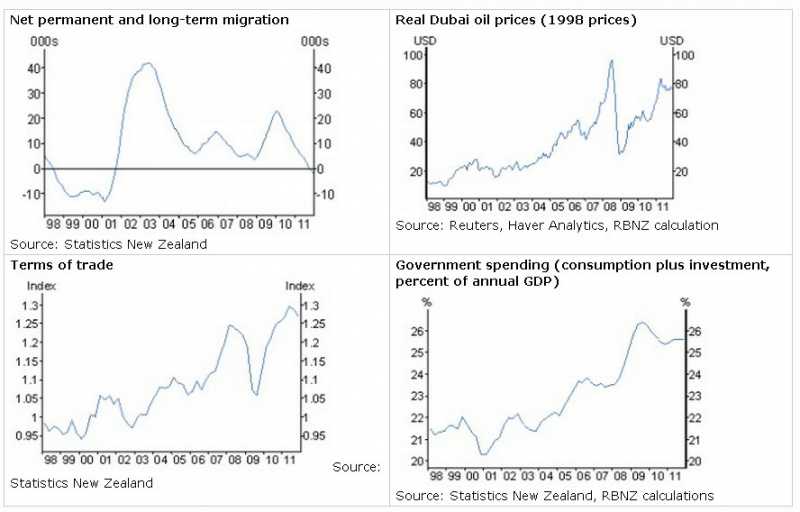
"From 1998 to 2007 there were a number of significant shocks that determined the shape of the business cycle:
- First, there was a strong and unexpected increase in population growth from net immigration in 2002/03.
- Second, there was a significant boost to the economy from a rising terms of trade from 2000, which accelerated late in the period.
- Third, oil prices roughly doubled from mid-2007 to mid 2008.
- Fourth, government spending rose rapidly from 2005. This came at a time of pre-existing excess demand in the economy."
In setting monetary policy, the Bank had to take a view both on how these shocks would unfold and how they might change the inflationary pressure in the economy, as summarised by its view of the output gap, McDermott said.
As a forthcoming Reserve Bank Bulletin article would note, throughout the recent boom, "we expected the output gap to dissipate rapidly. However, as it turned out the output gap remained positive for an extended period," he said.
That meant excess demand could remain long after the underlying shock, like rising migration, had gone.
Inflation pressures
With an extended period of excess demand pressure, average inflation tracked in the upper half of the Bank's target zone during the cycle.
"While the persistent component of inflation was higher than we would have ideally liked during the business cycle expansion, it did remain anchored within the target zone. That outcome was far superior to our experience of the 1970s when inflation was persistently at double-digit levels," McDermott said.
"The difficulty of anticipating how long an inflationary shock will last is central to the forecasting process required for monetary policy. In many models that are used for monetary policy analysis, the output gap often quickly returns close to zero following a simple aggregate demand shock, and it is natural to think in those terms," he said.
"However, the interaction of a persistent aggregate demand shock and inertia in the economy can considerably prolong the time for which the economy is in a state of excess demand pressure."
House price rises; 'We're watching the credit stats'
Even the relatively short-lived large inflow of migrants in 2002/03 had ongoing impacts.
"The housing stock cannot be increased as quickly as the changes in migrant flows. Consequently, house prices rose and, even after the boost to population subsided, continued to rise beyond all forecasters’ expectations," McDermott said.
"Higher house prices in turn stimulated a large construction boom which put further pressure on resources. Private sector credit started to expand well in excess of the nominal growth in the economy," he said.
"In line with conventional wisdom, we put relatively less weight on credit data than on interest rates. Had we had a higher weighting on credit growth data, our view of the persistence of pressure on resources would likely have been stronger much earlier in the boom."
McDermott said the Reserve Bank's monitoring of monetary and credit information had increased in the wake of the global financial crisis.
NZ$ issues
Meanwhile, conducting monetary policy in New Zealand was also complicated by exchange rate issues.
"In a small open economy the inflation target is a complement to a floating exchange rate regime," McDermott said.
During the boom period expectations of tight monetary policy to offset the excess demand pressure probably contributed to the persistently high exchange rate throughout the period, causing considerable discomfort and worries about the sustainability of parts of New Zealand’s tradable sector," he said.
After the global finance crisis there were new challenges for monetary policy to deal with.
"The current recovery in the business cycle, both in New Zealand and in other advanced economies, is proving weaker than historical precedents. Our forecasting frameworks need to be expanded so we can examine possible sources of the disappointing recoveries, such as say the impact of the overhang of public and private debt on the economy," McDermott said.
'It did what it was meant to do'
"Despite the challenges and the ongoing shocks to the economy, monetary policy did what it was supposed to do, keep inflation low. The framework maintained the Reserve Bank’s focus on the target and the frequent publication of forecasts forced us to constantly update our views of the economy and the inflation pressure within it," McDermott said in conclusion.
"The Bank’s analysis on the recent business cycle underscores that the inflation targeting framework is an effective way to conduct monetary policy under a range of testing circumstances and that the framework is a useful tool for future inflation control," he said
"With low inflation and the credibility of inflation targeting came much lower volatility in the general level of prices. That is helpful for resource allocation, affecting longer term performance, and for macroeconomic stability over the medium term. This credibility was very helpful when the global financial crisis hit. To help offset the very large negative shock the Bank started lowering interest rates even while annual inflation was above its 1 to 3 percent target.
"Of course, that is not to say the framework cannot be improved in any way. Over the course of the past 20 years or so the framework has evolved to reflect lessons learned and is likely to evolve further in response to new developments," McDermott said.
"In particular, our monitoring of monetary and credit information has increased in the wake of the global financial crisis. The Reserve Bank has also been looking into the effectiveness of some macroprudential instruments that may limit build-ups of problems in future periods of rapid credit growth," he said.
Here are the four shocks McDermott referred to:
No chart with that title exists.


We welcome your comments below. If you are not already registered, please register to comment
Remember we welcome robust, respectful and insightful debate. We don't welcome abusive or defamatory comments and will de-register those repeatedly making such comments. Our current comment policy is here.