
The Reserve Bank's move to put "speed limits" on high loan to value (LVR) lending could produce a short-term spike in house prices, a property industry commentator warns.
Alistair Helm, the founder of website properazzi.co.nz, says the move by the RBNZ to limit banks to 10% of new lending on loans in excess of 80% of a property's value from October 1 could cause a "rush to the exit" by buyers.
Helm, who was also the founding CEO of Realestate.co.nz, told interest.co.nz he was concerned that the RBNZ had given quite a long lead time for the introduction of the limits.
He had talked with a local Auckland real estate agent who reported that they had a sharp upturn in interest from buyers since the announcement.
Buyers, Helm said, were likely to feel urgency and a sense they wanted to "buy something" because they might not make the 20% deposit level when October 1 comes.
“They feel like they are sitting there with a bag of money. They want to buy a house and they feel pressure and almost believing they’ve got to buy something.
“That’s very worrying and dangerous potentially because just at the moment the Reserve Bank want to put some dampening on the market it could suddenly cause a degree of inflationary activity.”
“Given this love of auctions that the industry has for everything in the property market, particularly in Auckland. With that kind of demand matched to the fact that we still have a limited supply, it’s going to push prices up, absolutely."
Rush to the exits
On top of potential pricing ramifications, Helm also believed that this "rush to the exit" might also result in some bad buying decisions.
“There could be a crash and burn scenario of people buying houses that are not with a building survey, or houses they can’t afford, or houses in the wrong place – all of that worries me.”
Helm said he was concerned that there was a "laissez faire" attitude within the real estate industry that it was up to the buyer to do their own due diligence on a property.
“Almost as if, well if they can’t do it, that’s their fault.”
“...I mean surely there’s a relationship here with their customers, clients and people they are trying to help, to help them do due diligence. A two week auction, a five day auction, a one-day auction, how can anyone do due diligence?"
Helm believed that the October 1 deadline might see a lot of auction sales brought forward.
Pressure on
“That will put more pressure on buyers to act quickly. “
He said in the slightly longer term, however, that the LVR move was "the right thing to do” and eventually it will apply “some kind of braking to this somewhat overheated market”.
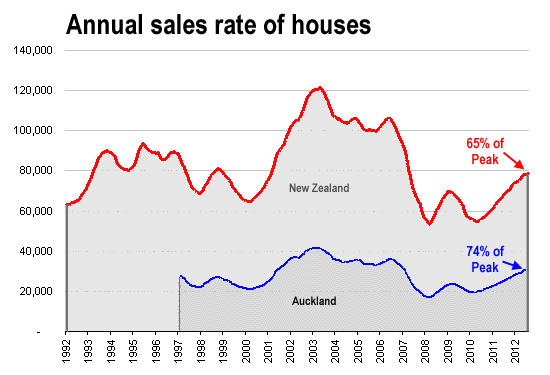
Helm said that prior to the RBNZ announcement there were signs that the housing market was beginning to level. The rate of increase in year-on-year house sales was declining. It was down from 20% earlier in the year to about 14% now.
Sales were still growing heading toward 80,000 transactions a year, up from a low of 55,000 three years ago and compared with a high 10 years ago of 110,000. Prices were easing a little and the market was starting to come to a bit more caution and "hesitation".
“...But the last seven days – a bit of a worry.”
Recent sales figures have shown that about 40% of houses in the Auckland region are being sold at auction.
Auction woes
Helm doesn't like what he sees in this trend.
“The principle of an auction is not wrong. But the principle of bringing auctions forward in this very compressed marketing period that used to be traditionally three to four weeks - which is a good time for all the parties to evaluate the properties, to get surveys done, to get due diligence done, to think about the process - is now being truncated to at least two weeks and sometimes less.
“That I think is disadvantageous for the buyers."
Helm said the agents would counter that and argue that they act for the vendor.
But he said he was concerned that the vendor was not being informed enough that buyers might be missing out because of compressed time frames.
"There are buyers who cannot come to the party, who might pay more than the person who won it at auction. They may even be able to go unconditional. But they couldn’t be satisfied themselves about the condition of the property, or the due diligence, or they couldn’t get the finance sorted out, or they were just away at the time and missed the first open home.
“So, it worries me that it’s a bit of a blind rush to a single solution that I don’t think is being given enough consideration by vendors."
A 'dangerous' silver bullet
The auction process was seen as “the silver bullet" by the real estate industry. "And I think that is dangerous."
Helm said there was huge "disintermediation” going on in the real estate industry.
Marketing was now a “one task”job that was all about putting the property on Trade Me.
Helm pointed out that the work done by the auctioneer could just as easily be done by a licensed auctioneer for somebody conducting a private sale of their house.
"We are seeing more of this. I’ve noticed more of this. And I’ve talked to people who are selling their house privately, on Trade Me and organising a licensed auctioneer to carry out a fully professional facilitated auction on the day at the property and they achieve excellent results."
Wake-up call
“And that I think for the industry should be a wake-up call...
"...If you don’t watch it and consider how you are doing, you could be out of a job.”
Estate agents had "driven down this road of believing auctions are a panacea" to selling houses, Helm said.
"In a way it is almost taking the hands off the wheel and saying, 'well let somebody else complete the sale', which is the auctioneer, forgetting that auctioneers are not purely real estate agents. Real estate agents can be auctioneers but auctioneers don’t have to be real estate agents.
"The guy who sells the furniture is licensed under the 1928 act and can sell a house. It doesn’t need to be a real estate agent. So, an interesting future for the industry I think."
We welcome your comments below. If you are not already registered, please register to comment
Remember we welcome robust, respectful and insightful debate. We don't welcome abusive or defamatory comments and will de-register those repeatedly making such comments. Our current comment policy is here.