
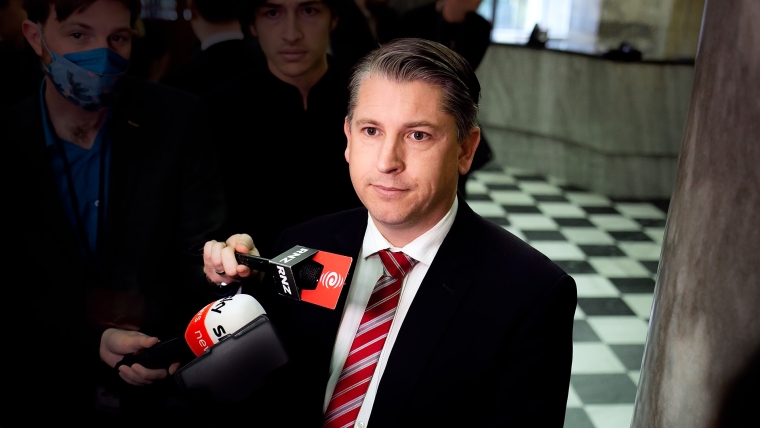
Political scandals often start as comedies before morphing into tragedies, and so Michael Wood may lose his beloved transport portfolio because he failed to sell a handful of shares.
It's not an outcome that an 18 year-old Wood would have imagined when he shelled out maybe $760 to buy 423 shares when Auckland International Airport went public in 1998.
(These are rough numbers, as the airport has done share splits and raised capital several times which makes it hard to know exactly how the minister came to own 1530 shares today).
That year Jenny Shipley’s government sold its majority stake in the airport in an IPO on the New Zealand stock exchange, when Wood was completing his first year at Auckland University.
Shipley’s sale of the airport was a continuation of the privatisation of state-owned assets kicked off by the fourth Labour government in the previous decade.
It was also the year Wood would be politicised by the Auckland power crisis, a five-week long power outage that was partly blamed on the privatisation of electricity providers.
Still, Auckland Airport has prospered as a private company, delivering its shareholders a more than 630% return on investment over the past 20+ years.
Wood’s 1530 shares are now worth about $13,200 on the open market, and his holding has appreciated almost 21% since he first told the Cabinet Office he held the shares.
Prime Minister Chris Hipkins revealed on Wednesday that Wood was asked 12 times to sell the shares since November 2020. During that time, he has accrued a capital gain of about $1,450.
When asked by reporters whether he was waiting for the price to recover from its pandemic slump, Wood denied that was a factor.
“I wouldn’t even know what the price of Auckland International Airport is. I purchased these shares when I was 17 or 18, I’m not a share trader.”
Shovel-ready share sale
It's a laughably small amount of money for a minister to lose their job over; about half a percent of his annual salary before tax.
There isn’t any serious suggestion that such a small amount of money could have influenced his decision making. And yet, he didn’t sell — even when prompted 12 times.
If you call your broker and ask them to sell some shares in a highly liquid asset, they might be sold before you hang up the phone. The whole deal takes five minutes.
It was more complicated for Wood, according to him, both because he had to prove his ownership of the shares and because he wanted to move them to a trust.
The minister would’ve been issued a paper certificate when he bought the shares in 1998, but without that slip of paper would’ve needed to ask for his Common Shareholder Number.
Companies themselves keep track of who owns what shares, and Auckland Airport’s share register is maintained by Link Market Services.
Wood said on Tuesday that he asked for information from the register, which was sent to the wrong email address and he didn’t get around to following it up further.
Then on Wednesday, the minister said he was also shifting the shares into his family trust before making the sale. Proceeds would then be reinvested in a managed fund.
He said this was a more appropriate way for ministers to manage their interests.
“So, that involved getting a number of signatures, filling out forms, and working through a process,” he told the media.
That all makes it more complicated than a five minute phone call, but it was still a job that should not have taken more than a few weeks.
Redemption possible
Prime Minister Chris Hipkins has left the door open for Michael Wood to be restored to the role of Transport Minister once he had sold the shares and corrected his disclosures.
But the opposition wants him fired from all his portfolios. National’s Paul Goldsmith said there should be a thorough independent review of his “conflicted decisions”.
The NZ Herald reported Wood declined North Shore Aerodrome’s application for airport authority status last year. The Aerodrome had hoped to expand its runway and possibly compete for small domestic flights at some point in the future.
Act Party Leader David Seymour had previously dismissed the issue but reversed his position overnight and now wants him to resign.
However it plays out, a handful of shares bought by a teenager during the era of privatisation has caused quite a headache for a senior minister (and possible Prime Minister).
Even now, the fourth Labour government haunts Parliament’s halls in unexpected ways.
We welcome your comments below. If you are not already registered, please register to comment
Remember we welcome robust, respectful and insightful debate. We don't welcome abusive or defamatory comments and will de-register those repeatedly making such comments. Our current comment policy is here.