
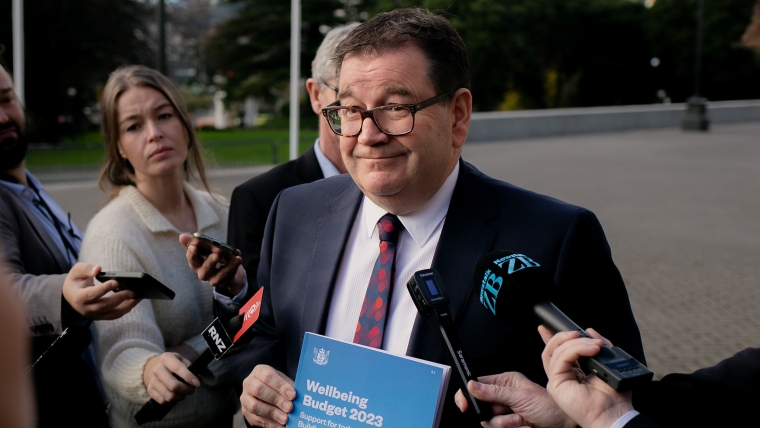
New Zealand’s crown deficit has grown to $6.5 billion in the eleven months ended in May, more than $2 billion worse than forecast in Budget 2023.
The shortfall was largely due to weaker tax revenue from corporate profits, which have been struggling against high interest rates.
Central banks around the world have been suppressing economic activity in an effort to tame stubborn inflation.
The IMF has forecast global economic growth to fall from 3.4% in 2022 to just 2.8% this year.
New Zealand’s economy is in a technical recession and business profitability has been falling as consumers have pulled back on spending in order to pay down debt.
Core Crown tax revenue was $103.3 billion, but $2.2 billion below forecast. Treasury said this was because of the lower corporate taxes and other individual tax revenue.
“Slightly offsetting these was source deduction revenue, which was $0.3 billion above forecast reflecting a stronger labour market compared to forecast,” it said.
This reflects what is happening in the New Zealand economy, with profits and economic growth slowing but employment remaining strong.
Core crown expenses were close to forecast at $115.1 billion but the missing tax revenue added $2.1 billion to the operating balance deficit of $6.5 billion.
Net debt was $5.1 billion higher than forecast at $73.3 billion, or 18.9% of gross domestic product (or 39.5% using the old core debt measure at $153 billion).
Finance Minister Grant Robertson said the cooling economy had resulted in a lower-than-forecast tax take but the deficit was still smaller than it was last year.
“The Government had already taken steps to respond to the uncertain economic environment by carefully and responsibly managing its spending,” he said in a statement.
Nicola Willis, the National Party’s finance spokesperson, said the Government had underestimated how much the economy had slowed and was blowing its budget.
“Government debt has soared by an additional $5 billion, and the books have been plunged even further into the red, with a deficit that is $2 billion larger than forecast,” she said.
David Seymour, leader of the Act Party, said it was reasonable to expect a full year deficit of over $9 billion, since Budget 2023 had forecast $7 billion.
“The main reason for the growing deficit is slowing company tax receipts. The economy is bad, and Robertson’s irresponsible policies are finally affecting his own books,” he said.
Robertson said the Labour government’s financial management had left enough space to meet the costs of extreme weather events.
Debt levels remain lower than in many comparable countries and below the self-imposed debt ceiling at 30% of GDP (or approximately 50% under the old core debt measure).
“We are striking a balance between supporting New Zealanders in the here and now and investing in strong public services and a resilient infrastructure network while carefully managing our resources to ensure the long term sustainability of the economy,” he said.
We welcome your comments below. If you are not already registered, please register to comment
Remember we welcome robust, respectful and insightful debate. We don't welcome abusive or defamatory comments and will de-register those repeatedly making such comments. Our current comment policy is here.