
National’s plan to cut income taxes will cost $14.6 billion over the next four years which will be funded through $8.4 billion in spending savings and $6.2 billion in new taxes.
The party has opted to proceed with this tax plan regardless of New Zealand’s fiscal position, meaning the $14 billion in revenue and savings will not be available to balance the budget.
Its flagship policy is an 11.5% adjustment to income tax brackets to partially offset the effects of inflation. Prices have risen 22% since National left office and 17% since 2020.
This would cost roughly $2.2 billion each year, adding up to just under $9 billion across four years.
National also committed to reviewing the brackets every three years and adjusted them again, if fiscal conditions allowed. This would first occur in 2026.
The next biggest tax cut would be reinstating interest deductibility for landlords, ramping up to an annual cost of $650 million or $2.1 billion across the first four years.
A $25 per week increase to Working for Families will deliver another $1.4 billion to some households in the first four years, with the annual cost rising to $455 million by 2026.
Another set of tax credits to reimburse childcare expenses, called Family Boost, would cost just under $1 billion or $250 million per year.
Spending cuts
To pay for these transfers, National would ask a selection of Government agencies to cut their collective budget by $594 million each year. That would add up to $2.3 billion.
The party would scrap a set of Labour initiatives, free childcare for two-year olds and discounted public transport, to save another $530 million each year.
And it would also order agencies to cut contractor spending by $400 million. That’s another $3.7 billion from those two cuts.
Finally, the plan would redeploy existing Government revenue by returning the proceeds of the Emissions Trading Scheme (ETS) into the central fund to help cover the tax cuts.
The ETS currently acts as a sort of carbon tax and the revenue it earns is set aside to be spent on helping businesses and households transition to low-emission technologies.
National said it would fund future climate initiatives out of annual operating allowances, and use the ETS money on tax cuts.
That’s estimated to bring in another $2.1 billion, although the carbon price is set by the market and can rise or fall due to demand.
The party leaders implied they would follow the Climate Change Commission’s advice and allow the carbon price to climb.
This could lift prices of things like petrol and food but would help New Zealand achieve its climate targets by incentivising businesses to cut or offset carbon emissions.
While this is a spending reprioritization, it involves using a higher carbon tax to fund lower income taxes. It’s hard to predict exactly how that would net out for individual households.
New taxes
The four new taxes are not imposed on households or income earners, and would bring in an estimated $6.2 billion over the next four years.
The largest is a tax on foreign home buyers. Non-residents would be permitted to purchase property valued at over $2 million thus overturning an existing ban, but would be hit with a 15% tax for the privilege.
It has been estimated to raise almost $3 billion over the next four years.
Second, National would scrap commercial building depreciation rules for a total of $525 million each year, or $2.1 billion. Labour plans to do the same to fund its GST-free policy.
Another $1.2 billion, over the forecast period, would be raised by taxing online gambling and charging a levy on immigration applications.
Castalia Advisors, a strategic consultancy firm, was hired to review the tax proposal and check the numbers all added up. It said the savings identified were “possible and plausible”.
Besides the main $14 billion tax switch, the party also pledged to scrap the Auckland Regional Fuel tax which funds transport projects in the region.
That money goes into Auckland Council’s coffers and doesn’t affect central Government revenue. But transport projects will still have to be funded, one way or another.
Heavy pocket of loose change
ACT Leader David Seymour said the tax policy was just “loose change” and not “real change."
“Keeping Labour’s $56 billion in extra spending and Labour’s tax system with minor adjustments for inflation is not the real change we need,” he said in a press release.
The extra spending Seymour references is a nominal figure, which is boosted by inflation and GDP growth.
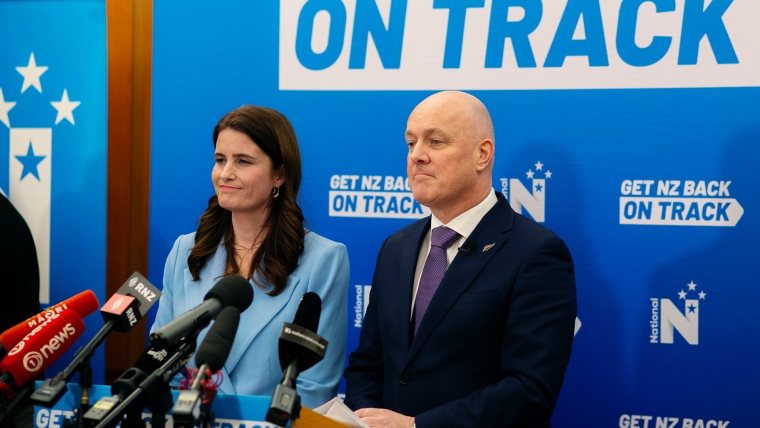
National leader Christopher Luxon said this was the best tax plan that would be on offer to voters this election.
“I’m not interested in what any other party has to say about our tax plan,” he told reporters.
“This is the tax plan we will take to the election and, importantly, we’re going to implement it on the other side”.
National’s finance spokesperson, Nicola Willis quipped: “I’d say to David Seymour, $50 a fortnight is a very heavy pocket of loose change”.
The plan aims to save an individual median wage worker $51 each fortnight, and the average household (with two-children) $102.
New Zealanders on higher incomes also get a tax break, but the cuts are largest for average workers and households. Low income households and workers get very little tax relief.
Fortnightly savings start at $4 and end at $40 per week for individuals across the pay scale, but it peaks at $51 for workers grouped around the median wage.
Two income households’ savings range from $9 to $80 with a peak of $102 around the average income. This will increase for households with children in 2026, when low income households will start with $134 savings.
No surplus in sight
Luxon said the party had chosen to “decouple” its tax cuts from its fiscal plan, so that the package could be delivered regardless of deficits or debt levels.
This is not entirely accurate, as the $14 billion in revenue and savings identified in the plan now cannot be used to balance the budget or pay down debt levels.
Willis said tax relief for middle income earners was more important than paying down debt, or ensuring the Crown accounts were in surplus.
“Actually, we have a cost-of-living crisis in people’s back pockets … that is the number one issue facing New Zealand workers,” she said.
We welcome your comments below. If you are not already registered, please register to comment
Remember we welcome robust, respectful and insightful debate. We don't welcome abusive or defamatory comments and will de-register those repeatedly making such comments. Our current comment policy is here.