
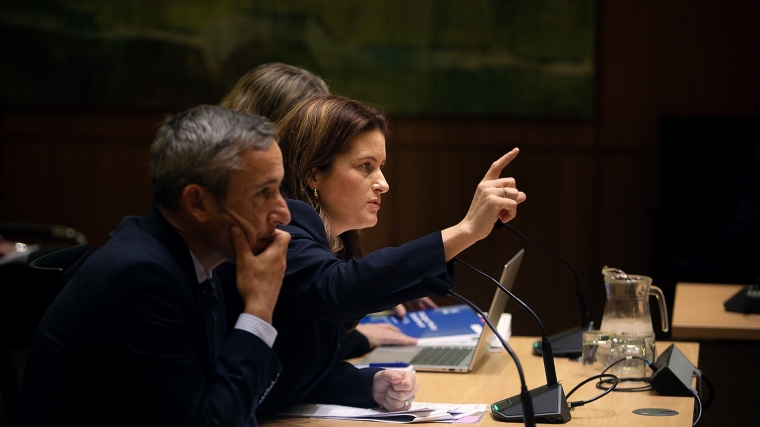
Finance Minister Nicola Willis told Parliament’s Finance and Expenditure Committee that Government borrowing would increase but not as a direct result of her government's tax cuts.
Willis appeared before the Committee on Thursday morning to answer questions about the Budget Policy Statement published late last month.
Opposition committee members, Barbara Edmonds and Chlöe Swarbrick both questioned the Minister over her seemingly contradictory views on debt and tax cuts.
Edmonds said Willis was on the record saying government debt was too high and unsustainable, but had also confirmed borrowing would increase in the future.
“Do you believe you wouldn’t need to borrow more if you didn’t have to pay for tax cuts,” Edmonds asked.
Willis said current debt levels were prudent in the sense they weren’t “putting New Zealand on an unstable footing”, but she still wanted debt to be on a downward trajectory.
“Yes, we will be borrowing but debt as a proportion of GDP will continue to decline,” she said.
Edmonds asked if commentators were correct that tax cuts would cost roughly $15 billion, but Willis wouldn’t answer directly.
She did admit the Government would be borrowing money, just not directly for tax cuts and not enough to increase the debt to GDP ratio.
This argument relies on the assumption that she wouldn’t have reduced public sector spending, or raised new revenue, if tax cuts weren’t on the table.
Swarbrick said since tax cuts reduced the revenue forecast to flow into the Government coffers, it could be argued that Willis was effectively borrowing to fund the tax cuts.
If the tax cuts were abandoned, the Government may be able to borrow less money.
Willis’ answer was that “there were trade-offs” being made and also that economic conditions would cause fluctuations in future revenue regardless of tax settings.
Swarbrick also asked why the Budget Policy Statement had not revealed the operating allowance for the upcoming budget, as most others had in recent years.
Willis said the allowance hadn’t been finalised because some policy choices hadn’t been made yet and some estimates for the costs of those policies hadn’t been finished.
These factors, and “fluctuating” economic forecasts, could affect the final size of the budget.
Neutral-ish
Speaking to reporters after the committee meeting, Willis said it would be unsustainable to remove income tax threshold adjustments from the wider package.
She said some commentators were asking her to do all the spending changes and all the new revenue measures, but then not return a “dividend” to taxpayers as promised.
“I just don’t think that is sustainable over the medium term, and I do not want to be a Finance Minister in a government that breaks that significant commitment to New Zealanders”
Tax threshold corrections were already long overdue, she said. The median full time salary earner was now paying over 20% of their income in tax, up from 15.5% in 2011.
Willis reaffirmed the full tax package would be fiscally neutral, meaning there would be no additional borrowing than would’ve happened without the full package.
“We will be spending less in this budget, in terms of the size of our operating allowance, than the last Government was planning,” she said.
Budget 2024 will be delivered on 30 May and will have an operating allowance of less than $3.5 billion.
We welcome your comments below. If you are not already registered, please register to comment
Remember we welcome robust, respectful and insightful debate. We don't welcome abusive or defamatory comments and will de-register those repeatedly making such comments. Our current comment policy is here.