
By Katharine Moody*
The Coalition government’s Fast Track Approvals Bill is proving highly controversial – so much so, I suspect the poor polling performance of the coalition parties, might have a bit to do with the widespread public distaste generated by this authoritarian-style, executive branch decision-making in environmental management.
At the same time as Chris Bishop is in damage-control regarding potential conflicts of interest, Shane Jones (another of the anointed ‘gang-of-three’ ministerial decision makers) is posing in the bucket of a behemoth bulldozer.
The Environment Select Committee has received more than 8000+ submissions on the Bill since closing date. Mine is displayed below;
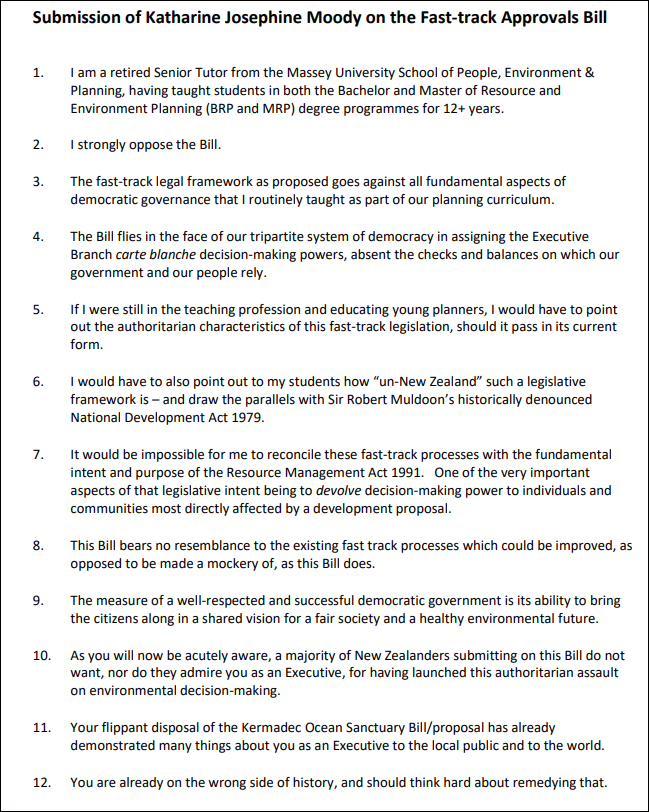
For those unfamiliar with the issue, there is already a fast-track consenting process defined by the previous government and administered by the Environmental Protection Authority. Therefore, it is difficult to see this undemocratic shift toward ministerial diktat as anything other than an executive power grab.
The kerfuffle arising from the Bill, reminds me of the last time a National Government tried to substantively reform the Resource Management Act (RMA), as a means to ‘tip’ the legislation in favour of development. That intention largely failed and the RMA’s Purpose clause remains (to this day) just as it was written back in 1991;
(1) The purpose of this Act is to promote the sustainable management of natural and physical resources.
(2) In this Act, sustainable management means managing the use, development, and protection of natural and physical resources in a way, or at a rate, which enables people and communities to provide for their social, economic, and cultural well-being and for their health and safety while—
(a) sustaining the potential of natural and physical resources (excluding minerals) to meet the reasonably foreseeable needs of future generations; and
(b) safeguarding the life-supporting capacity of air, water, soil, and ecosystems; and
(c) avoiding, remedying, or mitigating any adverse effects of activities on the environment.
I also recall at that time, the Parliamentary Commissioner of the Environment, Jan Wright being quoted widely from her media statement and submission on those proposed 2013 changes, that;
“The RMA itself provides the balance to the economic imperatives of the marketplace. It is not, and should not become, an economic development act.”
I agree with Wright that our planning legislation should not be an economic development act, but in my opinion, neither should it be an environmental protection act.
If we continue down the path of viewing environmental management through a simplistic ‘economy versus environment’ lens, then New Zealand will never prosper; its people will continue to argue; and its political leaders will repeal and replace planning legislation ad infinitum.
And with that, the basic tenets of - and belief in – democracy, will splinter ever wider. This ‘fast track’ Coalition Bill is testament to that.
As Jacques Derrida theorised, each binary oppositional privileges one side over the other, and to my mind, attempting to ‘strike a balance’ between the economy and the environment in environmental management decision-making, is a futile exercise.
Instead, as a means to avoid this ‘economy vs environment’ binary, triangulating considerations across a trio of agreed planning priorities is perhaps a direction that should be taken in reform.
Urban planning academic, Scott D. Campbell defines three fundamental “priorities” in planning practice (Equity, Economy and Environment) and their relational “conflicts” in the conceptual framework illustrated below:
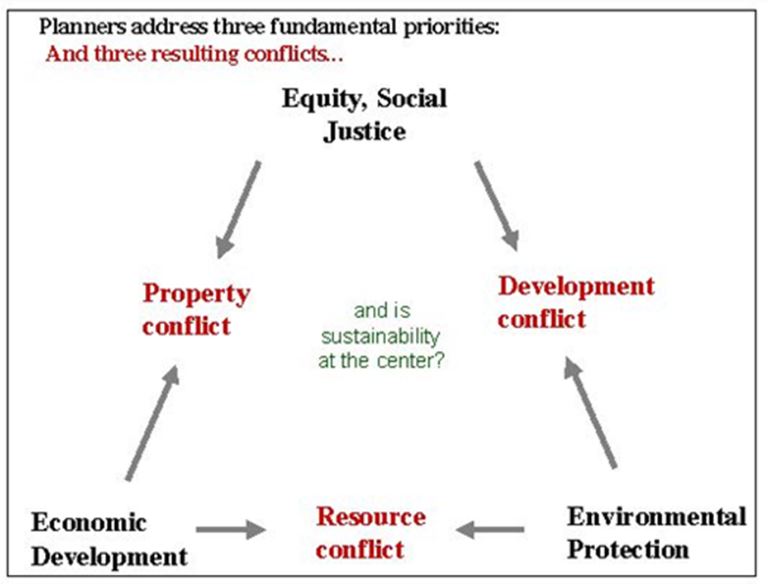
Campbell, S. (1996). Green Cities, Growing Cities, Just Cities? Urban Planning and the Contradictions of Sustainable Development, Journal of the American Planning Association (JAPA), Summer 1996.
He further elaborated on this framework in a 20-year review of it in theory and practice in an article titled, The Planner’s Triangle Revisited: Sustainability and the Evolution of a Planning Ideal That Can’t Sit Still (2016).
In looking at this framework, one can immediately identify the missing consideration in the ‘economy vs environment’ binary oppositional – that being equity/social justice, or as referred to in economic theory, human well-being.
A wise friend of mine in discussing an unrelated policy matter (that being, remittances as they relate to the New Zealand economy), reminded me that ‘the economy’ is an abstraction, and what counts (i.e., what I was missing in my analysis in that context) was people’s wellbeing as they perceive it for themselves – in other words, equity/social justice considerations for both the sender and the recipient in the remittance transaction.
Much of the complaints from the economics profession with the RMA’s Purpose was that it failed to prioritise individual/community preferences; many of which impact on private property rights. And it was this exchange that got me thinking of the concept of social justice in our national planning context.
In the Campbell framework, a short description of each of the “conflicts” arising between the three “priorities” are:
♦ Property conflict: The conflict between private interests and public good.
♦ Development conflict: The conflict between human prosperity and environmental protection.
♦ Resource conflict: The conflict between the economic and the ecologic utility of natural resources.
The framework, in theory, suggests that if we can identify and work through the matters arising toward the resolution of each of these three different conflicts on an individual basis, then the question on a specific resource consent, or the outcome of a deliberation on a particular environmental management policy issue, will provide a more sustainable direction in which to proceed (i.e., decide).
And so, as the Coalition must soon embark on something beyond this latest ‘authoritarian quick fix’ to the RMA, it might be worth considering the idea of ‘The Planner’s Triangle’ framework as an over-arching purpose for a replacement environmental management regime. That thought-exercise might kick off on a draft text for a new legislative Purpose clause by discussing something like this:
(1) The purpose of this Act is to address the resource management priorities associated with the economy, the environment and the wellbeing of communities, with the aim of achieving optimal sustainability, through individually identifying and addressing ̶
(a) The conflict between private interests and public good; and
(b) The conflict between human prosperity and environmental protection; and
(c) The conflict between the economic and the ecologic utility of natural resources
to achieve an overall broad judgment that is mindful of the wider interests of both current and future generations, taking into account the spatial aspect of resource management on local, regional, national and international scales, depending on the nature of the activity, policy or proposal under consideration.
As readers will recall, I was not a big fan of the previous government’s Natural and Built Environment Act (NBA), now repealed. In particular, I was concerned with the intention to move environmental decision-making away from individuals and their communities, in favour of a bureaucratically- appointed ‘elite’, referred to as “Regional Planning Committees”. And I had problems with the Act’s Purpose clause as well.
That said, the Coalition’s Fast Track Approvals Bill (2024) is a giant leap backwards – much, much worse than the decision-making by an ‘elite’ cohort as embedded in the NBA framework. The Fast Track Approvals Bill is a governance arrangement that is as bad as the partisan means by which US Supreme Court judges are picked – and one that is subject to much the same conflict of interest issues which lead to the bribery and corruption of individual decision-makers.
*Katharine Moody is a retired Senior Tutor from the Massey University School of People, Environment & Planning, having taught students in both the Bachelor and Master of Resource and Environment Planning (BRP and MRP) degree programmes for 12+ years.
We welcome your comments below. If you are not already registered, please register to comment
Remember we welcome robust, respectful and insightful debate. We don't welcome abusive or defamatory comments and will de-register those repeatedly making such comments. Our current comment policy is here.