
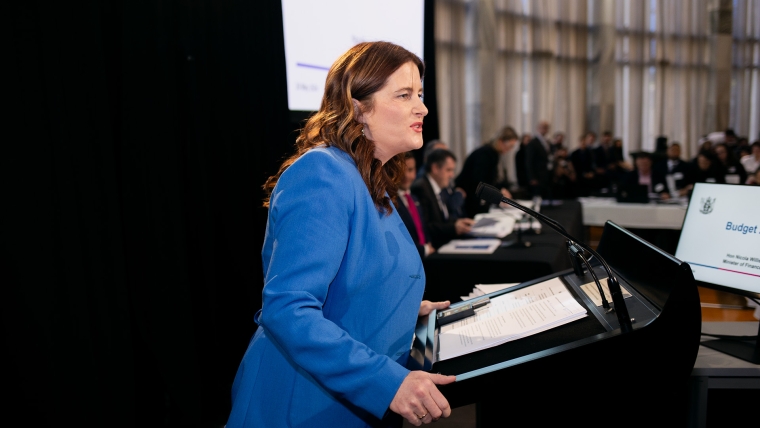
The Coalition Government says it cannot cut taxes again before the next election, as it needs future revenue to pay down public debt, projected to hit $100 billion this term.
It also won’t commit to indexing the new income tax brackets—which kick in today—to prevent inflation from pushing incomes into higher rates and effectively raising taxes.
Indexing tax brackets is popular with voters, according to a May poll, but politicians are reluctant to give up this tool, which makes it easier to raise taxes.
Finance Minister Nicola Willis said bracket creep was a flaw in the tax system, but the coalition couldn’t afford to index brackets or make other adjustments during this parliamentary term.
“We want to get the books back into surplus so we can pay down debt. That commitment means we're not in a position to commit to dealing with fiscal drag again this term,” she said.
New Zealand Debt Management (NZDM), a unit of Treasury, oversees government borrowing. NZDM issues debt via nominal bonds, inflation-indexed bonds, Treasury bills and Kiwi bonds. These interest paying securities are private sector investments, sold to investors including KiwiSaver fund managers, in NZ and overseas and are all denominated in the NZ dollar.
Willis has raised the income tax brackets and some tax credit thresholds by 11.5%, which will save the average household about $30 per week or $1,560 annually.
By coincidence, this adjustment perfectly corrects the tax brackets for the excess inflation that has occurred over the past three years.
The consumer price index has increased 17.6% since inflation broke above the Reserve Bank's 1% to 3% target range in the second quarter of 2021, while on-target inflation at 2% would have compounded to 6.2%.
If you deduct the normal amount of inflation from the total, you get 11.49%, which is exactly how much the tax brackets have been shifted upwards. Spooky, huh?
This means bracket creep has been tolerated at an annual rate of 2% for 14 years and may continue indefinitely.
Analysis by Infometrics showed tax revenue was roughly $4.6 billion higher in 2024, prior to the tax cuts, than it would have been if income brackets had been indexed to CPI since 2011.
Transparency needed
Terry Baucher, a tax consultant and commentator, said New Zealand had been much less transparent about bracket creep compared to many other countries, such as the United Kingdom.
New Zealand’s income tax brackets have only been adjusted five times since 1989, showing successive governments have knowingly relied on fiscal drag to bolster their revenues.
Brackets should be reviewed every three years, with a vote in Parliament to approve or reject an inflation adjustment for better transparency, he said.
James Ross, a policy and public affairs manager at the Taxpayers’ Union, said allowing fiscal drag was a “deliberate design choice” that hits people on low incomes the hardest.
“If politicians want a bit more spending money, they should find it by slashing waste. But for 14 years, their go-to has been punishing hard working Kiwis who are already doing it tough by slapping them with these tax hikes by stealth,” he said.
Despite this, New Zealand’s personal income tax rate remains very low by international standards. It was ranked as having the fourth smallest tax wedge out of 38 OECD countries in 2023, although this is partly offset by above-average taxes on goods and services.
Voters’ appetite for both relatively low taxes and high-quality public services could be one reason policymakers allow fiscal drag to continue.
Barbara Edmonds, the Labour Party’s finance spokesperson, said there was an obvious case for indexation if you looked at tax policy in isolation.
“[But] there's going to be a fiscal cost to indexing tax thresholds. Does that mean less money for health and education? There’s always a trade-off,” she said.
Deborah Russell, the party’s revenue spokesperson, said she doesn’t support indexation as it makes fiscal policy less flexible.
“What that does is constrain a Minister of Finance in their decision-making and imply that the current tax threshold levels are exactly perfect.”
“I think we need to leave the capacity for ministers of revenue and finance to adjust as needed, rather than being constrained,” she said.
We welcome your comments below. If you are not already registered, please register to comment
Remember we welcome robust, respectful and insightful debate. We don't welcome abusive or defamatory comments and will de-register those repeatedly making such comments. Our current comment policy is here.