
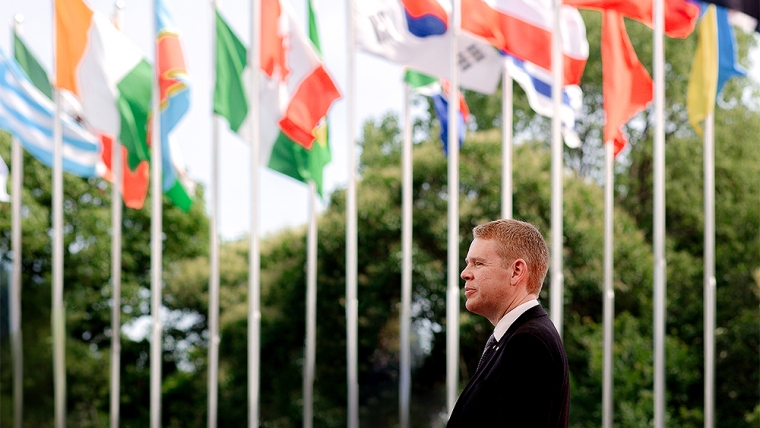
A Labour Government would not join military partnership AUKUS in any form, party leader Chris Hipkins has announced.
“Our country has a fiercely independent foreign policy, and a government I lead will not join pillars one or two of AUKUS,” he said in a speech at the party conference.
“We are proud to stand apart and lead the world being nuclear-free, that is not going to change now.”
AUKUS is a defence agreement, involving nuclear-powered submarines, between Australia, the United Kingdom, and the United States.
While New Zealand was not involved in that arrangement, it has been considering a wider defence project called AUKUS pillar II.
This would be a non-nuclear technology sharing and cooperation agreement, but it has not yet been fully formed.
Consideration of this side arrangement began under the Labour Government and was picked up by the Coalition.
Prime Minister Christopher Luxon has said he sees the AUKUS deal as positive for regional security, but has been non-committal on whether to join Pillar II.
However, his government is generally believed to be wanting to align itself more closely with the United States and sees merit in coordinating around AUKUS.
This approach has some fierce critics, including former Prime Minister Helen Clark.
Hipkins said in his speech Labour had become “deeply concerned” about the coalition moving too close to the US.
“…we spent six years in government diversifying New Zealand’s trade interests and staunchly defending our right to be independent.”
“New Zealand’s foreign policy will not be determined by Washington, Canberra or Beijing,” he said.
While he would want to have strong international relationships if re-elected in 2026, they could not be based on a “nuclear-adjacent platform”.
David Parker, the party’s foreign affairs spokesperson, echoed these comments in a press release.
“This does not mean we are non-aligned. We are a liberal western democracy and share those precious values with others”.
“New Zealand’s interests lie in trade, peace, and in on-going diplomacy, not in being a ‘force-multiplier’ for one super-power in a containment strategy directed against another”.
Taking this position will make the AUKUS decision more complicated for the Coalition, as governments generally seek bipartisan support for foreign and defence policies.
However, AUKUS Pillar II has not yet been developed and New Zealand has not even been formally invited to join it.
China, our largest trading partner, opposes AUKUS and will welcome Parker calling it a targeted containment strategy.
We welcome your comments below. If you are not already registered, please register to comment
Remember we welcome robust, respectful and insightful debate. We don't welcome abusive or defamatory comments and will de-register those repeatedly making such comments. Our current comment policy is here.