
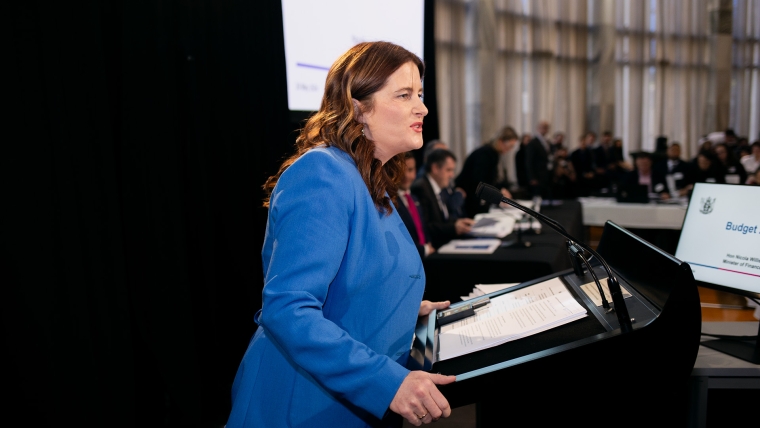
Twas the week before Christmas, when Treasury dropped the bomb: $20 billion of extra borrowing will be needed to plug Crown deficits over the next five years.
New Zealand’s recession had been deeper and the recovery would be later than expected seven months ago. Nominal gross domestic product (GDP) would be $19.8 billion less over the forecast period, contributing to a $13 billion reduction in core Crown tax revenue.
Less tax revenue and rising costs means deeper deficits, a total of $57 billion across the forecast, which will push net core Crown debt up to $234 billion or 45.2% of GDP in 2029.
Strict annual operating allowances of just $2.4 billion aren’t enough to get the Crown accounts back into surplus by the end of the decade, at least by the traditional measure.
Whatever Finance Minister Nicola Willis was wishing for this Christmas, it surely wasn’t this.
It must be said that some of this challenge was self-inflicted. The National Party campaigned on cutting taxes, despite knowing it would make their ‘fiscal repair job’ $14 billion harder.
Now, it looks increasingly like tax increases may be needed to put New Zealand back on a sustainable footing. That’s not something Willis was willing to entertain on Tuesday.
She said both tax increases and further spending cuts could threaten the economic growth which has been forecast to restart in the New Year, and neither should be pursued.
For all her tough talk, the Finance Minister is more of a fiscal dove than a hawk. Growing the economy is her number one priority and she’s willing to delay surpluses to support it.
This approach has critics on the right and the left of politics. David Seymour told Parliament he thought an extra $6 billion would have to be cut from coming budgets, while Labour said spending should be increased to stimulate growth.
The trouble is that much of the gunpowder in the fiscal cannon was fired during the pandemic and it needs to be reloaded. New Zealand does not have the luxury of infinite borrowing, and needs room on its balance sheet to finance infrastructure upgrades anyway.
Stephen Toplis, head of research at BNZ, said the HYEFU (Treasury's Half Year Economic and Fiscal Update) painted “a picture of a country that remains very much fiscally hamstrung” and could not rely on spending to drive growth.
“Achieving the targets that the government continues to pursue means there is still a long battle ahead and any thought that fiscal policy might be relaxed in the years ahead should be dismissed,” he wrote in a note.
Mark Smith, a senior economist at ASB, said the government needed to “pass the growth baton” to firms and households who had been reducing their debt levels in recent years.
The risk with that approach is that if the private sector doesn’t step up fast enough, the country could get stuck in an austerity doom loop. Deficit spending, on the other hand, kicks the can down the road in the hopes of finding a better moment to consolidate spending.
A possible third option would be to raise taxes. This would also come with a set of risks and trade-offs but is being discussed more frequently by economists.
Miles Workman, a senior economist at ANZ, said it was “hard to see [fiscal] challenges being overcome in an equitable way without bigger policy adjustments, such as broadening the tax base”.
And Nic Guesnon, an economist at UBS, even said wealth taxes could be an option given NZ’s wealth had become “increasingly skewed towards older demographics, which on average pay less tax but fiscally cost the government more”.
These aren’t really resounding endorsements but it’s notable that even non-political economists are weighing them up as serious options; the HYEFU forecasts really were that bad.
We welcome your comments below. If you are not already registered, please register to comment
Remember we welcome robust, respectful and insightful debate. We don't welcome abusive or defamatory comments and will de-register those repeatedly making such comments. Our current comment policy is here.