
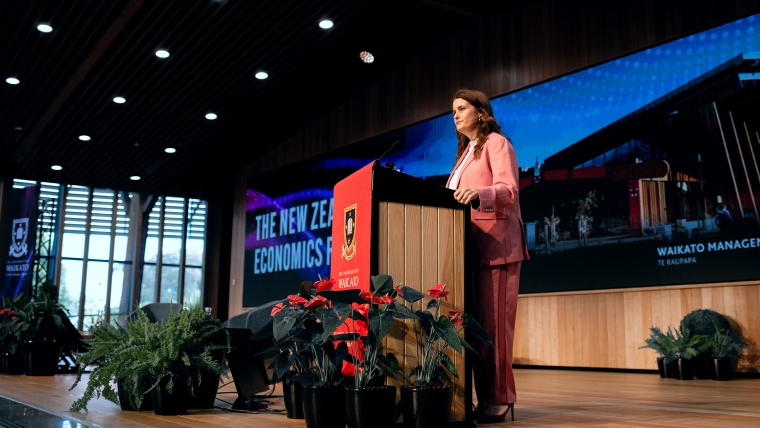
New Zealand’s businesses and policymakers have become paralyzed by a culture of risk-aversion which is stifling economic growth and creativity.
That was the key theme in many of the speeches at Waikato University’s annual economic forum, held in Hamilton last week. Again and again, speakers argued that New Zealand needs to take more risks.
Waikato has hosted the New Zealand Economics Forum for the past five years. It is a loosely conservative policy conference run by the university’s Management School.
Many of the panels were moderated by former National Party minister Steven Joyce, a strategic advisor and lobbyist for the university, while the guest of honor was former Australian Prime Minister Scott Morrison.
But it wasn’t just blue suits in the room. Former Green Party co-leader James Shaw also attended, along with former Labour ministers Andrew Little and Nanaia Mahuta (Ngāti Maniapoto).
Finance Minister Nicola Willis was the only sitting MP to attend, opening the conference with the release of an 80-point list of the coalition’s economic growth policies.
She told attendees that political leaders worldwide were being “compelled to act more boldly than they have for several decades.”
“From the United Kingdom, to the European Union, to China, to the United States, there is a growing realisation that growth must be fought for and that, even once achieved, can easily slide away,” she said.
Willis argued that Kiwi businesses had been too slow to invest in technology to boost productivity and promised to tear down any barriers to competition.
She made a direct appeal to international supermarket chains, which have so far seemed to conclude that entering the New Zealand market isn’t worth the trouble.
Potential entrants worry about securing resource consent, obtaining overseas investment approval, finding viable supermarket sites, and avoiding vexatious litigation.
"My whole objective is to reduce the risks they face. Because right now, if someone wants to enter our market, they look at it and they say, that's too risky,” Willis told reporters.
It is this risk-aversion that enables the supermarket duopoly to charge higher prices, resulting in an estimated $372 million of extra profits annually.
A similar story is unfolding in the banking sector, which reform activists described last week as having become “fat, dumb, and lazy” due to the lack of competition.
Quit your knitting
During an economist panel discussion, Infometrics chief executive Brad Olsen said businesses were overly incentivised to “stick to their knitting” and do nothing new.
This was partly due to the pandemic but was part of a long-term trend where businesses were more comfortable defending their patch, rather than expanding or innovating.
“You need to be making businesses almost fearful of standing still and doing nothing, because their competitors are going to come and bite them on the butt. That's where you start to get people to do things, start to take some risks,” he said.
“Risk is not a bad thing. It's just a tolerance level, and I feel like the tolerance level is too low”.
Kent Duston, an economic consultant and convenor of The Banking Reform Coalition, said ANZ had invested so little in its core technology systems that they had depreciated to zero—meaning the bank regarded its own system as completely worthless.
That’s not the behaviour of a business which worries a competitor might be about to bite a chunk out of its $2 billion butt.
Another example of risk aversion came from the artificial intelligence (AI) panel, where New Zealand’s fall from 9th to 40th in global AI adoption rankings was cited as a sign of the country’s willingness to watch from the sidelines.
Joyce—who once held the economic development and finance portfolios—said the Reserve Bank’s capital adequacy requirements were another symptom of New Zealand’s risk-averse culture.
“Most of the world's happy with a 1-in-100 years risk, and that's what the central banks have put in place in terms of capital requirements for banks to hold. In New Zealand, the Reserve Bank has gone for 1-in-200 years,” he said.
“We can debate whether there are too many banks or not enough banks. But what is clear, is that these prudential requirements probably means [the system] is biased against businesses starting up in this country”.
Olsen questioned whether the Reserve Bank needed full independence on regulatory issues, as it does with monetary policy, or if the government should set risk tolerances directly.
That’s a question you’re likely to hear again, as a growing consensus supports relaxing capital requirements—but the risk-averse RBNZ won’t be keen to follow suit.
Risk obsessed
Brian Roche, the new Public Service Commissioner, said this type of unwillingness had taken over the public sector, which had become obsessed with minimizing risk.
“The historic mythology of ‘gliding on’ is a mythology. People work hard and they're doing their best … but I'm also struck by the fact that a lot of things happen despite the system, not because people are enabled by it,” he said.
Accepting “suboptimal” systems was disempowering, and passivity was a learned behavior that needed to be unlearned. Roche said he wanted simpler processes, empowered frontline staff, and more responsive, innovative agencies.
"Risk has become an overly dominant feature of discussion," he said. "If we focused on creating value as much as we manage risk, what would that look like? What impact would it have on our productivity?"
Roche said risk was an unavoidable fact of life, and the public service’s obsession with eliminating it has led to "too many layers of management and meetings that can stifle and even kill action in progress."
"As we well know, the risk of doing nothing is often greater than the risk of action, so we need to move from avoiding risk to proactively managing it”.
Roche wants public servants to feel empowered to challenge the status quo, be curious, try new approaches, and experiment—without fear of public ridicule for making mistakes.
200-years of caution
Ian Rennie, who has been put in charge of the Treasury, made similar comments about wanting a culture of curiosity, dynamism, and a willingness to tackle complex challenges—rather than being overly cautious or incremental.
"When I came into the public sector, it was, in some ways, a very crazy time; policy reform on steroids. All kinds of great stuff was done, but also some weak stuff as well," he said, during a question-and-answer session.
“Now I work with colleagues who are as bright, or brighter, than my generation, but they’ve come into a world where thinking about change takes more time and is more incremental,” he said.
Rennie said the Treasury had been operating as an agency since 1840 and would soon start its third century. However, his speech outlining his vision for that century was fairly vanilla.
A former cabinet minister leaned over to me afterward and said, "That sounded like a speech any Treasury Secretary since 1840 could have given."
Robert MacCulloch, professor of macroeconomics at Auckland University, was highly critical of these speakers, whom he saw as the architects of the very stagnation they condemned.
“Waikato's speakers are not symbols of the types of people required to take NZ forward — who are genuinely interested in unconstrained thinking… [Willis] cannot pretend she wants change when not a single one of her appointments intends to disrupt the old order,” he wrote in a scathing blog post.
MacCulloch is right that these people are not innovative risk-takers; they are career bureaucrats adjusting to the latest political winds. But that doesn’t mean they’re incapable of getting the job done.
The talk-fest that is the Waikato Economics Forum may have diagnosed the problem—not enough risks—but now we need its attendees and speakers to get out there and take some.
We welcome your comments below. If you are not already registered, please register to comment
Remember we welcome robust, respectful and insightful debate. We don't welcome abusive or defamatory comments and will de-register those repeatedly making such comments. Our current comment policy is here.