
By Chris Trotter*
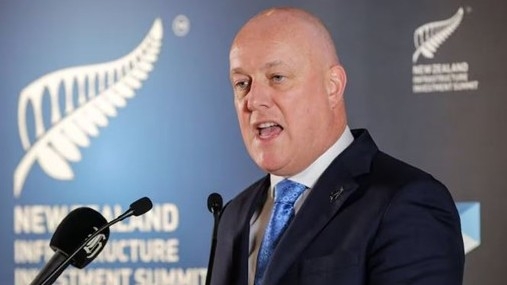
Having wooed the world's investors, what, if anything, has New Zealand won? Did Christopher Luxon’s guests board their private jets fizzing with enthusiasm for a little country palpably eager to embark on a new national adventure? Or, did they depart in a more sombre mood, disappointed by New Zealanders’ lack of spirit? Will institutions with billions of dollars at their disposal invest them in a country so obviously in a deep funk?
Or will they, like Michael Corleone in Godfather Part II, take note of more than the sales pitch of the gangster asking him to invest in the Mob’s Cuban casinos in 1959?
MICHAEL CORLEONE: I saw a strange thing today. Some rebels were being arrested. One of them pulled the pin on a grenade. He took himself and the captain of the command with him. Now, soldiers are paid to fight; the rebels aren’t.
HYMAN ROTH: What does that tell you?
MICHAEL CORLEONE: They could win.
It’s a safe bet that the real global investment community pays at least as much attention to what’s happening inside the countries asking for their money as the fictional Michael Corleone. After all, they pay a great deal of money to secure the most accurate and up-to-date information about their hosts. Not just the raw economic data, but information concerning the general disposition of the nation. Not only about the mood of the men and women seated around the boardroom table, but also about the mood of the men and women thronging the streets below.
Interviewed on Radio New Zealand, Tainui strongman, Tukoroirangi Morgan, boasted that he had told the global investors not to waste their time talking to the Crown, but to approach directly the iwi engaged in growing the Māori economy.
Though he gave it his best shot, Christopher Luxon’s pitch to the assembled global investors is unlikely to have resonated as loudly as Morgan’s. New Zealand’s prime minister, as they would have been well aware, leads a state whose outgoings far exceed its incomings, and a beleaguered government desperate for economic growth. All the corporate jargon in the world cannot disguise the brute fact of Luxon’s political need.
By contrast, Morgan and the many other iwi leaders presiding over the burgeoning Māori economy, would likely have struck Luxon’s guests as loud, proud, and hungry for the capital needed to keep their tribal enterprises growing. Māori businesspeople are not begging to be bailed out, they are asking to be built up. Because, as they were no doubt quick to remind these trillion-dollar tauiwi, the only place tangata whenua can succeed is right here. They have to win.
Were Luxon’s guests able to travel back in time 150 years they would have encountered Pakeha with almost as much skin in the burgeoning enterprise of “New Zealand” as the Māori of today.
These were immigrants who had travelled 16,000 miles, leaving behind everyone and everything they had known, and betting all they had on their ability to wrest a future from these distant islands. And what would have impressed today’s big investors – just as it did the big, mostly British, investors of the Nineteenth century – was how much these settlers were willing to wager on the proposition that New Zealand had a future, and how confident they were of winning the bet.
That confidence was crucial to securing the capital investment necessary to make a nation. Fortunately for the colonisers of New Zealand, the Nineteenth Century was awash with confidence.
In his book “Replenishing the Earth: The Settler Revolution and the Rise of the Anglo-World, 1783-1939” (Oxford, 2009) the New Zealand historian James Belich examines the extraordinary racial confidence that fuelled and underpinned the breakneck economic development, demographic conquest, and cultural domination of North America and Australasia:
“Though somewhat unmilitary, they were dangerous people, especially when in full-frothing boom frenzy. When they had the help of their trusty oldlands, as well as massive boom time numbers and the fanatical ideology of the colonising crusade, hardly anything could stop them. They destroyed, crippled, swamped, or marginalised most of the numerous societies they encountered. They also built new societies faster than anyone had ever done before.”
Certainly, it is hard to argue with that final sentence. In the century that followed the signing of the Treaty of Waitangi in 1840, the Pakeha population of New Zealand exploded from around 2,000 to nearly 2,000,000. The four main centres grew from a few hastily erected wooden structures to substantial cities of stone and brick. Railways and roads linked rural villages and provincial towns to the major ports. Industries grew and flourished.
The cultures and politics of Belich’s “Anglo-World” were shaped by what he identifies as the boom-bust-recolonisation phases that created and then consolidated it.
In this regard, the history of New Zealand conforms very neatly to Belich’s template. First came the great investor-fuelled rush for land and resources; drawing in tens-of-thousands of immigrants and driving off the Māori tribes. This initial speculative and extractive economic boom was succeeded by a period of contraction and retrenchment – the “bust” – which was followed by a second, much less anarchic, surge of immigration and investment – both prompted by the nation-defining technological innovation of refrigeration.
The question to be decided by Luxon’s guests is whether or not Belich’s three phases are still driving the economic and social history of New Zealand, and, if they are, which phase is the country going through in 2025 – boom, bust, or recolonisation?
It is difficult to sustain the argument that New Zealand is in the middle of a boom. In terms of metrics and mood the nation would appear to be situated squarely in the middle of a bust. Equally difficult to sustain is the argument that New Zealand is now, or ever likely to be again, driven by the “fanatical ideology of the colonising crusade” which underpinned its first 100 years. Booms seldom follow the mass emigration of the dominant culture’s best and brightest. Nor are the chances high that Mother England, or even Uncle Sam, will come to the rescue of the Anglo-World’s most remote outpost. Only in te Ao Māori is the cultural confidence of which booms are made on display.
What does that tell us? What should it tell the world’s big investors? Possibly, that the best returns are likely to come from backing the most daring and innovative sectors of the fast-growing Māori economy.
They could win.
*Chris Trotter has been writing and commenting professionally about New Zealand politics for more than 30 years. He writes a weekly column for interest.co.nz. His work may also be found at http://bowalleyroad.blogspot.com.
We welcome your comments below. If you are not already registered, please register to comment
Remember we welcome robust, respectful and insightful debate. We don't welcome abusive or defamatory comments and will de-register those repeatedly making such comments. Our current comment policy is here.