
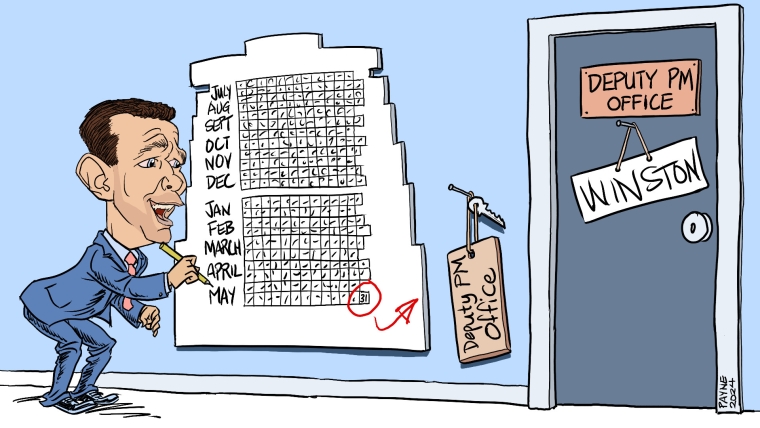
The countdown is over: ACT Party leader David Seymour was sworn in as Deputy Prime Minister at midday on Saturday.
It’s a striking achievement for the 41-year-old career politician, who almost singlehandedly kept the party alive after its disastrous 2011 election result.
John Banks, the sole surviving MP and leader by default, declared the ACT brand was past its “use-by date” and stepped down before the 2014 election.
Seymour was nominated for the Epsom electorate—having previously contested Mt Albert and Auckland Central—where National encourages its supporters to vote strategically for the ACT candidate.
He won the seat and became leader. But with the party brand tarnished, ACT failed to win enough party votes to bring in any other candidates in the next two elections.
Seymour was alone but made a name for himself through junior roles in John Key’s government, a stint twerking on Dancing with the Stars, and by successfully championing assisted dying reform.
He also borrowed blue and pink accents from Germany’s Free Democratic Party to soften ACT’s garish libertarian-yellow colour scheme. The brand was revived just in time for revival.
Jacinda Ardern’s Labour Party crushed National in the 2020 election, after leading a highly successful initial response to the Covid pandemic. But what looked like decisive leadership to some seemed like authoritarian overreach to others.
That perception merged with concerns about free speech, firearm laws, farm regulations, cogovernance, and a view among some that Ardern was a condescending lightweight. It also helped that National was being punished for a string of poor leadership choices.
ACT won ten seats in 2020, giving Seymour his first caucus to lead and, three years later, a role in forming a Government with Christopher Luxon after Labour’s defeat.
He now steps into the second-most senior job… on paper at least.
In practice, the Deputy Prime Minister is largely a symbolic role. The only formal duty is to take on the Prime Minister’s routine tasks when they are overseas.
Political tragics know the real second-most senior job is Finance Minister—which is why Luxon gave up the DPM role in negotiations but held tight to the purse strings.
During the election campaign, Seymour repeatedly said he wanted “policy wins”, not the “baubles of office”. But in coalition talks, he changed his tune—perhaps helped by the $42,000 pay rise, which will lift his salary to $362,600.
The DPM role was a sticking point in negotiations and was reluctantly split with Winston Peters. Seymour’s email signature includes “Deputy Prime Minister from 31 May” alongside his other portfolios.
With National’s Nicola Willis in charge of the Treasury and New Zealand First’s Winston Peters seated at the Prime Minister’s right hand, Seymour has had to puff his chest to show he’s not the junior partner.
He holds none of the top portfolios, leads the fourth-largest party in Parliament, and has the same number of Cabinet votes as NZ First. Still, he has carried himself as if he were the Prime Minister’s equal.
He has repeatedly undermined Luxon and often criticises Government decisions—despite signing off on them at Cabinet. He then contradicts himself by boasting of ACT’s outsized influence in Government, having secured just 8.6% of the vote.
National ministers and staffers sometimes grumble in Parliament’s hallways that ACT MPs are harder to work with than those from NZ First. They are zealous and expect to be consulted on everything—not just matters tied to their portfolios or election promises.
Despite the occasional complaint, National would still prefer a two-party coalition with ACT after the next election. That preference could cause trouble as the day approaches.
NZ First began planning for a snap election in March, according to Politik, as Winston Peters worried the coalition might collapse after the DPM handover. Which does sound a bit like lighting a cigarette at a petrol station, then warning the place might blow.
Peters plans to use the second half of the term to start campaigning for the 2026 election, with more spare time and fewer constraints on what he can say. Meanwhile, Seymour hopes to use the high-profile role to reinforce that ACT is a serious party of government, not just a fringe group of activists.
Both see a benefit in the timing of the handover. Peters and NZ First can differentiate themselves, while Seymour can demonstrate what a National–ACT coalition might look like.
They just have to survive another 18 months without blowing it all up.
We welcome your comments below. If you are not already registered, please register to comment
Remember we welcome robust, respectful and insightful debate. We don't welcome abusive or defamatory comments and will de-register those repeatedly making such comments. Our current comment policy is here.