
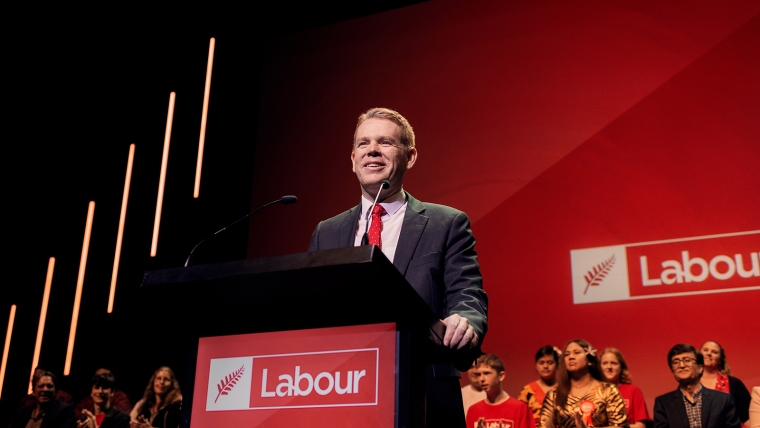
The Labour Party will be offering local doctors low-interest loans so they can set up new practices or buy into existing ones.
Called the Family Doctor Loan Scheme, the policy was launched at the party’s conference in Auckland on Sunday, with Labour leader Chris Hipkins saying this is a practical, targeted way to boost locally-owned clinics across New Zealand and strengthen the ones we already have.
In a document about this policy, Labour says this is a way to secure the future of New Zealand’s family general practitioner doctors (GPs).
GPs have been in the spotlight for a long time and New Zealand has even been reported as having "a GP crisis."
GP clinics have also been struggling financially with General Practice New Zealand chairman Bryan Betty telling RNZ in 2024 that this was due to rising costs and a failed funding formula.
Staff shortages were also a problem, Betty told RNZ, which meant clinics could not take on new patients and this could put additional pressure on emergency departments and hospitals.
So how will Labour’s policy work?
In a document about this policy, Labour says doctors will be able to apply for loans of up to 90% of the cost of buying a practice and this would be capped at $500,000.
Up to 50 loans would be available each year and would only be for owner-operated general practices.
“Corporate-owned practices are excluded to ensure we’re backing locally run GP clinics that stay closely connected to their communities,” the policy document says.
The loans would be targeted to communities with no GP clinic or where GP books are partially or fully closed.
The loan would be interest-free for the first two years and after two years, monthly repayments would begin on the outstanding balance - from then, an annual interest rate of 3% will apply.
Doctors would have 10 years in total to repay the loan. Each doctor can get only one loan under this scheme.
The loans would be available from July 1, 2027, through the Small Business Cashflow Loan Scheme.
The Small Business Cashflow Loan scheme was first launched in May 2020 to help out businesses affected during the pandemic. Up to $100,000 was potentially available via unsecured loans for businesses with 50 or fewer full-time staff.
The loans were interest free if repaid within a year. Thereafter an interest rate of 3% has been charged for a maximum term of five years, with repayments not required for the first two years.
Kick start
“The number of doctor-owned practices is falling, as is the number of doctors who work in doctor-owned practices,” Hipkins says.
“It’s expensive to start a new practice or buy into an existing one, so our low-interest loans will give doctors the kick start they need to get established."
“Two-thirds of practice owners and partners are intending to retire in the next 10 years, so it’s vital we can support the next generation to keep the doors and books open,” he says.
In its policy document, Labour says doctors have told them owning a practice is not always a sustainable option, especially for younger GPs who still have student loans and may be starting families or trying to buy their first home.
“Providing low-interest loans will back those doctors who want to spend their careers caring for their local communities,” Labour says in the document.
“The loans will help young doctors plan a future for themselves here in New Zealand, create local jobs for nurses and healthcare workers, and support more owner-operated practices that are connected to the communities they serve.”
An example Labour used in its document was someone called Katherine wanting to buy a house and be closer to their family in Cambridge.
"A local doctor in Cambridge is retiring and wants to sell his practice in 2029 ... Katherine would need to borrow $400,000 to buy into the practice and could be paying back upwards of $5000 a month if borrowing through a bank."
"She is reluctant to take on this loan, as she plans to buy her first home in Cambridge when she moves back, with a mortgage of $500,000 with monthly repayments of $2500."
The document goes on to say that with Labour's Family Doctor Loan Scheme, Katherine would be able to borrow $400,000 to buy into the practice.
"If the loan is approved, she would have no repayments and interest until 2031, and then until 2039 to pay off the loan.
"This reduces the risk for Katherine and she's able to spend the first two years focusing on patients and ensuring the clinic runs smoothly, rather than worrying about monthly repayments."
Independent Pricing Authority
Alongside this, Labour says it will “fix GP funding” by introducing independent pricing - “a fair, transparent funding system where an Independent Pricing Authority sets a national GP funding rate based on real costs and patient need.”
“When that rate goes up, Health NZ will fund the increase, instead of leaving practices or patients to carry the cost,” the party says in the document.
“Money that currently comes from patient co-payments will go into general practice funding, so clinics aren’t worse off. This reform will keep care affordable, back local doctors, and shift our health system towards prevention - keeping people well, not just treating them when they’re sick.”
Capital gains tax policy
This announcement comes after the Labour caucus agreed to campaign on a 28% capital gains tax policy on residential and commercial property.
This would be used to fund three visits to a general practitioner doctor for each New Zealander each year.
The capital gains tax excludes family homes, farms, KiwiSaver, business assets, inheritance, and other valuables. The capital gains tax is only on investment or second properties.
It would appear to capture a holiday or second home, even if that property was not held specifically for investment purposes. While the tax excludes “business assets” it appears to include any commercial property they may own.
Labour says the tax rate would be 28% to align with the corporate rate, so that property transactions are taxed like other business activities. It would apply at the sale of an asset and be charged on any gains after July 2027.
An example used by Labour is: two business partners who own 50% of an investment property which is sold with a net gain of $100,000 - each partner would pay 28% on their $50,000 share.
There's detailed information on the Labour policies here and here.
In its document on the proposed tax change, Labour - using a forecast revenue based on a model developed by the 2019 Taxing Working Group with an updated asset base and assumptions - says 2027/2028 would have a forecasted revenue of $100 million.
This is forecasted to rise to $385 million in 2028/2029, $965 million in 2029/2030 and $1.35 billion in 2030 and outyears. It would have an average of $700 million a year across the forecast period.
Every dollar raised by the new tax would be redirected into the healthcare system - including funding three free GP visits through “Medicard” - a physical card and digital system which would be used to track entitlements to subsidised care.
We welcome your comments below. If you are not already registered, please register to comment
Remember we welcome robust, respectful and insightful debate. We don't welcome abusive or defamatory comments and will de-register those repeatedly making such comments. Our current comment policy is here.