
By Dan Brunskill and Mandy Te
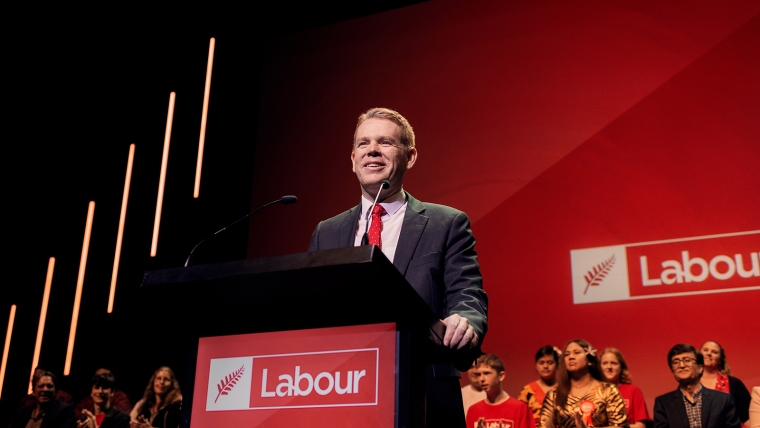
In what Labour leader Chris Hipkins thinks would be “the most progressive change to New Zealand's tax system in a generation” - the Labour Party caucus has agreed to campaign on a 28% capital gains tax on residential and commercial property.
This would be used to fund three visits to a general practitioner doctor for each New Zealander each year.
At a media conference on Tuesday following the party's abrupt release of the policy, Labour leader Chris Hipkins said Labour wants to be able to “fix the issues we’re facing with our health system and we need more money to be able to do that”.
“But we also want to send a very clear message that we want to encourage investment in the productive economy.
"We’re not going to get rich as a country by continually buying and selling houses from one another,” Hipkins says.
“We need to make sure that we’re investing in businesses that create jobs, that create opportunities for New Zealanders.”
What is Labour's capital gains tax policy?
The capital gains tax excludes family homes, farms, KiwiSaver, business assets, inheritance, and other valuables. The capital gains tax is only on investment or second properties.
It would appear to capture a holiday or second home, even if that property was not held specifically for investment purposes. While the tax excludes “business assets” it appears to include any commercial property they may own.
Labour says the tax rate would be 28% to align with the corporate rate, so that property transactions are taxed like other business activities. It would apply at the sale of an asset and be charged on any gains after July 2027.
An example used by Labour is: two business partners who own 50% of an investment property which is sold with a net gain of $100,000 - each partner would pay 28% on their $50,000 share.
There's detailed information on the Labour policies here and here.
In its document on the proposed tax change, Labour - using a forecast revenue based on a model developed by the 2019 Taxing Working Group with an updated asset base and assumptions - says 2027/2028 would have a forecasted revenue of $100 million.
This is forecasted to rise to $385 million in 2028/2029, $965 million in 2029/2030 and $1.35 billion in 2030 and outyears. It would have an average of $700 million a year across the forecast period.
Every dollar raised by the new tax would be redirected into the healthcare system - including funding three free GP visits through “Medicard” - a physical card and digital system which would be used to track entitlements to subsidised care.
Hipkins says Labour opted for a capital gains tax because it’s a simple change and brings New Zealand in line with many other countries who already have a capital gains tax.
“My message to New Zealanders is very clear: if you don’t own a rental property, you don’t own something other than your family home, you don’t own commercial property - you won’t pay a capital gains tax. That’s 90% of New Zealanders.”
“It is time for New Zealand to take that step and I’m very proud to be campaigning on it," Hipkins says.
When asked about a wealth tax (which is supported by Greens and Te Pāti Māori), Hipkins says this would be the policy Labour campaigns on and the one they would be implementing should Labour form the next Government.
“This is not our fiscal plan, it’s not our alternative budget.”
Hipkins made clear it was the party’s policy on capital gains taxation and its policy on free doctors’ visits.
He says there will be more policies to come from Labour and a fiscal plan showing how the party would pay for everything it is committing to.
‘Always debate around tax’
When asked about how much disappointment he thought there may be on the left about how far Labour has gone with the policy, Hipkins says: “In political circles, there’s always debate around tax and there are always going to be a wide range of views on that.”
“We’re putting forward a tax proposal that we think is fair. It’s reasonable, it’s measured, it’s targeted - and it helps us to fix a problem.”
National Party spokesperson for finance Nicola Willis was quick to slam the policy, saying that "Labour’s tax grab" would put New Zealand's economic recovery at risk.
"It's a tax on savings, investment and growth. The complete opposite of what our economy needs right now."
Green Party co-leader and finance spokesperson Chlöe Swarbrick called Labour's capital gains tax policy "watered down", saying it falls short of meeting the needs of New Zealanders.
135 Comments
My GP has a long wait list. Like, months.
How are they going to go when everyone has free visits to use up?
Dont folks who need support get a community services card?
The reasoning is less credible than drugs trade retaliation for trade tariffs.
Nimbys will be happy. A lot less building in Auckland now.
Agree, the last thing the health system needs is more demand. At least they limited to three.
Seems like they are moving more towards the working class voters. As you say the poor already get it free don’t they.
Healthcare is a tricky one. We are getting all the issues that you’d normally see with a subsidised system. People don’t give a crap about their health as Nanny will fix them up for free. That’s leading to excess demand. Whenever I go to my local medical centre I’m often the only person there that’s not obese. But no worries, Nanny will give you a free insulin shot.
But on the flip side, the American system is definitely no better.
I personally think somewhere in between might be better. A subsidised system that isn’t completely free so the user has a reason to keep themselves healthy. Obviously this policy is going the opposite way.
Perhaps we need a complete revisit on how we look at health? Instead of thinking its a funding issue vs demand issue?
I recently finished reading 'Good Energy' by Dr Casey Means - would definitely recommend. Basically our western diet and lifestyle is the primary reason why our medical system is overloaded. Perhaps we don't need more doctors and medical funding, but we need to live healthier lifestyles (no or little processed food, get more exercise in and prioritise good sleep). The typical western person is sick (at a cellular level) because of the way they are living and the Dr with medication is literally the ambulance at the end of the cliff. If we sort out our habits we could halve the demand on the health system (less metabolic disease that is highly correlated to nearly everything else which subsequently happens and puts high demands on the health system such as cancers, heart issues, high cholesterol, high blood pressure, insulin resistence, chronic fatigue, depression, anxiety etc). So I personally don't think we need more doctors or more funding. 30% of Kiwis are classified as obese....what are we doing about that? How do we fix that? Why don't we get to the root cause of the problem - why are so many people unhealthy in 2025 and need to go to the dr so much?
The current westerner views the world like this: "I'm going to live a bad lifestyle and accept that I am going to get sick in (5-50 years time) as a result and them I'm going to complain that the medical system is overloaded (because nearly everyone else has been living the same way) and is unable to give me effective treatment immediately when I demand it".
If you think about it long enough it is a deranged way to live and view the world. Perhaps we should give tax breaks to people who effectively manage their cholesterol, blood pressure and fasting glucose through diet and lifestyle given that the evidence show they will be less of a burden on the medical system and (over a society wide sample) need less future funding to treat? But this would be viewed as evil even though it gives incentive for people to live healthy lives.
But for now there are no incentives to live a healthy lifestyle but we will openly whinge and complain when we get sick after eating poorly, not exercising enough etc and don't get immediate treatment when we want it at a future point in time.
Taxing the stable door
After the horse has long bolted
and the barn just blew down.
The distance between Overton Window and reality is widening by the day.
I get the feeling the horse will make another run. Maybe Labour will be too late though.
You don't have to look too far to the west to see how that can be
Self sabotage?
One would almost think that Labours ineptitude around designing /promoting a CGT is deliberate.
They are very clunky aren’t they. Arrived in 2017 with very little planning of substance and futile policy such as Kiwibuild. Then it became a staggering of announcements about announcements and on the hoof such as the cycle bridge gushed out, that even the cyclists could see was not viable. Here there it seems to be that the exemptions outweigh the inclusions. Would think just taking the bright line back out to 10.years would be a simpler effort for much the same result.
The only region where there have been capital gains in NZ over the past 5 years has been Queenstown. We have the ludicrous situation where the many Australian investors there do not pay capital gains tax here on those gains but are obliged to do so in Australia. So, while it will negatively impact me, I'm happy to pay it if it stops the ridiculous situation where foreign governments are raising tax on our property capital gains.
As a matter of interest what happens as far as CGT when a NZ based owner sells a property in Australia? Assumedly the Australian government collects one?
Tax residency is not necessarily domicile
https://www.ird.govt.nz/international-tax/individuals/tax-residency-sta…
https://www.ato.gov.au/individuals-and-families/coming-to-australia-or-…
It depends on the situation. If the Kiwi was living in the house in Australia, then they will receive the primary residence exemption so no CGT. If it was a second house, or they were living in NZ, they will be subject to capital gains tax on the sale. There is a 50% discount on CGT if it is held for >1 year.
Worth noting now that a number of Australian States (note States and not the Federal Govt), now classify Kiwi's as foreign owners and apply 8% annual tax on land value. They only way around this is to reside in Australia for >200 days in a tax year.
So, there will be no longer be any Kiwi's living in NZ with second houses in Sydney. Zero.
Update, both NSW and Queensland view NZ based Kiwi's as foreign owners and apply surcharges. The Surcharge in Queensland is 3% and NSW is 5% (these are added to the local land tax and thresholds removed, so very punitive)
Make no mistake. This CGT is yet another attack on future retirees by successive governments. Whether its our poverty level universal super or our draconian outlier TTE super savings structure (look up TTE), then attack on citizens' ability to save enough for a comfortable retirement is relentless. Shame politicians don't subject themselves to the same super savings structure the rest of us have to endure. Everyone beware, no-one escapes this CGT - we all own 'commercial or residential '2nd' properties through our Kiwisaver or our businesses or farms. All will be caught and taxed. See... https://www.taxpayers.org.nz/labours_bach_tax
Nah
1./ If we cannot afford the universal super due to it;s reliance on endless growth and population increases, which are going backwards, then needs must for change to allow a minimum standard of living for future retirees, lest we resort to the top 10% having everything and the rest in poverty
2./ If retirement relies on capital gains, endless increase in the price of shelter at the expense of the youth having any change of homeownership, and the ability for govt to fund reasonable healthcare, then it is a flawed system and needs addressing to disincentivise housing speculation and accumulation of assets in the tier of society
It must be hard to accept for some that we have to allow the youth a change and put the ladder back down for them, after having had a good run and pulling it up behind.
Won't somebody think of the children.
"The capital gains tax is only on investment or second properties.".
So, baches, holiday. 2nd + homes etc captured whether or not rented out.
Labours virtue signalling the thin end of their wealth envy wedge to their congregation. There's a more reasonable question whether the existing Brightline cgt speculator test should be 2, 5 or 10 years however for property owners its still the same asset with the same relative market value. The $ price +/- simply reflects money as the medium of exchange, re/devalued by monetary and fiscal policies outside the control of the asset owners. Looking forward to seeing their tax treatment of capital losses.
So when those property speculators were making millions in tax free gains each year, it wasn’t actually a gain it was just the NZD devaluing? How come my income didn’t go up by the same amount?
The flaw with your argument is that land has a fixed supply, but the demand (population) keeps increasing. Land will increase in value in that scenario. And why shouldn’t you be taxed on your gain, when almost all other gains are taxed.
But I agree a CGT probably won’t just tax the value increase, it will also tax inflation, and that will result in people with baches etc paying much more CGT than any PI will. They really should fix that, the same problem exists for savers where inflation is taxed. They should assume inflation of 2% per year and deduct that, it’s not perfect but better than assuming 0%. And it can be paid for by doing the same with interest deductions for borrowers, the first 2% shouldn’t be deductible.
Land supply is a political decision: we've seen many decades of central & local govt lock it up to maintain value / price increases. Population is also a political decision: NZs rate of natural increase is now a net decline so this millennium Govts L&R have imported more immigrants to increase gross GDP.
The most egregious increase in property prices in the last 50 years was the direct result of 2020/21 political, monetary and fiscal policies. As was the subsequent devaluation.
It's absolutely a tax on inflation (= devaluation of monetary value)
The population increase is not the key driver rather it is the expansion of credit that has driven the gains....population support of this credit (new bodies to borrow) is however is one means of sustaining demand.
The removal of credit (capital) controls towards the end of last century set us on this path, but the problems have accelerated as output has stalled creating a disconnect between credit supply and output....the resulting 'money' has to go somewhere.....unless destroyed by taxation or debt reduction, and we are unable/unwilling to tax those with the bulk of it.
I reckon if the NZ population was still the 3 million it was when I grew up houses would still be affordable. Or if they’d allowed people to build houses while increasing the population that would have helped too, instead of forcing single house zones right near NZs biggest city centre for example.
Either way, the people that gained should have paid tax. Might be too late now though.
If the population was still 3 million and the credit supply was the same as it is then the price per property would be higher (assuming the same property/pop ratio, or we could be like China and build twice as many houses as needed)
Unless we were using that credit to invest in something else....like maybe infrastructure or production, but we dont do that here for various reasons.
It’s not just the credit supply, it’s the income supply, households went from one income to two. Houses are probably as affordable to a household now as back then, but you need two incomes instead of one. One to pay for general living, and one to pay for the house.
"It’s not just the credit supply, it’s the income supply,"
Ultimately it will be income that is the undoing of the bubble, but the driver is credit supply....we are witnessing the struggle maintaining credit servicing and so interest rates are falling (plus the proportion who are credit worthy is declining) but the bubble can be sustained by increasing credit to the reducing pool of credit worthy until it reaches a point when the debtors can no longer service that debt and then the whole house of cards collapses and the debts are defaulted....i.e. the 'money' is destroyed.
Better all round to destroy that excess money with taxation rather than collapsing a functioning system, but greed gets in the way.
Capital losses are ring-fenced and effectively lost forever for most people with only a single bachelor or investment property who sell for a loss. For all implications... see https://www.taxpayers.org.nz/labours_bach_tax
Why not sell it as a way to cool a still-too-costly housing market rather than tying it to medical visits?
As others have noted: the problem in that latter is system capacity, not demand, and this doesn't detail anything to fix that.
It feels like a really ill-conceived policy, with the shackling of two unrelated problems, with one of them feeling like a fundamental misdiagnosis (sorry).
I disagree. When you introduce a new tax you want to add a sweetener. People want to think that money is going to get used for something that makes their lives better, not just disappear. For many people this will make a difference, and there are also a lot of voters are themselves well off but sympathetic to those that aren’t that will also like it. Most people don’t understand demand and supply (including many politicians!)
Lower house prices for the poor and the squeezed middle - prime Labour electorates - isn't a sweetener?
And the less dramatic you can make it, the less available traction for the opposers.
Not if you already own one!
Your own home isn't affected, and how many of the above people have holiday homes or investment properties?
I strongly disagree there should be any exemption to the family home. People will simply flip houses as before and move from home to home saying it is their primary residence and boom, no CGT, easily swerved and BAU continues. For it to be an effective CGT, all residential property must be included to avoid any loopholes. Just as one sells and buys in the same market, if all is taxed under CGT the market is not distorted via elusive accountancy.
Do you think moving every couple of years is a fun game?
People don't invest in property for fun, but for many seeing the financial benefit then yes, absolutely if it would allow tax free gains and setting them up for the future.
People may not 'invest' in property for fun but I would suggest that costs, inconvenience and labour do indeed play a role in determining what is a suitable activity to invest in.
So where does that money go? Lower government debt? They need to tell us the other side of the ledger too.
Voters don't care about lower government debt. In fact most voters would support, spend spend spend as long as my life improves in some measurable way.
Self interested voters don't care about government debt - but those who actually care about the future prosperity of the nation and future generations do (such people do exist).
ie. they can see beyond themselves and today and think about how things are goign to be for the children and grandchildren 10, 20, 30 years from now based upon government/voter decisions of today.
I care about government debt. But I don't think its a huge problem for Nz immediately, especially when compared to other nations like the US (up over 100% GDP) - but given Treasury forecasts with the boomer cohort retiring, I think it could be a serious problem in the next few decades.
Care to explain HOW you would lower house prices ?
By encouraging those who own multiple properties to sell (to avoid labours CGT) thus increasing supply further and thus further creating a supply/demand imbalance of houses (more people trying to sell than buy), thus pushing prices lower.
Or never sell, keep it in trust for family use & periodically refinance for access to increased capital value
Yep agree that is quite possible as well. Inheritance taxes then?
To the best of my (limited, I don't have one) knowledge a key point of a family trust is that beneficiaries don't own Trust assets so no inheritance tax can be applied to individuals. Trusts & beneficiaries are respectively taxed on Trust income & disbursements.
Check out UK Trust law and inheritance tax, it becomes incredibly complex but they will get the assets one way or another.
That incentivises crafty accounting and legal structures and may well lead to capital flight. And what would be included?
That is exactly why inheritance taxes came about in the first place. Families never selling but passing on assets.
Why shouldn't they, its their own property isn't it. NZ had inheritance taxes for a century as a colonial hangover from the UK class system envy heritage, getting rid of it (& stamp duty, 66% income tax rates etc) was an electoral mandate quid pro quo for the original introduction of GST.
It's only "their" property as long as a government allows
In an inheritance tax event, the person who owns the property is no longer around to be taxed. The question is why would you not tax the unearned windfall that happens to arrive at the next generation? How is that income more worthy than the income that same person earns from working for a living?
Inheritance tax is one of the ways we could move towards a society with equality of opportunity.
Oh the humanity....speculators would have to actually pay some tax. Hosk all red faced this morning on the wireless.
End of the day NZ is in a Tax loss window as stupid policy drives our future workforce offshore. More tax has to come from somewhere and this is the last untaxed lolly pop in the store. Something will happen. When and what is in debate...
Or someone who buys a family home, moves to another city to work, rents there because they can't afford to buy, and rents out the family home to cover the mortgage.
Under the Labour brightline test that got captured as speculative activity.
I have no problem with this.
One gets to keep 72% of a capital gain windfall that hasn't involved any effort. Sounds OK to me. :)
P8, very good post!
Perhaps the level of upkeep and improvement will lull e.g john doe spends 50k on landscaping and a new granny flat he builds himself, then expects to get 100k extra on the sales price based on the improvement. Will people cease adding value if they perceive they will not get a profit on their work or investment into the house/property?
I expect the opposite
Winston Peters has been vocal about the fact he blocked it in coalition with Labour as they refused to allow capital losses. I guess it's to early to tell whether this remains the case, however, as they are likely to be needing NZ First after the election they may need to accept this to get the policy over the line (and live with whatever direction the implementation of this policy sends house prices).
If you read the detail at the link in the article, you will see that capital losses are ring-fenced and only claimable against future capital profits. No fairness there. Yet another flaw in this poorly thought out CGT envy tax. Thin end of the wedge too. Think GST came in at 10%. Then Caygill increased it to 12.5%, then Key increased again to 15%. Pollies can never be trusted. Without bipartisan support and agreement that 75% of parliament required to make any changes, vote NO to CGT.
Same as Australia, standard. You can only offset losses against profits, nothing controversial about it whatsoever
Only if you believe that cash gains should be taxable in the current tax year as income while cash losses should be ringfenced for possible uncertain future dates depending on subsequent property transactions.
Yes, i know that's the Brightline tax regime. That isn't fair either.
The taxing event is property sale. If there are capital gains then CGT applies, if there is a loss that can be ring-fenced and used against any future capital gains.
This makes perfect sense to me, the tax payer should not compensate you for losses.
The sale event creates a tax years profit which is taxed in that year. The normal approach with a tax years loss is to carry forward losses in nto subsequent tax years until exhausted & then recommence tax payments.
Guilty - I missed those links!
No fairness there. Yet another flaw in this poorly thought out CGT envy tax.
The use of the word envy has shown your hand.
From the guy who restructured healthcare bureaucracy during a pandemic. Switch to the Singapore healthcare system already and reward people for being healthy and being good doctors. Don't muddy the waters with housing.
I don't have a problem with a CGT as described, but I would have preferred to offset the extra income against lowering income tax for the working class.
Fair enough but don’t forget how GST played out. On introduction and each increase income tax was compensated to some degree. However succeeding governments then ratcheted up the income tax. Trouble is that income tax , PAYE in particular, is just too much of an easy target.
Not to forget over a decade now of bracket creep with both Labour and National clipping the extra "unearned" stealth tax in excess of currently $1Billion pa
It would barely make a dent. If it covers 3 free doctors visits, lets say an average of $50 each, that's $150 a year. If they offer the equivalent $3 a week tax cut instead, they will be a laughing stock, people will say they are out of touch with the cost of living crisis.
Wouldn't this be an incentive for the Govt to have house prices increase in order to fund these costs...
You will probably be right with that Nifty!!!
After this NZ housing crash finally craters into the ditch its destined for in 2027/2028, small rises are possible, as is the tax on any small uplift.
Spruikers be puking, on having to actually get off the freeloader tax free train and actually pay taxes!!
You'll be wanting spruikers to stack those capital gains if you want the Healthcare system to be fixed. Small rises won't be enough.
You'll also know who to thank 3 times a year when you're visiting your lovely GP free.
Your outlook on Spruikers may change Gecko.
To the people opposed to a CGT, don't forget that:
1) if you don't make any profit, you don't pay any tax
2) if you do make a profit, you get to keep 72% of it.
I'm assuming deductions for improvements and some expenses as well.
We cannot be a global outlier and allow non-residents to invest here untaxed. This is a policy any economically literate person will support.
I wasn't sure who I was going to vote for next election but this might just push me in favour of Labour.
It seems reasonable - it doesn't punish investors excessively but might cause a few to list and put their capital else where while increasing supply of houses available for owner occupiers/FHBs.
We need it and the Coalition are so weak they need to roll Luxon to have a chance, he's completely ineffectual. Reminds more and more of David Brent every day.
If Labour rule out a coalition with TPM and Green's, I'll vote for them, and they'll walk the election.
Over the years our views have aligned quite a lot!
lol
Imagine you buy a bach now for $1 mil, and in 50 years time you go to sell, and the bach is still worth the same amount in real terms, but due to inflation is worth $3mil NZD, you owe 28% of $2 million even though you have made no gain whatsoever.
I like the idea of deducting 2% inflation across the board for tax (2% is the RBNZ's target). It might not be perfect, but it is much better than assuming 0% inflation.
Another (easier) way to cover this point (inflation, expenses like rates, insurance, interest etc) is to do what Canada does - only tax 50% of the capital gain and apply a fairer tax rate of, say, 25% flat. Better still, dont have CGT at all because pollies can't be trusted to not change it for the worse in future.
"The National Party's finance spokesperson Nicola Willis was quick to slam the policy, saying that "Labour’s tax grab" would put New Zealand's economic recovery at risk."
What economic recovery is she referring to?
Just a typical fast mouth political retort which unfortunately has become boringly, the norm nowadays. The point being, it would not have been at all necessary had the government itself formulated and published any sort of intended policy in a similar vein.
Indeed. Just targeted tax avoiding property speculation. The 10 year flipper tax was better than this.
The one that she will have no hand in but will take all the credit for if/when it does happen.
Hipkins said, including funding free GP visits through “Medicard” — a physical card and digital system which would be used to track entitlements to subsidised care.
What's this digital system they speak of... I wonder what else they'd like to track.
Months of breathless speculation Labour would come out with a genuinely dial shifting public attention grabbing initiative but tired old limp biscuit it is. The coalition will be celebrating.
Stating very early on that Labour would introduce a CGT, a policy so many previous parties were scared of, is NOT limp biscuit, it's actually bold and strong.
1. Great to see a large political party making some sort of move on property tax.
2. But, OMG, could they have butchered it any more badly? So many conditions, loopholes etc.
3. And, don't link it to GP access. Unrelated issue which will not be altered by this new tax.
Colour me disappointed.
Did you expect it to include the family home. Will never happen...
How to define the family home, in the modern age?
My wife and I both own one house each (we met later in life). Due to our prenuptial agreement, my house (which we live in) is mine while her house (which the kids and grandkids live in) is hers. Figure out how to tax that?!
Easy, no tax as bought before the CGT!
I guess both would be classified as family homes if family genuinely living in them.
I agree though, I thought brightline was a better idea than CGT. 5 years brightline would probably be enough.
Add trusts, farm houses (aka lifestyle blocks), holiday homes with split commercial and private use, etc. How REITs will be treated, how to respond to the inevitable mansion effects and locked in consequences that distort investment flows, and no doubt many more consequences, will be generate much interest.
You operate on the basis of logic.....tax does not need to apply logic.
If the state decides they wish to tax you you have two options....pay the tax, or risk the default of the asset. You are not going to outspend the state in court ( and they make the law).
Poorly conceived or incomplete measures aimed at addressing horizontal tax inequities but which spawn a slew of new inconsistencies and exemptions will worsen existing resentments and provide much ammunition to political opponents.
One could suggest that is exactly what is occurring
Agreed. If its not generating meaningful tax contribution (limited to post 2027 gains etc), its a fail. Loopholes and exclusions add to the rudderless nature. Really underlines why a universal land tax is the best option. Simple. Unavoidable. Regular. Any new tax that is not those three things is a waste of time.
Good that the debate has started. The endless chasing of tax free gains is killing NZ.
Yes, a simple land tax, for all the reasons that you have stated.
The only issue with a land tax is the massive shift for those who have worked hard, paid tax, and set themselves up. Imagine you are retired with a nice home that you worked hard for, then all of a sudden the rules change and you are penalised for your hard work. Who’s going to vote for that, certainly not any homeowner.
As someone who derives the bulk of my income from earnings, I would happily vote for a reduction in income tax offset by a land tax.
I also derive the bulk of my income from earnings, but I also want to retire one day. What would your retirement plan be? Save enough to pay the land tax for 30+ years? Rent?
What's your plan for paying rates when you retire? The answer here is the same. Either save enough to pay it, continue earning, downsize/reverse mortgage, or defer the payment until you sell the house or die and let the government take its chunk then when it's no longer your problem.
Rates is nothing compared to a significant land tax. If its not a significant land tax, then I don't see the point...
I'm of that generation that seems to constantly get it from both ends. I'm assuming the entitlement age for superannuation will have raised slightly by the time I get there, and that retired millionaires will not get free ferry rides to Waiheke Island any more.
When i do retire I'll be better off living in a country where young people can afford to buy houses and raise families ; where working for a living is a viable proposition; where the health system is actually functioning when i need it.
Maybe I'll have to downsize from my 600m2 mansion to something more modest even if it means that the wife's Bentley has to park outside.
Investments that have positive gearing, so that it pays its costs and surplus to live off. Why are so many investments loss makers, especially in realestate....?
Don’t overlook too that the vast majority of local councils calculate their rates largely according to property value. Simply speaking as an outcome, the more your property is worth the more your share of the overall rate take will be. Any restructuring of property taxation will need to address the inequitable and compounding nature of that system
FG. An unholy alliance of councils and insurance companies is conspiring to eject us from our sprawling estates though the imposition of extortionate levies and taxes. The comrades are coming for we kulaks, we'll be lucky to escape being strung up in the collective village square.
Thanks a lot. Will now try not to let the image of that, villagers and flaming torches in the best tradition of a Hammer movie, invade the solitude of my sleep tonight.
Imagine bein born in a time where buying a house through hard work is very difficult due to many of previous generations hoarding them via leverage, a.k.a imaginary credit created from the mere fact of having equity in a property that was paid for by the tenents, no the landlord themselves. Oh wait, that time is now.
Imagine the average home costing ~8x or more the median salary vs say 4x for previous generations. The result is many have to work 2x or more as 'hard' to get the same thing, and then we wonder why many say it's tough when the rules change?
If John and Marjory in their 70's paid off their mortgage which cost 3-4x one income, and have lived with more spare cashflow since and built up a retirement nest egg then that is wonderful, that is great, but if the cost of rates, tax changes impact things, then they have made significant capital gain regardless and can enjoy that on sale of the property, or reverse mortgage etc.
I quite like the idea of a deemed return tax on second properties, like the FiF regime. You pay tax as if your second property earned you, say, 5% of its capital value (so a higher tax payer is out about 2% of the capital value).
If you actually make some money from renting the property out, you can probably counteract that. If you have a loan on the property that's your business and not the tax man's.
Massively simpler for landlords to calculate their tax, no escape using negative gearing means less incentive to borrow as much as possible, strong incentive to get second properties into productive use. Tax rate can be ratcheted up and down in response to investor demand - easy way to turn down that flow of money if it disrupts the property market.
Why are farms excluded. Actually, what constitutes a farm?
I have ant, spider and borer colonies in my investment properties, so they are farms, hence exempt of CGT !
Do those ants, spiders and borer generate income?
Eventually the borer will generate income for a carpenter.
Lol..no house ever fell over due to borer, and I suspect IRD may argue the point...dosnt pay to argue with IRD.....unless you have organised the win beforehand
Better announcement would have gone something like:
"Labour will adjust income thresholds for all wage and salary earners, giving everyone a tax cut. Oh, but we will be taxing land. "
Then they'd have no chance of winning the election.
You're probably right. Sadly.
Tying it to free GP visits seems... myopic. A few questions:
- Over the next decade, who will benefit from the 3 free visits the most?
A good chunk of this money will again flow into the pockets of the older and wealthier (non-CSC-holders). Appointments are free for the young. Subsidised for CSC card holders. The middle-aged don't see their GP 3+ times a year, on average. The elderly do, consistently.
- When this tax yields less than what is being forecast, for whatever reason, but 3 free GP visits have been promised... how will that be funded?
Labour puts itself on a position where CGT may generate almost no revenue for years (say, a stagnant property market), but still needs to find money to pay for the promised free visits. More debt, or more taxes.
- Another anti-competitive move hurting surgeries wishing to set themselves free of the capitation dependency, and new surgeries who can't yet get Cornerstone-accredited...
... as we can expect these 3 free visits to only be redeemable at surgeries where the Government is dictating the terms.
abreis. Good points. As one of your ageing financially independents this would simply put $300 a year in my pocket. Surely there would be some kind of means test for the 3 visits?
The cost of administering a means test would far outweigh the savings of not finding those not in need of the free visits. Means testing the pension however.....may be a more fruitful investment of this system.
and overnight watch the army of Colins and Maureens disappear into the night. NZ has high labour force participation rate, with over 65s a significant contributor. We'd need to open the doors even wider to the huddled overseas masses seeking a new home.
The only thing that stopped me moving to Oz a couple of years ago (pre election) was their pension means test. And its the only reason some of my family in Oz are now looking to return to NZ.
Sounds like neither of you need a govt pension then.
I'm paying for a number of other people's pensions as well as my own
Earlier this month, I delivered a report I had written to a group on Some Notes On Capital Taxation. In it, I discussed the potential for a CGT to be introduced with the proceeds to be hypothecated for say health. I reasoned that this might make it more palatable to voters. It seems that labour has listened.
It's not what I would do. I would introduce a Stamp Duty on on all property sales. It would be much simpler to administer and raise considerably more money. In Australia it is a state based tax and NSW for example raises over $11bn annually. The OECD average is some 1.60% of total tax revenue.
The IRD recently produced its long-term insights briefing to guide debate on future policy. In it, the possibility was raised of simply increasing GST to 17.50%, raising around $5.50bn in additional revenue. To compensate for low-earning households, it proposes a tax credit to fully compensate families earning less than 60% of the median disposable income-some 20% of families. This it calculates would only reduce the gross revenue by 8%.
Stamp duties are another envy ticket clipping rort that constrains economic efficiency & inhibits labour mobility & flexibility. Providing yet another opportunity for central / local govt rapacious greed to waste other people's money on their vanity projects & extend their bureaucratic empires instead of looking for basic & sensible economies. That's why NZ got rid of them last millennium.
“The problem with socialists is that they eventually run out of other peoples money” Maggie Thatcher
"The problem with capitalists is they run out of subsidy money derived from personal tax"
Redcows
Envy subsidies.
Who's really being subsidised from personal tax here ?
60% of taxpayers receive more in income support and benefits that they pay in tax. That leaves 40% funding those 60% and the vast majority coming from the top 10%.
https://www.kiwiblog.co.nz/2024/03/net_taxpayers_in_nz.html
At the time of Arderns Tax Working Group, the ratio was 50%
https://www.stuff.co.nz/business/opinion-analysis/114628351/an-inconven….
As a proportion of income tax paid:
Bottom 50% of tax payers = 8%, top 50% = 92%.
Top 12 % of taxpayers = 50%, other 88% = 50%.
Top 5% of taxpayers = 66%.
That is the real but secondary effect.
Imagine for a moment if house prices and rent were half what it is today? Imagine if just half the cash chasing tax free gains had been invested in productive business. Imagine if half the billions in profits sent to Aussie banks wasn't necessary and stayed in NZ for productive or charitable activity.
Ponzi as a term doesn't really do this mess justice.
You come out with the same bollocks every time. Everyone of those getting a transfer would rather the market set the rates for wages and rent.
Take it a step further. The government spends more than it brings in therefore everyone is subsidized.
The majority of the transfer are to subsidise low wages from business and high rents from landlords.
How much complaints do you think many had in say the 60's and 70's when the top tax rate was in the 60%'s and was used to justify expenditure on the likes of mass state home building (50's onward), hydro dams for electricity, roads, hospitals, free tertiary education, which benefit everyone.
Perhaps it was so much of a bugbear that it prevented anyone wishing to be doctors, lawyers, engineers etc.....but it didn't as people could see the benefit long term to their children and society. Since then we have seen lowering top tax rates, capital gains being rorted through leveraging assets, removal of free tertiary education, slowly crumbling health system and NZ struggling to cope as many retire from these esteemed professions.
KKNZ2025,
Quoting Thatcher is not going to convince me. I had the 'pleasure' of living in Scotland during her reign and after initially welcoming her, quickly grew to dislike/hate her along with most other Scots and all these who weren't able to enrich themselves at the expense of the common good. She sold off as much of the public services as possible benefitting a few who could slurp at the trough. She became a horror story.
We already have capital gains tax. This from several years ago covers it.
https://www.buddlefindlay.com/insights/just-admit-it-already-new-zealan…
Residential rental is a business (as investors all tell us) so should be included in tax on disposal or inheritance.
What's the problem here?
It's not enforced, and the 'intent' test muddies the water significantly, hence the Brightlines attempt to bring clarity (which has become a political football).
That rule is much abused. Needs a simple rule - accept any rent on a property in your ownership and its included in taxation on change of ownership, regardless of layers of companies and trusts.
I largely agree. Presumably that would mean all share sales would also be subject to tax on any gains on sale too, as the only reasons you buy are for the income (rent), or for the capital gains. I think that makes sense but means we're not actually encouraging productive investment, as we're knocking both property and share investment with the same stick.
Any income or capital gain on shares is already taxed, and has been for some time.
We welcome your comments below. If you are not already registered, please register to comment.
Remember we welcome robust, respectful and insightful debate. We don't welcome abusive or defamatory comments and will de-register those repeatedly making such comments. Our current comment policy is here.