
By David Mahon*
New Beginnings are often disguised as painful endings.
Lao Zi, fifth century BCE
Over the last decade the American and European architects of the rules-based global order disabled it step by step, believing they would lose their centuries-old political dominance in competition with China.
More recently formed entities and forums, such as BRICS and the Shanghai Co-operation Organisation (SCO), are challenging the preeminence in Asia of such institutions as the US dominated WTO, the IMF, and the World Bank. The economic influence of the United States Government itself is receding. China does not need to confront the US in order to establish its authority in the region; it just needs to stand back and allow the US to continue disempowering itself.
Initially a diplomatic coalition of the relatively non-aligned, the 10 BRICS nations are forging deeper commercial links by the year, with 30 countries applying to join in 2025. BRICS operates a renminbi-backed,
Cross Border Interbank Payment System
(CIPS), allowing 185 countries to bypass the dollar dominated trading system. Trump’s tariff regimes and weaponising of the US currency leave America’s friends and foes alike little choice but to seek alternatives to the dollar, or risk being ensnared in random sanctions and trade embargos. Washington maintains sanctions, war by non-military means, on 30 countries today.
The SCO includes China, Russia, much of Central Asia, India, and Pakistan, with Iran, Afghanistan, and Mongolia as observers. Despite the fact some members are un-natural allies and even adversaries, the SCO is becoming a regional platform for establishing Asian and Central Asian economic and trade norms.
It is as innate for humans to collaborate as it is for them to compete; governments in the pursuit of economic self-interest can manage these opposing motives. There is no better demonstration of this than the Chinese seeded Asian Infrastructure Investment Bank (AIIB), meeting needs in Asia unfulfilled by the Asian Development Bank and the IMF. India, China’s frequent adversary, is the AIIB’s largest debtor.
When I joined the AIIB, not being a China specialist, I was unsure whether I could deal with its culture. The office culture can be a challenge sometimes; it is very Chinese and so different to what I have known. But the investment strategy is more objective than similar organisations I have worked for in the West. In fact, as we grow and bring in more members, Chinese influence reduces. It was designed this way.
AIIB manager
By purchasing power parity Asia accounts for roughly 50% of global GDP and 40% of consumption. Approximately 60% of the world’s population live in Asia, while roughly 23% of Asians still live in relative poverty. As China has demonstrated, governments that can promulgate effective development policies while allowing entrepreneurs to flourish can unlock a potent economic resource, one which is driven by the collective aspirations of their under-developed citizens.
Co-operation or conflict
From the early 1990s, policymakers and economists in Washington and most Western countries were sure their systems would prevail over China’s, and as China accepted the principles of free market economics, full regime change in Beijing would follow. Most Western attempts at regime change in the last 50 years have nevertheless failed, and continual US attempts since 1945 have been a primary cause of the weakening of the American empire.
Trump’s New Year’s kidnapping of Venezuelan President Nicolás Maduro and his wife was a direct assault on international law and upon the interests of not just China, but any nation depending on international law to guarantee its security. For more than ten years China has been vital to Venezuela’s economic survival. In 2024, Venezuela sold 60% of its oil to China, amounting to 480,000 barrels a day, paid for in renminbi. China invested USD 50 billion in Venezuelan infrastructure over the last decade and Caracas holds USD 60 billion in Chinese loans, collateralised by oil.
Nations with respect for international law need now to speak out and distance themselves from Washington, or accept that their silence is complicity. Many Western nations have already stood by while Trump threatened Canadian, Mexican and Danish sovereignty; supported genocide in Gaza; bombed Iran, Yemen, Somalia and Nigeria without declarations of war; and killed Venezuelan seafarers in the Caribbean because they might have been drug traffickers.
Washington’s actions over the past year will likely force a reassessment of assumptions within those countries that trade with China and yet have taken care not to undermine their loyalty to what they saw as the more law-abiding United States. As the world becomes more multipolar and competitive, countries have more to benefit from trading freely with all, and more to risk and potentially lose from partisanship.
Some of the infrastructure China built here was poor, and I think Beijing needs to govern private contractors on Belt and Road projects better. But overall, we prefer Chinese aid and investment because it comes with skilled engineers, know-how and good technology. They don’t lecture us on how we should manage our islands, which cannot be said for Australia and New Zealand. The US talked about doing more in the Pacific. But they threaten they will do less if we deal with China.
Pacific island official
Further conflict is inevitable unless the West realises it must work with Beijing and acknowledge the changing global order, in which regional nodes of power interact within agreed frameworks. European and US leaders seem unable to see that the right partnerships with Beijing could help stem their nations’ economic declines, while increased attempts to isolate and contain China will most certainly accelerate them.
For its part, China must think more deeply on how to work with its major trading partners beyond sparring through tit-for-tat tariffs or flooding their markets with goods. China has already demonstrated it can strengthen the economies of geographical neighbours through trade and investment. This was and remains one of the motives behind the Belt and Road project. China’s Africa policies over the last 20 years have largely benefited both Beijing and African states. Although different historically and in terms of level of development, Washington and Brussels could work with Beijing to agree on principles of trade and entente if they so wished.
Boundaries
In the 1980s and 1990s when China was still weak, it imposed conditions on foreign investors, limiting ownership in businesses and excluding selected industries. Rather than erecting tariff barriers to staunch the flow of electric vehicles and renewable energy technology into their markets, Western governments would create greater trust and achieve more balanced trade if they required Chinese firms to form joint ventures to manufacture and share their technology.
When managing regional conflicts China has less than ever to gain from trying to exact retribution for historical injuries. When Japanese Prime Minister Takaichi made comments recently alluding to a military alliance with Taiwan, Beijing would have projected more strength with short, dismissive admonition, rather than vociferous outrage.
The history of Japan’s invasion of China is taught in schools and most families have a relation who suffered at the hands of the Japanese. I know the West thinks we should just ‘get over it’. But it’s not that simple, and one who has not suffered doesn’t have the right to tell someone who has what to feel. You wouldn’t dare say ‘just get over it’ to a Jewish person whose family suffered in the Holocaust.
Chinese doctor
The US and its allies use Taiwan to provoke China in the hope it will destabilise and weaken it. Few Western politicians understand the history and contemporary dynamics of Taiwan; even fewer care for the people of the island, and none are likely to risk the lives of their soldiers to support its independence. The best situation for all is to accept the discomfort and quasi-stability of the status quo and encourage Taibei to renew dialogue with Beijing. Unfortunately, Washington fears China too much to let go of what it imagines, falsely, as its key instrument restraining its rise.
China’s advantage in this conflict is patience. Absent an unlikely direct US military escalation, Beijing will wait for American regional influence to wane, so it may negotiate with Taiwan when tensions are lower. In the meantime, Taiwan is well shielded from coercion from any power, due not to its military might but its production of microchips, constituting 90% of global and therefore Mainland Chinese supply. Neither Beijing nor Washington can risk disruption to the supply, let alone its destruction from an invasion.
China’s leaders’ objectives are to secure domestic economic balance while reducing dependence upon those conspiring to contain it. It would be folly for the West to provide China with any cause to take a more radical, militant path in pursuit of its security.
With the likelihood China achieved GDP growth of 5% in 2025 and laid the ground for similar growth in 2026, its economy is, with some caveats, recovering well. Beijing has shown resolve in engaging, without overreacting, to US trade coercion, restoring a substantial degree of public confidence in the process. But Beijing still needs to do more if it is to stabilise and strengthen its domestic economy, retain public trust over the long term, and deal with an unpredictable geopolitical environment. The country continues to experience persistently high youth unemployment, and unemployment among urban professionals is increasing. This is due in part to industrial automation and AI replacing white collar processing, data management, accounting, and service sector jobs, but companies are also continuing to retrench in the generally sluggish economic environment amid trade uncertainties. Yet, overall unemployment is still in single digits with millions of manufacturing job vacancies. Some experts are noting an absence of clear signals from Beijing on regulatory policy as a key factor in subduing business confidence.
We know it is only a matter of time before business picks up. I don’t know what will trigger that. I travel to Japan and Europe and see business confidence is low. This is not a Chinese phenomenon, but I do know China is well placed for a stronger recovery than Europe, and I expect the US too. We’re still developing and people are hungry for success. In Europe there is a sense in the air of complacency, even defeatism, despite the fact it has many good companies.
Technology marketing manager in Shenzhen
Balance at home
To reduce irrational domestic competition and overproduction, Beijing could reduce its local officials’ GDP targets further. For over a decade Beijing has combined officials’ KPIs with sustainability objectives and anti-corruption aims, but the imperative to deliver raw economic growth still dominates. Western policymakers are often too focused on GDP growth, but many of their counterparts in China are enthralled by it as the ultimate indicator of national success. However, GDP indicators reflect an economy’s temperature, but seldom its underlying health and long term productive sustainability. Resetting local officials’ goals would help to stem deflation and expand consumption; it would also reflect better the values and aspirations for greater life-work balance and physical, even spiritual, development of the younger generation.
Having exceeded most industrial nations in the quality of its supply chains, logistics, smart manufacturing and robotics, it is logical that 30% of global manufacturing should be undertaken in China, a nation that is home to 20% of the world’s population. The Chinese middle class also offer considerable consumer growth potential for imported raw materials, ingredients and brands, despite the current lull in domestic consumption.
While Western industrial companies are cautious about entering the Chinese market, global portfolio managers are less
so. Interest in listed Chinese tech companies is rising in London, Europe and the Middle East, with the Hong Kong stock exchange, an early beneficiary, growing 28% in 2025. Australia’s treasury estimated that China accounted for 19% of global GDP in 2024 and the United States for 16%, and by 2035 China will likely account for 24% while the US would be 14%.
There is no reason why the West cannot compete while still collaborating with China on the leading edges of manufacturing technology. China’s rise cannot be stopped, but it is not a rise driven by the rudderless juggernaut of the Chinese Government, bent on the destruction of its competitors’
markets, as Western media casts it. It is the essential dynamo of an emerging global economic order in which there will be many nodes of power and prosperity, and interwoven networks, which could bring greater common wealth and stability to China, the Global South and also, despite diminished primacy, sustained prosperity in the West.
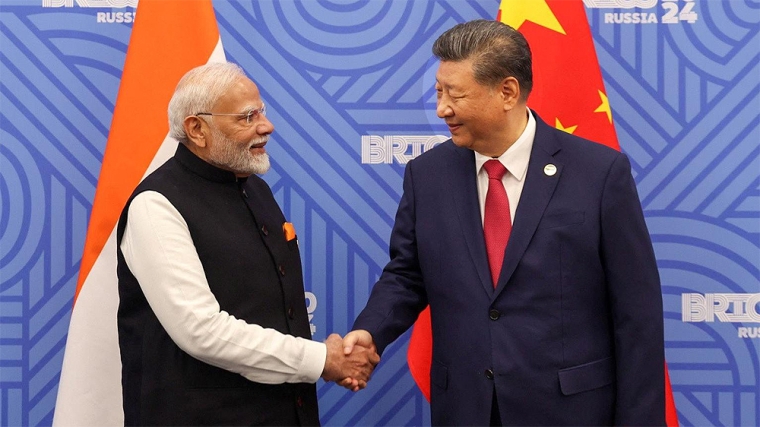
The handshake that may change history
Indian President Narendra Modi attended the SCO meeting in Tianjin last year. He and President Xi discussed border disputes, expanding trade, and future Chinese investment in Indian infrastructure.
Triggered by Trump’s imposition of a 50% tariff on most Indian exports to the US and his condemnation of the Indian economy as ‘dead’, China seized the opportunity for rapprochement. China has many reasons to form deeper economic relations with India. With a population of 1.43 billion, it is the one country with the potential to compete directly with China. It has a young, well-educated population, controls the Indian Ocean — through which 80% of China’s oil imports pass — and is a founding member of the Quad, Washington’s performative attempt to create a miliary coalition to contain China in Asia.
India increased its high tech exports by 400% over the last five years, reaching USD 23 billion, and accounted for 44% of US smartphone imports last year. The Indian economy grew by more than 7% in 2025, anything but dead. The meeting between Modi and Xi may turn out to be as significant as Nixon’s visit to China in 1972.
Together Xi and Modi’s initiative may change a relationship marred by strategic and commercial conflict into an economic alliance no other nation or trading bloc can rival.
*David Mahon is the Executive Chairman of Beijing-based Mahon China Investment Management Limited, which was founded in 1985. This Briefing is here with permission.
We welcome your comments below. If you are not already registered, please register to comment
Remember we welcome robust, respectful and insightful debate. We don't welcome abusive or defamatory comments and will de-register those repeatedly making such comments. Our current comment policy is here.