
The Government is receiving advice over potentially rationing fuel demand, should the situation in the Middle East deteriorate further. While the Government would first look at fuel sourcing, other options are on the table as fuel prices climb.
As a member of the International Energy Agency (IEA), New Zealand was part of the unanimous agreement that 400 million barrels of oil from emergency reserves would be made available to address disruptions in oil markets stemming from the war in the Middle East.
Associate Energy Minister Shane Jones said on Thursday the Ministerial Economic Security and Supply Chains Group which met Wednesday night, also agreed to take; "a proactive set of steps to ensure we've done the policy work in the event that the Crown needs to take any further decisions should this level of hostility become hopelessly protracted".
Jones said the IEA expected its members to explore all options, including demand restraint. He said the Government was getting advice on that, "and Kiwis should expect us to be proactive".
Those options would "only kick in in the event that this situation deteriorates further, because we do have up to 50 days worth of fuel, either on the water or here in country".
Government has the power to impose demand restraint regulations including the restriction or use of cars, rationing schemes, prohibiting the storage or sale of petroleum products, if it is likely to be in short supply.
Asked how many days' worth of fuel it would take to see measures implemented such as car free days, Jones said, "that's the level of analysis that we're getting done by MBIE and obviously Treasury have undertaken to lead a lot of the policy work, I don't want to jump to any sort of indiscriminate day figure".
"I'm just telling Kiwis that we've got 28 to 50 days worth of fuel on the water or in the country, but we're doing the proactive work to identify when would we kick in, and share with the public, the next steps," he said.
"Feeding any sense of alarmism is unhelpful. We are going to take a measured but thorough approach, so that when the committee does refer back to Cabinet, it's on the basis of high quality information and good work undertaken by our officials."
Finance Minister Nicola Willis said there were a number of policy steps that would be taken prior to considering rationing.
On how many demand measures the Government was considering, Willis said at this point there was “no need… but there is provision in New Zealand law that should we need to take those steps”.
“The first thing is to understand whether there is any disruption that would warrant that, we don't have information that suggests that is the case yet.
“The second thing to consider is whether we would have options for expanding where we could get supplies of fuel from. That's actually the first thing that we would do - to look at, are there better options for where we could source fuel, alternative options from where we normally get it?
“That may require, for example, us considering, do we need to look at the fuel specifications we currently have to widen the set of options that we have.”
16 Comments
To EV or PHEV, that is the question...
Not according to this government it's not.
EV, unless you can get a PHEV with a battery that can last much longer than 3 years
Just when there were signs of improvement in my industry...
I'm just grateful we have a government determined to increase our exposure to international destabilisation.
radio talking Balance to leave NZ next year due to no gas, man we are forked here
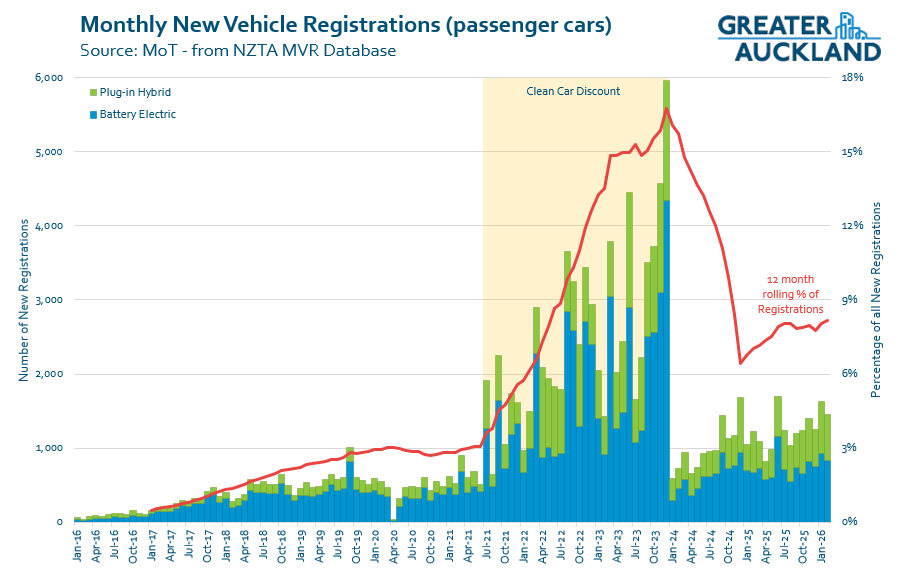
This chart is interesting: https://www.greaterauckland.org.nz/wp-content/uploads/2026/03/EV-Monthl…
It would be a different world with 91 over $4/lt
https://www.stuff.co.nz/world-news/360950505/dirty-fuel-fill-gaps-austr…
It's not the $$$$$
It's the availability.
That's what the stoush is about - wo gets the last half of the FF stocks.
The joke is that those who prepare for a post-FF world, will be in a relatively better position than those who don't. But they will still be in a 'worse' position than when they were FF-ed. China is away ahead of everyone in that way.
But EVs are not part of the post-FF world. Not enough surplus energy to support such discretionary activity.
That's what the stoush is about - wo gets the last half of the FF stocks.
Oh, you've sat down with the Iranians, Israelis and Americans then?
Super super flawed trying to reductively shoe horn this into your pet cause.
Although I guess what could happen will look a lot like an LTG scenario.
Not 'my pet cause'.
All activity needs energy; a hegemonic collection like the US demands an insatiable flow, and the stocks are half-depleted. Venezuela and Iran between them, are 30% of what's left; Iraq ranks 5th.
Oil Reserves by Country (2025) - Worldometer
The modus operandi is always something else; the target is always the same. The Iranians have already been 'couped' by the US/Britain; they know the game and the target.
Oh, really.
https://www.weforum.org/stories/2025/10/space-based-solar-power-energy-…
More you know and all that.
Classic Australia - export your dirty emissions. This is in regard to their high sulphur content fuel that they refine and usually only ship overseas.
Bing tells us this:
Diesel vehicles that require low sulfur content diesel include:
New Zealand vehicles: Vehicles built after 2007 generally require ultra-low sulfur diesel (ULSD).
Euro 6 vehicles: All highway diesel vehicles must use ULSD.
Off-road vehicles and boats: These can often use regular diesel, but ULSD is preferred for newer models.
So, will Australia start to see engine failures? I guess that will cut emissions when those engines have died.
Should make for a need for plenty of catalytic converter replacements in the medium term for those who haven't cut theirs out already.
Cats cannot legally be removed in Aus (this is not usually identified until the vehicle is sold of course), but there is a bit of an industry involving removing the insides and leaving the casing in place. That could have a tiny impact in improving their GDP!
This is ChatGPT's analysis of duration and impact of the current oil crisis, and recommendations for households
https://chatgpt.com/share/69b33ae6-dfe4-800d-a210-053146e7a0ec
Summary of forecast impacts for NZ households
Category Baseline | price sensitivity to oil | Peak increase (short-term) | Expected duration | Long-term residual
Petrol / diesel Very high +30–60% 1–3 months +10–20%
Air travel Very high +40–80% 3–6 months +15–30%
Food overall Moderate +8–18% 6–12 months +5–10%
Fresh produce diesel + fertiliser +10–20% 6–12 months +5–10%
Meat & dairy feed + transport +5–12% 6–12 months +3–7%
Grain / bread fertiliser + shipping +10–25% 6–12 months +5–12%
Imported goods shipping+5–15% 6–18 months +3–8%
Electricity low sensitivity 0–8% 3–12 months ~0–5%
We welcome your comments below. If you are not already registered, please register to comment
Remember we welcome robust, respectful and insightful debate. We don't welcome abusive or defamatory comments and will de-register those repeatedly making such comments. Our current comment policy is here.