
The fuel crisis is forcing the Government to put a magnifying glass over its transport plan and the upcoming fuel excise increase.
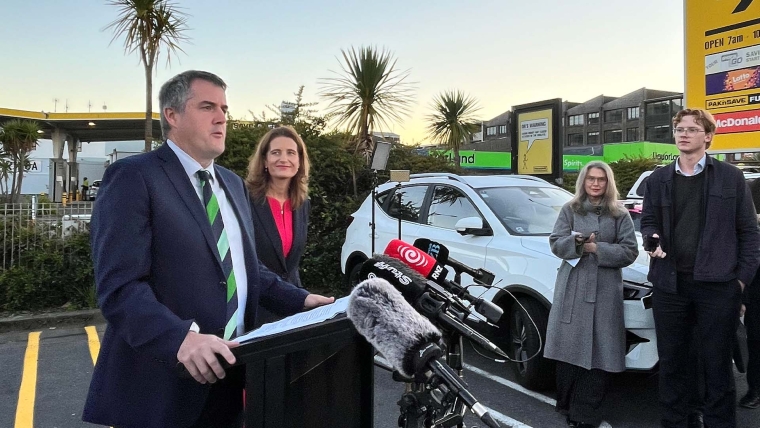
Announcing loans for more Electric Vehicle (EV) charges in Lower Hutt on Monday morning, Transport Minister Chris Bishop said the Government was working its way through its transport commitments - “and clearly there's been a material change in the situation in the last few weeks.”
As petrol and diesel prices continue to rise and fuel security becomes increasingly fragile, advice has been sought about potential measures to deal with demand, while fuel stocks are being closely monitored.
“I think you have to reassess commitments in light of changed situations,” Bishop said. “That's the plan at the moment, and when that plan changes, we'll tell you.”
Excise is going up 12 cents in 2027, which will contribute funding to the Government’s transport promises.
“Clearly, the fuel price increases that New Zealanders are experiencing each and every day at the pump are prompting reassessments of lots of things inside government. I think you can expect that to continue,” Bishop said.
From a security and price perspective, Bishop said it was diesel that they were more worried about due to the flow on costs.
“Seeing people increasingly look at public transport, and I think you're going to see that continue, but there will be flow on costs for public transport operators as well."
“I'm working with NZTA [the New Zealand Transport Agency], and in fact, I've got a meeting with all of the public transport authorities … in a couple of hours, to go through what they're seeing, what the impacts are on them, what contingency planning they've got in place for capacity increases that may or may not be happening.
“It's a very dynamic environment, and we're looking at all of those issues.”
Finance Minister Nicola Willis said at some petrol stations; “depending on how competitive the price is on a particular day, we are seeing that they are being used up more quickly.”
“The fuel companies are ready to make sure that they can be topped up again so if a station runs dry it can be topped up, and ultimately. New Zealanders are making their own decisions about when they fill their tanks, but it doesn't have an overall impact on the supply of fuel available.”
Over the weekend, the Green Party proposed a package for free public transport and a windfall profits tax to prevent corporations from price gouging.
13 Comments
This is the perfect opportunity for the government to cancel some of those hugely expensive road projects without too much embarrassment. "The situation has changed", rather than "we really messed this up".
Maybe they could even throw a few dollars at alternatives like bike and walking infrastructure and public transport instead?
2.5 wasted years by this ideologically driven clown show!
I sincerely hope this is real leadership and strategising by Chris Bishop, in a crisis. Not virtue signalling.
Over a very short period, the removal, rather than reshaping, of incentives to lift fleet electrification, have been shone as a very retrograde step for building domestic resilience.
Personally, I hope the government will pick up the Aussie policy to incentivise rapid installation of rooftop solar. And reintroduce an incentive scheme for electric vehicle purchase. Maybe a sliding scale of incentive based on income levels. We can do it for working for families, surely there is a workable way to do that for EV incentives.
Surely its only fairly wealthy people buying new cars? Any EV that isn't new probably isn't worth importing...
But rooftop solar would help the uptake of EVs, makes them even cheaper to run.
Solar PV is money in the bank; energy for years to come.
EVs are the right answer to the wrong question.
Yes, i agree PDK, in principle. However, there are pragmatics that come into play, as we were discussing last week.
I did the maths on my true diesel fuel costs per litre last week. I get about 11.5 km/lt (8.7lt/100km). RUC (7.6cents/km) added to the pump price, to compare with petrol, adds $0.87 to each litre. Today, pump price is $3.09 in my area, real cost close to $4. Hmm, hybrid is looking attractive. So is a horse.
Did I miss something, or has the government not actually "done" anything to deal with the immediate situation? I believe there is a "plan" that has been presented, but where are the changes, the actions, that might improve the situation?
What could they do? Only a subsidy, probably too early for that.
Sounds very much like working for families targeted adjustments. Willis said something about "low and middle income", which is code for WFF. And chuck in something for those on Super. If you're working, less than 65, and get paid "too much" then nothing for you is my prediction
Are you expecting an: Act in haste, repent in leisure response....?
I'm hoping for some very carefully thought out strategy with cross party support that won't eliminate the pain, just make it a bit easier for the most impacted who have very little scope to buffer the shock. And that will keep critical areas of the economy functioning to avoid supply shocks to living essentials that would compound the pain.
I'm prepared to wait a little longer to get a great plan.
Why would excise be going up when the plan is to remove fuel tax & move to rucs in 2027
https://nzta.govt.nz/vehicles/road-user-charges/replacing-fuel-tax-with…
RUCs are fuel tax or really excise duty, just calculated on kms rather than litres. The changes are to how excise taxes are collected, not a move away from excise tax.
When I convert the 7.6cents/km I pay in RUC to RUC $s per litre of diesel I use (making diesel comparable to the excise tax inclusive price of petrol), it adds $0.87/lt to what is displayed at the pump.
it is apparent that whatever the gov. decide any mitigation will be short term. there is no appetite to address the med/long term questions that the current situation highlights, be it fuel security, energy in general or climate impacts.
The truly sad feature is that none of the other parties are doing ant different.
We welcome your comments below. If you are not already registered, please register to comment
Remember we welcome robust, respectful and insightful debate. We don't welcome abusive or defamatory comments and will de-register those repeatedly making such comments. Our current comment policy is here.