
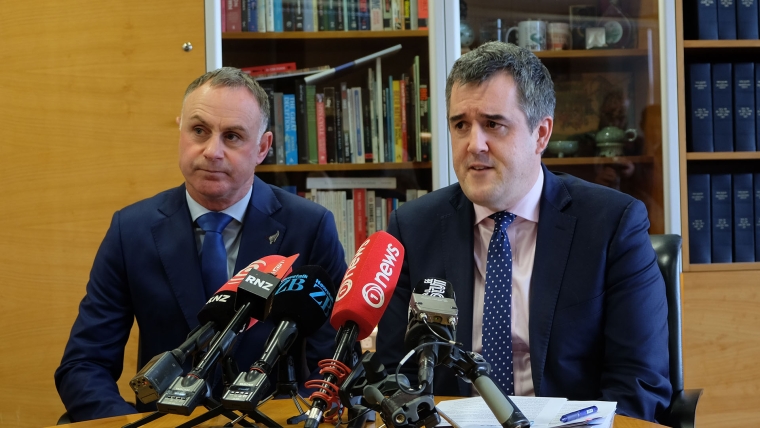
The Government is giving councils three months to put forward proposals on how they would rearrange their local governing structures, with Resource Management Act (RMA) Reform Minister Chris Bishop saying: "Our message to councils is simple: lead your own reform, or we'll do it for you. Either way change is coming."
On Tuesday, Bishop and Local Government Minister Simon Watts announced the Head Start Pathway, a fast-track for local government reform, where two or more territorial and/or unitary authorities can submit a proposal to establish a new unitary authority covering all or part of a region. These will need to be submitted by August 9.
A document about the pathway said council proposals will be assessed on deliverability, how it supports the new planning system, how it simplifies local governance, how it supports economies of scale and maintains local voice.
Councils who don’t submit a proposal will face mandatory change after the 2028 local government elections. They will be subject to a backdrop process and legislation for this will be enacted before nominations open for the 2028 local government elections.
This follows their announcement in November, when they proposed removing regional councils and replacing those councillors with combined territories boards. These boards would have been made up of mayors from the region’s city and district councils, and they would take the lead on regional issues.
Regional councils are in charge of things like natural resources, supporting biosecurity and biodiversity, and offering transport services.
'There is a clear carrot'
As part of this initial announcement, the Government put out a draft proposal for public discussion and consultation, which closed on February 20. There were over 1150 submissions with about 70 from councils and local government sector bodies, and around 60 from iwi and Māori organisations.
Bishop said: “What we heard was quite consistent. There’s strong support for change and many councils actually want more flexibility to get on with that change in a way that works for them.”
He said several mayors had indicated to the Government that they wanted to move now and they had clear ideas around what should change.
Asked by reporters at a press conference about the Head Start pathway, which councils have signaled they may amalgamate, Bishop listed Northland, Waikato, Wellington, the Wairarapa and Hawke’s Bay as some places that have either established steering groups or have been having discussions.
“There is a clear carrot which is a three-month window for councils to shape their own destiny and the future of their own local governing arrangements,' Bishop said.
He said the Government was still working through the details of what the backstop (this is if councils don't put forward a proposal) will look like but; "it will look something like the combined territories proposal that we published in November, which is focusing on mayors, focusing on region-wide governance".
"Put it this way, regional councillors will not be elected at the 2028 local body elections."
Watts said when the proposals come in, they will be assessed by the new MCERT (Ministry for Cities, Environment, Regions and Transport) and officials will assess them across a specific set of criteria.
“This is about giving those councils around the country the steering wheel to design a system that actually works for their communities and their ratepayers," Watts said.
“We want to see unitary authorities. We want to see a one-stop shop that are larger, leaner and more efficient. We’re looking to kill the duplication that exists, that slows down the housing and infrastructure … that this country so badly needs into the future.”
‘Quite fundamental, transformational change is coming’
When asked about the three-month timeframe, Bishop said many conversations have already been happening.
“We want to make decisions this side of the election. We think it’s important to keep momentum up … it does also sync into resource management reform.”
Watts and Bishop were also working on development levies which Bishop said was “fundamentally reforming the infrastructure funding and financing system for councils.”
“Quite fundamental, transformational change is coming. To set New Zealand up for success in the 2030s, a lot of that is local government reform, RMA reform and infrastructure and funding reform designed to make it easier to build housing and the infrastructure that New Zealand needs into the 2030s.”
Timeline
According to the Head Start pathway document, Cabinet will decide which proposals are accepted in principle in September. Final proposals will be submitted in March 2027 and Cabinet will confirm proposals in May 2027.
Legislation will be introduced in late 2027 with it expected to be implemented in 2028. The implementation of council proposals will begin in May 2028 and the backstop will start around October.
'Imbalance has to be addressed'
Infrastructure New Zealand chief executive Nick Leggett says: “This fast-track process gives regions an opportunity to come together, build scale, and strengthen their ability to deliver for their communities. They should take it.”
Councils now face a clear choice, Leggett says.
But he also says that structural reform alone will not be enough.
“You cannot expect better performance from local government without giving it the tools to succeed. Councils own around 35% of New Zealand’s public infrastructure but receive only about 11% of total tax revenue. That imbalance, which stands out globally, has to be addressed.”
The next few months will be decisive, Leggett says. “There is a real opportunity here to reset how local government delivers for communities. With the right balance of leadership, support and ambition, this reform can make a lasting difference.”
'Any reorganisation will involve tough conversations'
Local Government New Zealand (LGNZ) president Rehette Stoltz said: “Local government reorganisation is complex and LGNZ will be meeting with our members next week to understand their views."
While some regions will be ready to submit proposals by August, other regions have "greater complexity that needs to be worked through", Stoltz said. "That needs to be respected."
“To support councils that choose to move more quickly, the Government should consider practical support, including regulatory relief from processes that may become redundant and financial support mechanisms such as transition loans,” Stoltz said.
“It’s inevitable that any reorganisation will involve tough conversations."
We welcome your comments below. If you are not already registered, please register to comment
Remember we welcome robust, respectful and insightful debate. We don't welcome abusive or defamatory comments and will de-register those repeatedly making such comments. Our current comment policy is here.