
The Government has finally pulled the trigger on major reform of the public service, a move talked about widely for the last year, but now only put into play six months before the election.
Here’s what’s happening:
Most agencies have been given a baseline saving cut of 2% for the next year, and 5% for each of the two years following.
That frees up about $2.4 billion over the next four years, which the Government wants to put into areas such as health and education.
Where will that money come from?
Well, the Government expects that to come from mergers, utilising technology in customer facing and back office functions and therefore, reducing headcount.
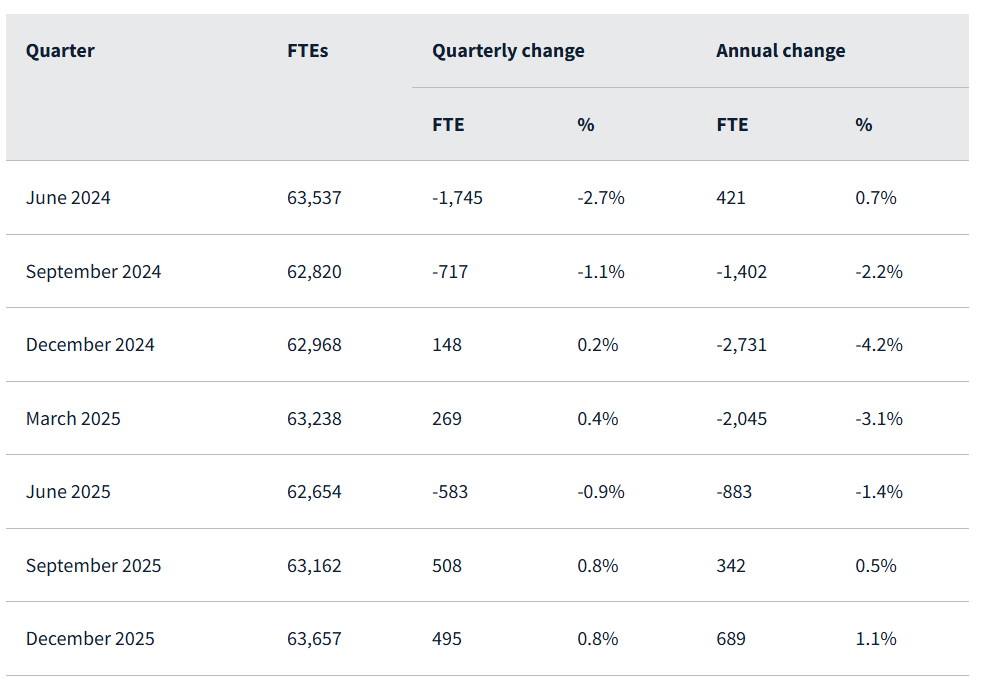
That lines up with the Government’s expectation the public service sheds about 8,700 jobs by mid 2029, from its December 2025 total of about 63,000.
While the details are still being ironed out (agencies asked to come up with proposals on how they could merge), it will lead to some real fundamental changes in the public service - if it all goes ahead.
Labour leader Chris Hipkins said the $2.4 billion saving figure was completely unrealistic.
"There's no way you can cut that much money within the time frame they're talking about, without cutting frontline services, and without affecting New Zealanders' entitlement to access to those services," Hipkins said.
The questions:
1. Why now?
Many would quite rightly ask, at just six months before an election, why not do it earlier?
Public Service Commissioner Brian Roche has consistently said there are questions around the size and organisation of the public service, scope to reduce fragmentation and strengthen the ability to focus on core business.
Midway through last year, the potential for significant consolidation was being looked at - even a number of 20 agencies (there’s about 40 currently) was mentioned at a Crown Entity chair meeting. (The Government hasn’t given its ideal number of agencies, ACT leader David Seymour has suggested 30).
What came from the talk around consolidation was the ‘MCERT’ merger (pulling together the Housing and Urban Development, Environment and Transport Ministries). That was intended to serve as the blueprint for future mergers, while the merging of back office functions (like that of the GCSB and SIS) has always been attractive to Roche and recent Public Service Ministers.
MCERT is in the throes of merging, with a ticking date of a July 1 start. It makes sense why the Government would want to wait until the bulk of that is done before launching into other major restructures across the sector.
Then there’s the money.
The Government has been open about needing to run the ruler over the upcoming Budget in light of the fuel crisis, Finance Minister Nicola Willis saying last week; “as we go into the budget, we have on one side of the ledger the spending priorities that we think are most important, and then on the other side of the ledger we go and hunt for savings and reprioritisations”.
“We did have to do a rejig to ensure that we included within our spending plans adequate responses to the fuel crisis, but we went in determined that the operating allowance target we had set would be a ceiling, not a floor.”
Also to note, in the case of MCERT, savings won’t come through immediately after its merger this year, but instead is likely to take a few years.
- Is the reliance on technology overstated?
Almost 9000 jobs in just three years is a lot compared to levels seen in the last few years in the public service, that’s just shy of almost 3000 a year - but the workforce in the public service fluctuates significantly.
The December 2024 annual full time equivalent (FTE) change was down 2,700, but by the following December 2025 the annual change was up 689 FTE.
There are cases such as that in Immigration NZ, which The Post reported last year estimated automating its systems would see up to 500 roles go over a seven year period.
And plans are already underway to accelerate the use of AI, but it isn’t clear how much it will actually save the country. The Government chief digital officer Paul James saying in February there was not a lot of data points available yet on how much AI would save New Zealand, and while it would absolutely drive down costs, it would take a while to get there.
- Will this stick?
Any person content with the current structure and working of the public service is a rarity. While everyone seems to agree change is needed, consensus on how to do that is very few and far between.
Foreign Affairs Minister Winston Peters bluntly telling journalists when asked if he was concerned about job cuts at the Ministry of Foreign Affairs: “One more time, you guys, no budget can constrain the future parliament, you got that?
“So I'm not concerned.”
And so most of this hangs on November 7, and how the next Government is formed as to how this will look in the future.
But for now, proposals for mergers are currently in the hands of agencies, Willis saying on Tuesday they will be asked to come up with ideas to “logically merge their existing activities around citizen-facing functions, using common technology platforms”.
“We expect to announce more detail in the coming months.”
But it is the Government who gets the final say. Whether this much organisational change and admin is appetising for a Government with a very nearing election date that is also dealing with a massive worldwide fuel crisis, will become a lot clearer in those coming months.
We welcome your comments below. If you are not already registered, please register to comment
Remember we welcome robust, respectful and insightful debate. We don't welcome abusive or defamatory comments and will de-register those repeatedly making such comments. Our current comment policy is here.