
This is a re-post of an article originally published on pundit.co.nz. It is here with permission.
Many readers may find this week’s column difficult compared to the discussions they are familiar with. That is because it tries to get the analysis right rather than skipping over the difficult bits and leaving the reader with misunderstandings. So apologies for the difficulties. It’s not the columnist’s fault. It is a bloody difficult subject.
You know when your car has driven 100kms. That is quite different from driving at 100kms per hour. One is a ‘distance’, the other is a ‘speed’ or, mathematically, one is a ‘stock’ (a ‘distance’) and the other a ‘flow’ (signalled by the ‘distance per hour’). You rarely confuse those two ideas when you are driving – you could get into a lot of trouble with the traffic law if you did. Yet the distinction is frequently confused in economic discussions.
Consider Donald Trump’s promise during his 2024 campaign to reduce prices beginning on ‘Day One’ and, specifically, that he would cut energy prices in half. Did he really mean he would reverse the car back to 50kms? Or was he saying that he would cut the speed to 50kms per hour? I don’t know whether he understood the difference; I am sure many politicians and others in the commentariat do not. Or did he know the general public did not and he could get away with the cheat?
The confusion is compounded by sloppiness. We talk about 2 percent inflation, when we mean 2 percent annual inflation or inflation is 2 percent per annum (p.a.). Leave out the time dimension and add to the confusion between stock and flow. *
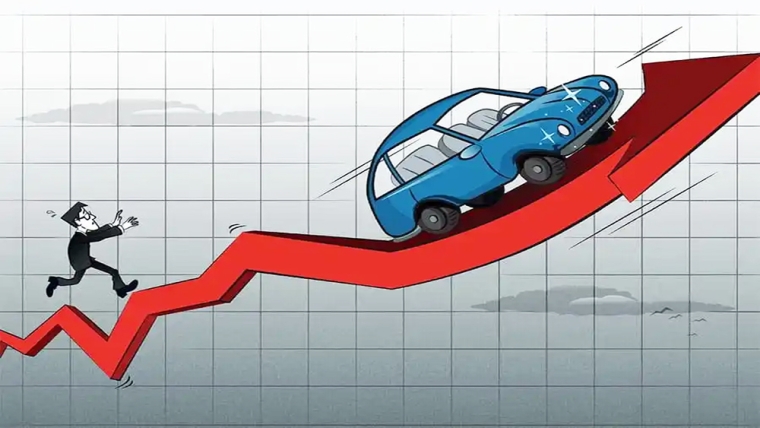
The distinction is important as we experience a price shock from the rising cost of oil and petrochemicals as a consequence of the Iran War. Suppose it amounts to a 1 percent rise in prices, that is someone has smashed into the back of the car and pushed it forward from 100kms to 101kms. Is that inflation or just a price shock?
A common definition of inflation is a ‘general, sustained increase in prices for goods and services across an economy over a period of time’. The crucial terms here are ‘sustained’ and ‘over a period of time’. It does not really apply to a one-off shock.
It could, of course, be that one-off shock may trigger further price rises. It is inevitable in this case that some importers will pass their prices on but that is just a manifestation of the one-off shock. The concern is that others, suffering a loss of real income, will increase their prices (and wages) to compensate their loss of income. And then others will follow, and – well – that really is inflation.
That was the concern in November 2022 when then RBNZ Governor Adrian Orr stated that the bank was deliberately engineering a recession to combat rampant inflation, explaining the action was necessary to break the inflation spiral that saw prices rise well above the 1–3% p.a. target range.
That has to be the concern of the Reserve Bank when setting its monetary stance. In principle, it can ignore the price shock from the Iran War. (There is even a provision in its Policy Targets Agreement which would allow it to.) In practice, the Bank has to worry that the shock will trigger the inflation of a price-wage spiral as people respond.I cannot tell you how the Bank is going to react. It has to judge how long the elevated import prices will last – they could be temporary, they could be for a very long time, they could go a lot higher ** – while it also has to assess the domestic responses to the shock.
One way into understanding the domestic responses is to look at the distributional impacts, an issue often underplayed in discussions on inflation (and slightly easier to analyse when the shock is from import price rises, as in this case).
A rise in the external price of imports reduces the effective incomes of New Zealanders, even if there is no change in output (say, as measured by GDP). (The technical terms include a ‘terms of trade’ effect and reduction in ‘real National Income’.) The mechanism is that prices go up, but incomes don’t follow them so real spending power is down.
The following question is critical even though you know the answer. There is a reduction of (real) income of New Zealanders; who is to take the cut? Everyone knows the answer: ‘NOT ME’. Which is impossible: somewhere in the system someone has to take a reduction. At which point we will have a confused discussion in which people propose policy responses which never mention that they are each cutting someone else’s income (never theirs and, of course, reflecting their own political preferences).
In the market the response can be to put up one’s own prices (that includes wages) to offset the price rises that are being faced. But it is a bit like a ‘pass-the-parcel-in-a-Belfast-pub’, in the much more turbulent times in Northern Ireland when the parcel contained a bomb. Someone has to be holding it when the bomb goes off. Similarly, putting up one’s prices passes the loss reduction onto someone else does not resolve distributing the loss of income; it does not stop the bomb going off.The result is the wage-price spiral – inflation. That is what the Reserve Bank is charged with preventing. Unfortunately, the Bank has limited means for doing this. In 2022 it concluded all it could do was induce the recession by hiking interest rates. The idea is that the slackening economy (including rising unemployment, underutilised capacity and bankruptcies) will deter economic agents putting up prices.
But wait a moment! Does that not mean in that the RBNZ was dealing with the consequences of a real income cut by further cutting real incomes? Yup. It may not seem a very good way to deal with the shock, but what is the alternative? Probably the only alternative, aside from letting inflation rip, is to acknowledge the real income cut imposed by the shock and collectively agree on how it would be shared out. Unfortunately we don’t have the institutional framework to implement such an incomes policy. (The last time we tried was in 1990 before the Employment Contracts Act destroyed the cohesiveness and power of the unions.)
All together, we face a not very happy prospect, unless the Strait of Hormuz opens soon and the Middle East settles back into a more peaceful state.
* Another common mistake is to confuse ‘percent’ and ‘percentage’. If inflation rises from 2 percent p.a. to 3 percent p.a., it does not rise ‘1 percent’; it rises ‘1 percentage point’. I leave you to calculate the percentage increase in the rate of inflation.
*Brian Easton, an independent scholar, is an economist, social statistician, public policy analyst and historian. He was the Listener economic columnist from 1978 to 2014. This is a re-post of an article originally published on pundit.co.nz. It is here with permission.
We welcome your comments below. If you are not already registered, please register to comment
Remember we welcome robust, respectful and insightful debate. We don't welcome abusive or defamatory comments and will de-register those repeatedly making such comments. Our current comment policy is here.