
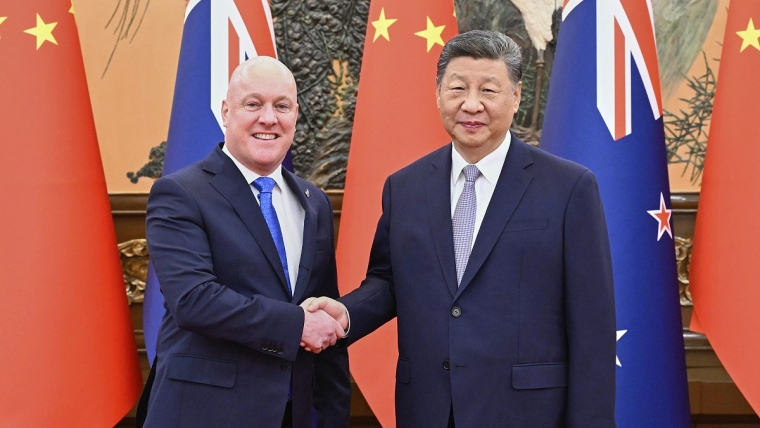
Chinese officials are watching the 2026 election for a signal on whether New Zealand’s more United States-aligned security posture will become a permanent fixture.
If they assess that it is, the trade relationship might be at risk. That’s the opinion of David Mahon, a Kiwi business consultant based in Beijing.
“New Zealand–China relations are already at their worst stage since diplomatic recognition,” he told the Of Interest podcast.
“At the moment, there's not some sword hanging over us, partly because China is so busy dealing with a massive geopolitical mess, as all great powers and smaller and medium sized powers are.”
But Mahon sees two risks in the future: China could retaliate by blocking the import of some non-essential luxury goods, or it could simply become “indifferent” towards its relationship with New Zealand.
“New Zealand sells a lot of things to China. None of them are irreplaceable. In the end, it's just milk. In the end, it's just fruit or honey. That's something that we need to acknowledge.”
“If you look at our free trade agreement, the profit margin, the rationale for many of our companies trading with China is only based on the fact we pay no tax. If we lost that free trade agreement. We would lose much of our business with China”.
Mahon doesn’t think the Free Trade Agreement is currently at risk but there are signs Kiwi businesses in China are nervous about the deteriorating relationship.
An article written by China trade consultant Anna-May Isbey in a report published by the NZ Business Roundtable in China warned there could be direct consequences for geopolitical policies.
“The language used by governments when navigating geopolitical tensions can have real commercial consequences. Exporters consistently express the view that New Zealand’s longstanding, pragmatic, and independent approach to international engagement should continue,” she wrote.
This perspective contrasts against security analysts in Wellington and elsewhere who are increasingly concerned about China as a security risk, and want New Zealand to bolster its defence capabilities and diversify its export markets.
Government agencies have linked China to both foreign interference and cyber espionage in New Zealand, such as hacking the Parliamentary Service network in 2021.
But a political pivot towards the United States, which began while Jacinda Ardern was Prime Minister, has been complicated by the country’s plunging popularity in New Zealand.
The United States is now seen by Kiwis as more of a threat than China, according to an annual survey commissioned by the Asia NZ Foundation.
Mahon believes New Zealand should “learn to do less” and avoid taking sides in geopolitical competition which doesn’t directly affect it.
“Stop seeking the approval of these big countries that impress you so much, including Beijing … If we do less, and our need for the approval of other nations is less, then I think the navigation is going to be a lot simpler,” he said.
2 Comments
The fact that there is friction between the major hegemonies, tells us this is set on a bigger tableau.
There isn't enough planet left, to even maintain the present rate of resource/energy throughput. China has seen the future; the US has doubled-down on the past. The latter is also clearly disintegrating: the EROEI of maintaining it's current collection of infrastructure - including 7-800 bases around the globe - is decreasing exponentially (no energy return on the recent sally; whether they preserved the petrodollar status is the only remaining question).
NZ need to be as self-sufficient as possible, facing a de-growth future. As do we all individually. More maker skills, more recycling and repurposing, less waste, less entropy.
PDK your constant commenting on every subject is becoming beyond boring.
We have heard your script but you have put forward very few positive suggestions.You sound like you have become obsessed with a position and its causing you so much trouble.
Its also taking enjoyment from many other readers and subscribers.
If you carried on like this in a face to face discussion between colleagues I would you tell you where to go...and if you didn't we would have a frank and robust chat outside.
I don't think you realise how arrogant and rude you come across.
David...please give PDK an opportunity to submit a few articles a year in exchange for stopping his commenting behaviour.
Im ready pull stumps and Im sure other readers are too.
The constant "world is ending' is beyond ridiculous.
We welcome your comments below. If you are not already registered, please register to comment
Remember we welcome robust, respectful and insightful debate. We don't welcome abusive or defamatory comments and will de-register those repeatedly making such comments. Our current comment policy is here.