
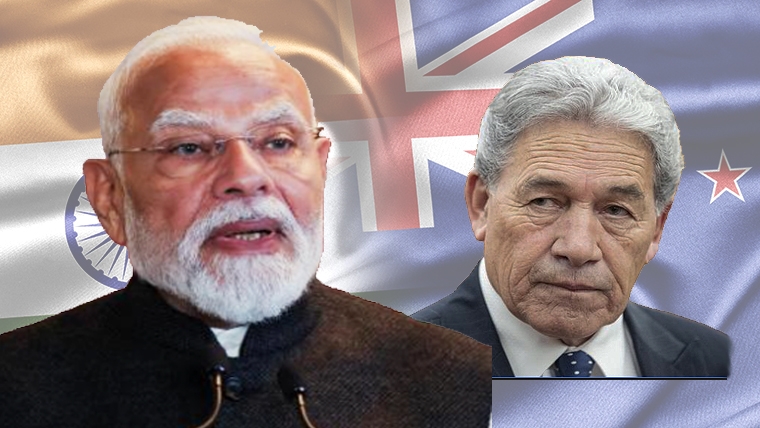
By Natalia Albert*
Our current coalition government is saying two things at once. It's sending mixed signals of the most consequential kind. And it's a problem.
National to India: come, work, study, staff our hospitals, we'll light up the Sky Tower for your Prime Minister.
NZ First to permanent residents (many of them the very people that welcome is courting): we're moving to take away your vote. Nobody has to have coordinated this for it to matter.
It could be a total coincidence, or a strategic stab from one coalition partner to another. What matters is that the outcome is a set of mixed signals landing on the fastest-growing, most diverse population New Zealand has ever had. Signals about who belongs here, and who only gets to work here. Very confusing and the timing of it is hard to ignore.
Kia Ora Modi
On 11 July, a Saturday night, Narendra Modi walked into Spark Arena to a noise Christopher Luxon physically could not talk over. The Prime Minister got to "make some noise for…" and never reached the name, because the arena was on fire. Modi was received in full pomp and ceremony.
This was, by most accounts, the most significant state visit New Zealand has hosted in a generation. It was the first visit by an Indian Prime Minister in four decades. The last one came when Muldoon was in charge. So this is not trivial or inconsequential. This is New Zealand rolling out something close to the full carpet for the leader of what is now the world's most populous country, three months after signing a free trade agreement with it. Great! Modi coming is a huge diplomatic win.
And it was a celebration. For the Indian community in New Zealand now the third-largest ethnic group in the country, behind Pākehā and Māori, having quietly overtaken the Chinese population at the 2023 census, it was a night that said: you are a political force, we see you. Which is lovely. Hold onto that feeling for about ninety seconds.
What happened outside
Outside Spark Arena, more than a hundred protesters gathered, anti-immigration activists among them, chanting "send them back" and holding signs reading "remigration now." And inside, at the official welcome at Government House, only National Party ministers sat at the table for New Zealand. NZ First's leader and Foreign Minister, Winston Peters, whose party had spent months trashing this very trade deal, was conveniently out of the country that weekend.
The timeline that could or could not be a coincidence
27 April 2026: New Zealand signs its free trade agreement with India. Todd McClay and Piyush Goyal, handshakes in New Delhi, the most significant political achievement of Luxon's career. The deal opens up a capped stream of skilled work visas, better post-study work rights for Indian graduates, a working holiday scheme. The whole architecture of come here and contribute.
5 July 2026: Winston Peters, standing in Warkworth, announces that New Zealand First will campaign to strip the vote from anyone who isn't a citizen. Permanent residents’ people who've passed character checks, health checks, often years of temporary visas would lose the franchise they've had since 1975. Voting, he said, should belong to those who've "sworn allegiance." Everyone else can live here, work here, pay tax here. Just not have a say.
10 July 2026: Modi lands in Auckland.
Peters announced his policy five days before the guest of honour arrived.
The claim I'm not making
Let me be clear about what I'm not saying. I'm not saying NZ First timed this policy to coincide with Modi's arrival, deliberately, as a dog whistle at the fastest-growing migrant community in the country. That's too easy: a villain, with a motive, smoking calendar.
But I don't need that claim. It's the weak one. Whether or not anyone planned this, the effect is the same and the effect is the thing worth wrestling with.
Why is this problematic?
Because of our hyper-diverse growing population. Because it is a real threat to our social cohesion.
Social cohesion isn't a feel-good vibe. It's not whether we all get along at the barbecue or can hold hands and sing kumbaya. It is a complex social phenomenon, and when it's disturbed, violence creeps through the cracks faster than you can comment on this post. National-level social cohesion is paramount: not just for everyone's safety and wellbeing, but as the foundation of any country. And NZ First's direction of travel directly threatens it. And by national level social cohesion, I mean our capacity to coexist with competing and diverse views.
So, think about what these two policies do to a permanent resident, especially one from India, in this case. Message one, from the trade deal and the Sky Tower and the Prime Minister of your birth country being feted at Spark Arena: you matter, you're wanted, you're a force. Message two, from a speech in Warkworth: but you don't get to vote on how any of this is run, and a party in this very government thinks your presence here is a problem to be managed.
So why is NZ First policy a problem for our Indian community specifically?
Because many of them can't just become citizens to keep their vote, even if they wanted to. India doesn't allow dual citizenship; it’s written into their constitution. Take New Zealand citizenship and you surrender your Indian passport outright. No going back, just an "Overseas Citizen of India" card that isn't the real thing. For someone with ageing parents, property, or family still in India, that's a very hard trade-off. It's choosing between two lives. So, NZ First's policy catches people whose birth country makes them choose and punishes them for a barrier they didn't build. If you are not an immigrant or have never ever have to wrestle with deep identity issues, this might seem minor but believe me it is not!
This coalition government is essentially saying it wants your labour, your GST, your nurse's registration, but not your vote. Come do the work. Just don't expect a say in the conditions of the work.
Absolutely not. Every day, no to this!
This is exactly what starts to crack our capacity to coexist across many diverse, sometimes competing views. The kind of disagreement a liberal democracy should be able to handle, just not the way NZ First is going about it. For social cohesion to hold at a national level, people need to believe they belong as influencing members, not as a useful workforce. Strip the vote from permanent residents and you are formally, legally redrawing the line between the people who count and the people who merely contribute. And you're drawing it, whether you mean to or not, right through the middle of the community you just signed a trade deal to bring here while asking those same people to come and work and live here. It's just too much, honestly. WTAF!?
This touches a nerve
So, I still think the policy is xenophobic. I said so last week. What's changed is that I can now see it sitting inside a pattern: the India deal NZ First opposed as "neither free nor fair," the migrant "values statement," the bill to entrench English, and now: citizens-only voting. What I see is a clear and problematic direction of travel.
I also know it touches a nerve because last week's Less Certain ran on my Substack and was reposted on interest.co.nz, and between the two platforms it drew 116 comments: 76 in one place, 40 in the other. I replied to nearly all of them. The views where passionate and all over the show.
What struck me wasn't that people disagreed with me. That's fine and welcomed. It's that they didn't even agree with each other about what the argument was. One crowd said New Zealand is a global outlier and we're just catching up to Australia and the US, who also don't let permanent resident’s vote. Another said the whole framing misses Māori sovereignty and the fact that the citizenship oath is sworn to a foreign monarch. Some wanted to weight votes by tax paid. Some argued about the definition of mass immigration. Some wanted to talk about infrastructure. There was no shared premise. None.
And that's the actual state of play: New Zealand has no settled, agreed answer to the most basic question a democracy can ask: who gets to decide? We just have a lot of people who feel very strongly about their version of the answer, and a government making consequential moves, mixed and contradictory ones, as though they were separate political moves with no real consequences for folks.
So
I don't think NZ First drew up this policy as a targeted strike on the Indian community. But I don't think that matters. What is true is that this government has decided, across a dozen separate decisions that nobody's bothered to connect, that some people are here to contribute but not influence, and some people are here to influence and therefore belong and that you can tell which is which by whether you'll let them vote.
The trade deal moves through Parliament. The voting policy waits for an election. And a few hundred thousand people who got told they mattered on Saturday are left to work out what it means that, five days earlier, a party in the same government told them they didn't.
I don't have a tidy ending for you. I just think that when a country sends two signals this loud in opposite directions, it threatens our capacity to coexist peacefully and that is worth debating, flagging, and noting, at the very least.
*Natalia Albert is a political scientist living in Wellington exploring how to govern divided societies in diverse, liberal democracies, with a focus on New Zealand politics. She writes weekly on her Substack, Less Certain. Albert stood as a TOP candidate in the 2023 election.
We welcome your comments below. If you are not already registered, please register to comment
Remember we welcome robust, respectful and insightful debate. We don't welcome abusive or defamatory comments and will de-register those repeatedly making such comments. Our current comment policy is here.