
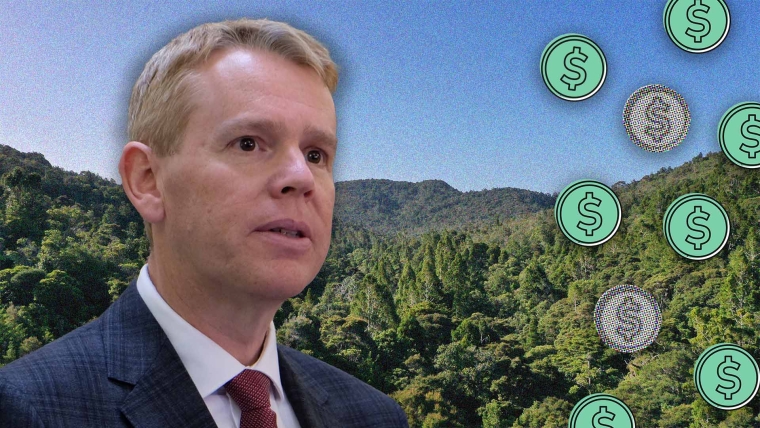
Labour says fixing the “broken” Emissions Trading Scheme (ETS) will be an urgent priority if it's elected to Government in November's election.
On Tuesday morning, the party reaffirmed its commitment to the Paris Agreement and announced it would urgently review the ETS and move quickly to make changes following the review.
Through the review, the party will identify changes to incentivise genuine emissions reductions rather than relying on offsets, reconsider the role of forestry and ensure the ETS supports New Zealand’s Paris Agreement targets.
The review would also develop new rules to prevent whole-farm conversations while new forestry registrations in the ETS would be paused while this work is completed.
The ETS prices emissions by requiring certain sectors of the economy to have "surrender obligations" for the greenhouse gases they release into the atmosphere. These sectors include forestry, liquid fossil fuels, stationary energy, industrial processes, synthetic greenhouse gases, and waste.
The ETS was initially set up to help NZ meet its 2050 net emissions target and international obligations under the Paris Agreement. Recent changes to climate change law removed a provision which stated the ETS unit volumes and price control regulations must "accord with" Nationally Determined Contributions (NDC) under the Paris Agreement.
Labour leader Chris Hipkins says the ETS is broken.
“The carbon price is too low to drive meaningful emissions reductions. Under National, climate pollution is the only thing that has got cheaper over the last three years.
“Current ETS rules also make it cheaper to plant exotic forests than to grow food. That doesn’t create jobs or help our economy.”
Hipkins says if elected into Government, Labour will ensure the ETS does what it is supposed to do and maintains a genuine price on emissions.
“We will restore credibility and certainty to the carbon market, generating revenues that can be invested in affordable energy and resilience,” he said.
“We will stop the short-term political tinkering that undermines business confidence and puts us all on the back foot.”
In a report released last month, the Parliamentary Commissioner for the Environment Simon Upton described the ETS as “rudderless” - calling for major reform, cross-party consensus and a fundamental rethink of forestry’s role.
The Paris Agreement
Hipkins says his party is fully committed to the Paris Agreement and “will put New Zealand on course to meet its targets”.
“The Paris Agreement is essential for bringing countries together to address a problem affecting every country, every community and every generation. Walking away from it, as National and its mates are planning to do, would be giving up on our kids’ future and impose huge costs on our economy.”
Prime Minister Christopher Luxon, who is National Party leader, has repeatedly said there was an economic argument to stay in the Paris Agreement and recently shared it was a bottom line in any coalition negotiations after the election.
But Luxon does think there will be a bigger conversation coming in the future, saying; “The top 25 countries are going to have to ask some questions about their delivery of their Paris target as well.”
Coalition partners NZ First and ACT have been pushing back on the Paris Agreement, with NZ First wanting to pull out of the agreement while ACT has made it clear that; "if Paris will not accommodate a fairer approach for New Zealand, we should be prepared to leave".
Under the Paris Agreement, every country sets out its own Nationally Determined Contributions (NDC) - this is to show the contributions countries will make towards delivering on the 2015 Paris Agreement climate goals. The obligations are to limit global warming to “well below 2 °C” and attempt to keep it to 1.5 °C.
Countries can transfer carbon credits earned from reducing greenhouse gas emissions to help other countries meet their climate targets.
‘Climate change is one of the greatest challenges we face’
Labour climate change spokesperson Deborah Russell says: “New Zealanders deserve a government with a plan - one that understands climate action and economic growth go hand-in-hand.”
“Climate change is one of the greatest challenges we face, but it is also one of the greatest opportunities available to New Zealand,” Russell says.
“We can deliver cleaner and more affordable energy, gives businesses the certainty to invest, and help our farmers to compete in global markets by building on New Zealand’s reputation for world class sustainability.”
We welcome your comments below. If you are not already registered, please register to comment
Remember we welcome robust, respectful and insightful debate. We don't welcome abusive or defamatory comments and will de-register those repeatedly making such comments. Our current comment policy is here.