
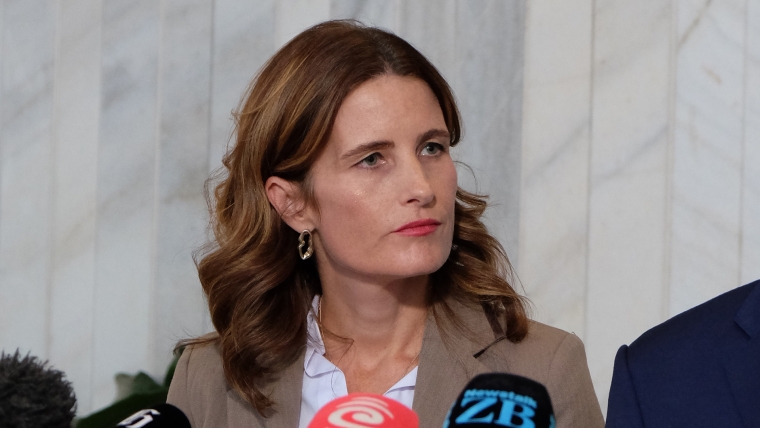
National’s finance and economic growth spokesperson Nicola Willis has pushed back against Foodstuffs and called on the country to "decide who you want to believe" when it comes to a claim that National’s supermarket policy could potentially drive up grocery prices over time.
Speaking to reporters on Thursday, Willis said Foodstuffs have a “vested interest in the status quo”.
“Decide, New Zealand, who you want to believe: The people with the vested interest and some of the highest profits in the supermarket sector internationally. Or independent economic expert after independent expert who say ‘actually with more competition, prices will fall’.”
This comes as National is receiving some criticism for its latest policy. National announced on Wednesday that, subject to an independent Commerce Commission assessment, it was proposing to pursue the structural separation of Foodstuffs - breaking the co-operative up into two competing grocery chains.
If a structural separation were to go ahead, New World and Four Square would be one nationwide chain and PAK’nSAVE would be another.
Willis' comments follow Foodstuffs North Island chairperson and owner of PAK’nSAVE Tauranga, Dean Waddell, telling RNZ's Morning Report on Thursday: "We started with five co-ops, we're down to two, and that's given us the scale and efficiencies and the buying power to stay competitive for our customers.”
Going back the other way and demerging, Waddell said, would put member stores into "a more higher-cost base and a potentially more uncompetitive situation in the years to come".
Asked what it would do for prices, Waddell said: “Over time, it will drive them up. It has to, because if you look at our history, we've been merging back office supply chains and … support offices to stay competitive and be able to offer New Zealanders very, very good value."
"So going back the other way and adding cost back into our businesses … by divesting them and making them smaller will only drive cost into our business, which ultimately ends up with the consumer.”
Put to Waddell that he was saying this would drive up grocery prices for consumers, he said “potentially over time, yeah”.
“Don’t forget it reduces our buying power as well. And we’re still a relatively small business from a global scale.”
Asked if they would litigate, Waddell told RNZ that was a question for its board over time.
“Our early understanding is litigation is not going to achieve the outcomes we need ... This is about commonsense and what's good for an established New Zealand business."
‘My job is to think about New Zealand as a whole’
Asked about what the pushback has been like, Willis told reporters that “Foodstuffs’ claim that this would lead to higher prices” was “extraordinary”.
“Take it with a big grain of salt. Of course they’re going to tell you that this won’t work. They have a vested interest in the status quo.”
Willis had looked at independent economic analysis - a report where the Ministry of Business, Innovation and Employment had asked Sense Partners to look at the cost-benefit analysis of options to restructure the current duopoly of Foodstuffs and Australian-owned Woolworths.
“What that says in black and white is that a change of the sort would lead to lower prices for Kiwi shoppers, and I'm on their side.”
While there was support from the likes of the Grocery Action Group, business lobby groups were not impressed with National's proposal.
The Employers and Manufacturers Association (EMA) head of advocacy Alan McDonald said: "Seeing a right-of-centre, business-focused political party like National suggest this type of policy will sit uneasily with businesses in New Zealand.”
"It might be a populist policy for a grumpy electorate but that doesn’t make it a good policy."
BusinessNZ’s director of advocacy Catherine Beard said National's policy sent a "chilling signal" to businesses and "the wrong signal" to foreign investors.
The group likened it “to be in the same league as Labour's ban on oil and gas exploration and New Zealand First's promise to split up the gentailers” Beard said.
Willis wasn’t surprised to see pushback from BusinessNZ, saying Foodstuffs was one of their major members.
“Their job is to take their side. My job is to think about New Zealand as a whole, including all of those mums and dads and households who do a supermarket shop every week.
“BusinessNZ are there to represent the interests of the business owner, and I appreciate in this case that there is a stark difference between those interests.”
To owner-operators, Willis said: "I want to offer that message of reassurance, which is no one's taking their store away from them. They'll continue to own it. No one's taking their brand away from them. They'll continue to have it and we will ensure that they continue to have access to national distribution chains."
"So this isn't a crazy policy in which we're expropriating your business, as some other parties have proposed. This is about making sure that the Kiwi shopper gets a better deal."
She confirmed her party’s caucus members were fully on board, which comes after POLITIK reported that “the [supermarket] announcement has come after a senior National MP recently told a major stakeholder lobby group that any plan to split the supermarkets would be ‘bonkers’ and would provoke a Caucus backlash”.
Asked about the analysis, Willis said she had been open and candid about the report being “sensitive to the assumptions you make around costs and benefits”.
“That’s why I think it’s appropriate that the Commerce Commission run the ruler over it,” she said.
What do other political parties think?
On Wednesday, ACT Party leader David Seymour said: “Green-Party style policies from parties to break up supermarkets and ‘ban price-gouging’ shows desperate and visionless campaigning driven more by focus group than economic policy.”
“ACT agrees New Zealand needs more grocery competition so families can see lower prices, but we need to be confident the solution will leave those families better off. Policies should be judged by outcomes, not intentions.”
Seymour told reporters there was only five million of us.
“We need to stop attacking industries thinking somehow, if we beat the golden goose, we’ll be able to afford more. What happens is you kill the golden goose and we’re all poorer.”
'They can't eat the review'
Labour leader Chris Hipkins said: “New Zealanders won’t get a better deal from another review. They can’t eat the review.”
Hipkins later told reporters that by National announcing another review, “they’re not actually promising to do it”.
“They’re saying they’re going to do another review.”
Labour would set out its own policy on supermarket competition shortly, he said.
Greens co-leader Chlöe Swarbrick said her party welcomed “our comrades in the National Party waking up to realising that we need government intervention in this duopoly”.
But this went only part of the way with National proposing to intervene in one side of the duopoly, she said.
Referring to the independent analysis, Swarbrick said it was clear the biggest possible benefit for consumers will come from breaking up both sides of the duopoly.
“We need to go further and that looks like introducing a third competitor. It’s why the Greens put KiwiMart on the table because we can have publicly owned supermarket that drives affordability in groceries.”
The Great Pretender
NZ First leader Winston Peters said there had been so much imitation of policy going on, before playing reporters the song The Great Pretender by The Platters.
“Well everybody’s borrowing our policies as you’ll notice and we’re getting a bit sick of it.”
On social media, Peters called National the “Copy Nats” (a play on the word copycat), saying “they have just cut and pasted our policy to break up the supermarket duopoly and give the Commerce Commission more teeth”.
“The Copy Nats list is growing - first it was our baby boost KiwiSaver policy, then it was the “no asset sales”, and now it’s the breakup of the supermarket duopoly - we are waiting with baited breath for their new policy to break up of the power companies (spoiler alert).
“We know it’s hard for them to ignore the heavy use of reports and ‘focus groups’ for their policy development but you don’t need those things to understand what really matters to kiwis and the policies to back them up.”
Peters wrote NZ First would be happy to share its election manifesto for the “Copy Nats to use during the campaign as long as every time they mention a policy they first say ‘thank you NZ First'”.
Asked about Peters playing The Great Pretender on Wednesday, National leader Christopher Luxon laughed, before saying: “Isn’t he great with the singing? I mean it’s one of the great joys of working with him.”
“It’s fantastic there’s political consensus,” he said.
We welcome your comments below. If you are not already registered, please register to comment
Remember we welcome robust, respectful and insightful debate. We don't welcome abusive or defamatory comments and will de-register those repeatedly making such comments. Our current comment policy is here.