
Interest.co.nz is talking money, tax and delving into political parties' financial and economic policies ahead of this year's election. In this installment, Labour finance spokesperson Barbara Edmonds talks about her stance on house prices, debt and how her party plans to fund a fuel tax freeze promise.
Labour's finance spokesperson Barbara Edmonds says she wants neither big peaks or troughs in house prices and insists the 3% annual growth assumed in the party's capital gains tax (CGT) proposal is "conservative" enough to accommodate weaker forecasts.
Speaking to interest.co.nz on Monday, a day after Labour released its fiscal plan, Edmonds also defended Labour's fuel tax freeze costings and outlined her approach to debt, tax cuts and MPs' accommodation allowances.
House prices and a capital gains tax (CGT)
Higher interest rates, housing supply growth and lower migration are causing weaker house price growth, according to Treasury's pre-election economic and fiscal update.
On how current forecasts relate to Labour's CGT proposal, Edmonds said their estimates were based on a "conservative" 3% growth over the forecast period.
Edmonds' comment comes as National finance spokesperson Nicola Willis has previously said Labour may need to make its CGT proposal "more comprehensive" to accommodate for the slower growth.
But Edmonds said they were conservative "when we announced [CGT workings] in October 2025 because at the time Treasury were forecasting house prices to be 5% over the forecast period, we actually get in more at about three".
"We get about 3.1% on average over the forecast period. So we believe the 3% is conservative, and we think is prudent given that the forecasts do change, house prices do change annually, but we're looking at it over the long term average."
On house prices, Edmonds said she wanted them to be "stable" rather than going up and down.
Asked if "stable" meant a stable rise, Edmonds said: "It's just stable, you don't want huge peaks and troughs ... because people lose out at both ends of that particular of that."
"I don't want it going heaps over or heaps under. For me, [it] is just making sure there is... steady and stable house prices."
Fuel tax freeze funding
When Labour announced it not increase fuel excise for three years if elected, the party's transport spokesperson Tangi Utikere said the cost would be less than $4.6 billion, and they would make the cost estimate "very clear when the government open their books" at the end of September.
National's transport spokesperson Chris Bishop has questioned Labour's transport plan, saying it had a "$3.2 billion hole".
“Freezing increases to fuel excise and road user charges for an additional two years cannot possibly cost $1.8 billion, as Labour claims. The total cost of freezing all increases for three years is $4.68 billion over the forecast period, and National has already funded a one-year freeze in 2026/27 at a cost of $1.48 billion," he said.
Asked why the fuel tax costings were not in the fiscal plan, Edmonds told interest.co.nz "if you look at fiscal plans for most political parties over the years, the National Land Transport Fund (NLTF), which is the source of transport funding, is actually not in the fiscal plan".
"The other really important point that people need to remember is there is a government policy statement which sets out the government's priority areas, what they're going to build, the investment... [the Government] have delayed this until after the election."
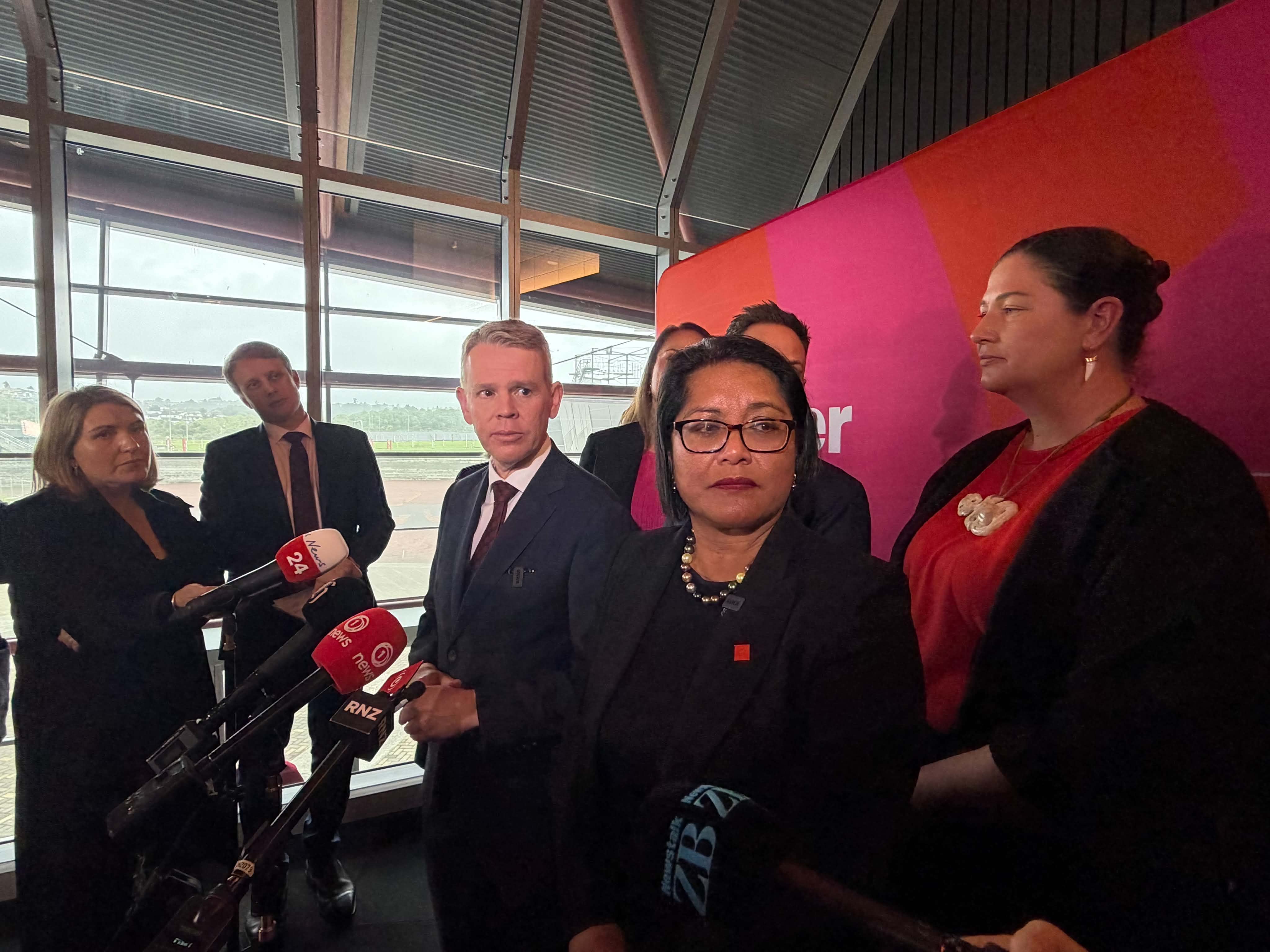
Edmonds said National was "going around the country declaring that these roads are going to be open, and yet at the same time have delayed the government policy statement so that other parties, not just ones in opposition, but also other government coalition partners, can't see what's actually in the government policy statement".
In response to this, Bishop said: "Our plans to freeze fuel tax in the NLTF were in our 2023 fiscal plan, so she is wrong to claim that usually these aren't included in fiscal plans."
"The new roads we’ve announced in the last couple of days are funded from the Budget capital allowances in 2027 and 2028 (just as Cambridge to Piarere was in Budget 2026)."
On the difference between Labour's $1.8 billion costing and National's $3.2 billion, Edmonds said "it's actually less because the government have also committed to their 25 cent fuel tax changes as well".
"They've put money into the National Land Transport Fund as a result of that. So therefore, our costings look at... just under $1.8 billion for the cost to do the fuel excise tax freeze for three years, and that will require reprioritisation within the actual National Land Transport Fund."
Where does Edmonds sit on debt?
Net core Crown debt is just over 40% of GDP, forecast in the last Budget to peak at 46% in 2028.
"We want to be able to bring debts down," she said.
"So this is the wider principle. Bring debt down because you need to have a cushion within your financial accounts to account for if unexpected events happen, for example. And that's just very good, prudent fiscal management. Ultimately, for us, at the same time, we know we have an infrastructure deficit."
Edmonds said in general, debt should be used for capital, not operational costs.
MP expenses
The renumeration authority is making it harder for MPs to claim a full $52,000 accommodation allowance, requiring proof for expenses or proof non-Wellington based MPs could rent their house out for $1000 a week, Stuff reported.
Asked if she supported this move, Edmonds said it was what the public expected.
"Our leader will have more to say on this because obviously it does impact on MPs across the board. But we have to respect that this is the independent remuneration authority that is their job.
"They believe that it's fairer to go to actual costs, and you know I agree with it."
Income tax changes
On her view of changing income tax rates once the books are in surplus, Edmonds said for "any finance spokesperson or finance minister, tax cuts need to be allowed as the fiscal and economic environment allows for it".
"There are always pros and cons around tax cuts or changes to thresholds, such as the fiscal impact of them if at the time the economy is running hot, so there's different things that you have to weigh up.
"But ultimately, that is why I say tax cuts should be considered within the fiscal and economic environment."
We welcome your comments below. If you are not already registered, please register to comment
Remember we welcome robust, respectful and insightful debate. We don't welcome abusive or defamatory comments and will de-register those repeatedly making such comments. Our current comment policy is here.