

Higher interest rates, housing supply growth and lower migration is causing weaker house price growth. Despite this, Labour is still confident its promised capital gains tax policy would generate enough revenue to cover its free GP visit pledge.
Treasury, releasing its pre-election economic and fiscal update (PREFU) on Tuesday, noted the housing market remained "soft with little house price growth at a national level" based on figures from the Cotality Quarterly House Price Index.
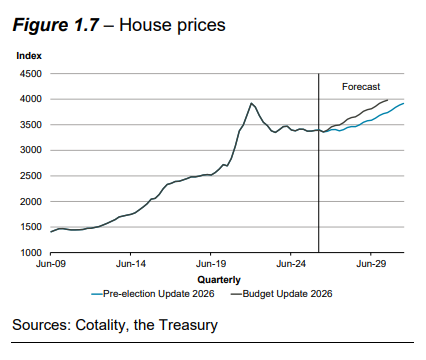
"Higher interest rates, growth in housing supply and lower net migration than forecast in the Budget Update contribute to a weaker outlook for house prices over the forecast period, reducing private consumption relative to the Budget Update forecast through a weaker wealth effect," the PREFU documents stated.
It added that strong consents issued since the end of last year pointed to a "robust pipeline of housing construction activity, supported by ongoing reforms to zoning regulations aimed at increasing housing intensification."
In May's Budget, house prices were forecast to grow at an average yearly rate of 3% to 4% over the forecast period, revised down from 6% to 7% previously.
The annual percentage change in PREFU forecasts compared to the Budget:
| PREFU | BUDGET | |
|---|---|---|
| 2027 | 0.6% | 4% |
| 2028 | 2.4% | 4.6% |
| 2029 | 3.7% | 4.3% |
| 2030 | 4.1% | 4.4% |
| 2031 | 4.8% |
Finance Minister Nicola Willis, initially acknowledging New Zealanders who bought during the Covid-era price peak, said the forecasts showed a return to positive annual growth across the remainder of the forecast period.
"That growth is more moderate than we have seen at some periods in New Zealand's history, where frankly house price growth got out of control and was distortionary to the economy and ruined the dreams of future homeowners."
Willis said the 'modest' forecasted growth "means that New Zealanders who have equity in their homes can be confident that that asset is secure, while also ensuring that this government's progress to deliver more first-time buyers into the market can continue".
What does it mean for Labour's capital gain tax?
Turning to Labour's capital gains tax promise, Willis said it was "predicated on a range of assumptions that may not hold."
"One of the biggest assumptions is that it will simply be a narrow capital gains tax. It's my view that in order to generate the revenue they are forecasting from that capital gains tax, they may need to add to it and make it more comprehensive..."
Labour finance spokesperson Barbara Edmonds pushed back on the assumption, saying her party "always projected for our forecast for capital gains tax that it would be 3% over the longer term."
"So you'll see that obviously it's a little bit lower than 3% the next fiscal year, and then it goes actually up over 3%... We'll make whatever adjustments that we need to do as part of our fiscal plan."
South Island growth
House price growth was stronger in rural New Zealand, "reflected in the differences in regional housing market performance", the PREFU document stated.
"Although national house prices have been broadly flat over the past year and a half, prices have continued to rise year on year in parts of the South Island that are particularly exposed to export performance, while continuing to fall in the main urban centres of the North Island."
We welcome your comments below. If you are not already registered, please register to comment
Remember we welcome robust, respectful and insightful debate. We don't welcome abusive or defamatory comments and will de-register those repeatedly making such comments. Our current comment policy is here.