
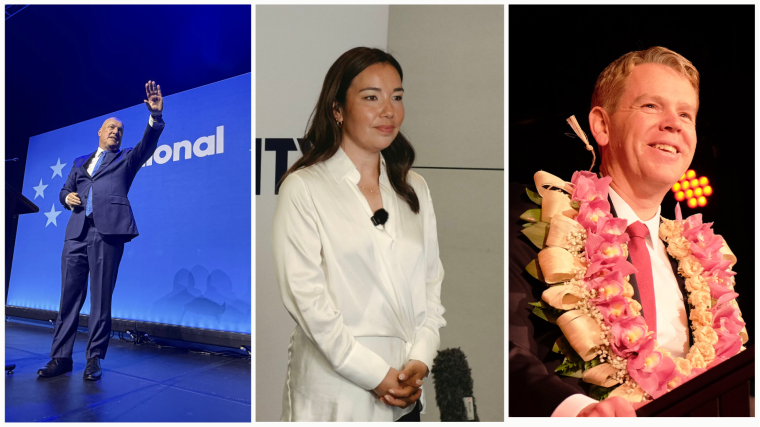
As Parliament waits for the special votes and the final result of thw 2026 election, the right holds a slim majority, the left is hoping for a late swing, and both sides face tricky questions about who gets what in a coalition, starting with the finance portfolio.
The key date:
November 27 is what everyone is waiting for. Some MPs have gone to ground, others, such as Opportunity's Qiulae Wong has been meeting with the likes of National leader Christopher Luxon, Labour leader Chris Hipkins and Greens' co-leader Chlöe Swarbrick.
Luxon is also heading away next week to China and the Philippines to represent New Zealand at APEC and the East Asia Summit.
Key seats:
Political pundits will be keeping a close eye on Wairarapa which has 139 votes between National's Mike Butterick and Labour's Kieran McAnulty as the closest result from election night.

It's not as close as some of the electorates that flipped between the preliminary count and final result in 2023, such as Nelson flipping back on a 26 vote margin, and Te Atatū flipped back to Labour after National's 30 vote preliminary lead went to a 131 buffer to Labour.
If Wairarapa flipped over to Labour, it would bring National's seat total down to 41 and the overhang down to 130.
Wellington Bays (Labour's Craig Renney leading by 140 over Greens' Julie Anne Genter), Mt Roskill (Labour's Michael Wood leading National's Carlos Cheung by 262), Te Tai Tokerau (Te Pāti Māori's Aperahama Edwards leading over Green's Hūhana Lyndon, and Hamilton East (National's Ryan Hamilton leading Labour's Georgie Dansey by 456).
Key outcomes:
This is the current situation:
Projected blocs (66 needed) for a 131 seat Parliament (11 seat overhang)
- The right bloc seats: National 42 + ACT 13 + NZ First 12 = 67
- The right bloc with Opportunity: National 42 + ACT 13 + NZ First 12 + Opportunity 7 = 74
- The left bloc: Labour 36 + Greens 16 + TPM 5 = 57
- The left bloc (with Opportunity and the Greens as Labour's preferred partners): Labour 36 + Greens 16 + Opportunity 7 + TPM 5 = 64
The special votes, which have not yet been fully counted, make up about 14% of the overall vote. Once those have been included, the Electoral Commission will release the final result. Interestingly, special votes appear to be lower than previous recent elections, with the Electoral Commission estimating about 400,000 cast, which is more comparable to 2017, rather than the 600,000 cast last election, or the 500,000 cast in 2020.
The overhang makes things slightly more complex (here's my overhang 101 story), but most of the previous elections since 2008 have seen one or two seats knocked off National once special votes are counted, with the left picking those up.
Three hypothetical scenarios post special votes:
- The right bloc get it - with or without Opportunity
If the preliminary vote doesn't change once the special votes are in, the right would be able to form a government with 67 seats - albeit uncomfortably.
Regardless of the specials, Luxon has already met with Wong.
There's a cross bench situation - NZ First leader Winston Peters suggesting this in 2014, which may be an attractive option for any party that wants to slightly distance itself from the Government, especially as a major sticking point here may be the Opportunity relationship with ACT and NZ First.
This is highlighted in an interview with interest.co.nz in July, when Qiulae Wong spoke of a potential relationship with National, saying alongside meeting their bottom lines, the other consideration was what the minor parties were putting on the table.
"Obviously, it's probably not going to be a two-party coalition. If there are things there that are really contrary to what we believe, so things like [NZ First's] gender definitions bill, which we don't believe is a good piece of legislation, [ACT's] treaty principles bill, for the same reason, we wouldn't agree to that," Wong said.
"And so we'll either have to go into a confidence and supply arrangement or walk away completely."
If she was prepared to swallow dead rats through being part of a governing arrangement, Wong said it depended on what they were.
"If it's something that is really contrary to where we think New Zealand needs to go, that's something that we will walk away from."
"It'll be interesting to see what the other parties put on the table in the lead up to the election. I think that will make it clearer. For example, New Zealand First wanting to spend a billion dollars on oil and gas exploration, that's not something we're going to agree to support in our first term," Wong said.
2. The left bloc get it
New Zealand politics can always serve up surprises. The left will be relying on a major surge from the specials here to pull up its result from the preliminary count, and if that were to happen, it could be Labour, the Greens, Opportunity and Te Pāti Māori.
This would not be a simple relationship either, with Hipkins back in February saying the infighting within Te Pāti Māori meant they needed to show the party could work together before working with others, while RNZ reported Labour's Māori campaign chair Willie Jackson said the party had "a number of extreme views".
Not to mention Hipkins' ruling out the Greens and Te Pāti Māori from major ministerial roles following a visit to a gang pad during the election campaign.
3. Hung Parliament, another election
While the right may be confident it is ahead enough to sustain an addition of the special votes, the possibility always remains that a government may not be able to be formed if neither side can come to an agreement, or the blocs are hung (but still, a majority is needed in Parliament to even get that across the line too).
Key people:
First, let's look at the finance fiasco. This has been an ongoing drama through the campaign, each side using finance positioning as scaremongering political ammunition, - the left using David Seymour and the right using Chloe Swarbrick.
Speaking to media last Sunday, Luxon said a finance minister in his government would be a National MP. That followed speculation around Seymour taking the role with Nicola Willis now out of Parliament.
"That's not negotiable," he said.
Well, actually - "everything's negotiable, Christopher", was David Seymour's response.
Talking to the NZ Herald, ACT Party leader Seymour said Luxon's position on the finance portfolio staying with National was "no longer tenable".
“The National Party needs to recognise they are not a National government with two inconvenient bolt-ons; they are now a coalition."
Equally, the same could be said for the left. While Hipkins was adamant before the election Labour finance spokesperson Barbara Edmonds would get the role if the left were in power, coming in at just 29.36% in the preliminary count, and the Greens in a higher position than ACT at 13.3%, while unlikely, it would not be totally unreasonable for the Greens to ask Labour for Swarbrick to be in the finance role.
If Labour were to enter government with the Greens and Opportunity, Edmonds told interest.co.nz deciding if the Greens' Swarbrick and Opportunity's Wong would be her associates was above her pay grade, but she was "comfortable with working with whomever the prime minister, Chris Hipkins, delegates to me as associate."
Who's left in National?
National's front bench has had a huge chunk of experience ripped out from losing the likes of Nicola Willis, Chris Bishop and Paul Goldsmith.
Looking at the National Party list of 42 MPs, the number of potential Cabinet candidates further slims out once those who were demoted in the last government or are new MPs are taken into account. National also may have to give up more Cabinet position to minor parties.
Speculation is swirling Pakuranga MP Simeon Brown would be the leading choice for a National-led government's Finance Minister, depending on what happens with the National v ACT lay to claim on this one. That could mean the health chalice could go the likes of Erica Stanford or Louise Upston, while newer, solid performers outside of Cabinet such as James Meager and Cameron Brewer may need to be quickly boosted.
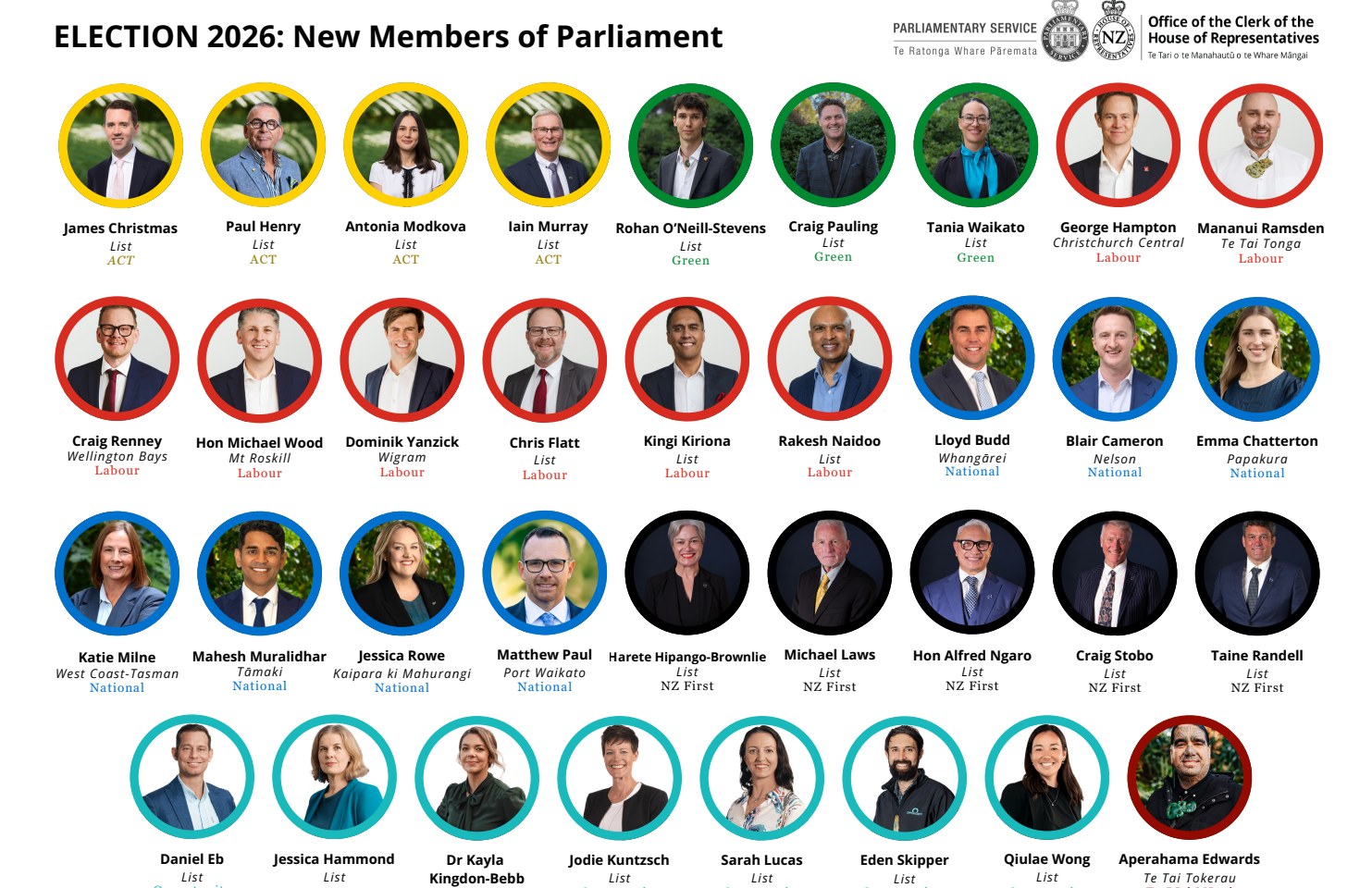
While ACT's James Christmas was touted as a potential Attorney General, former lawyer and caretaker Māori Crown Relations Minister Tama Potaka's name has also been suggested.
For Speaker, deputy Speaker Barbara Kuriger and caretaker ACC Minister Scott Simpson could be options to replace Gerry Brownlee, who didn't make it back to Parliament.
The parties, as it stands
National Party 29.21% 42 electorate seats, 0 list seats (42 total)
Labour Party 29.36% 21 electorate seats, 15 list seats (36 total)
Green Party 13.30% 2 electorate seats, 14 list seats (16 total)
ACT New Zealand 10.92% 1 electorate seats, 12 list seats (13 total)
New Zealand First Party 9.78% 12 list seats (12 total)
Opportunity Party 5.96% - 7 list seats (7 total)
Te Pāti Māori 0.57% 5 electorate seats (5 total)
The Electoral Commission estimates the number of special votes is approximately 399,365 - approximately 14% of total votes.
The overhang
Parliament has 120 seats, but this election has delivered a staggering 11 extra overhang seats. The overhang is when additional seats are added to Parliament's 120 to accommodate extra MPs due to the difference between electorate and party vote results.
Those seats come from Te Pāti Māori which only received 0.57% of the vote, but were successful in winning five Māori electorate seats. They bring in one new MP, Aperahama Edwards who won Te Tai Tokerau.
The other overhang seats come from National, which only pulled in 29% of the party vote but won 42 electorates.
We welcome your comments below. If you are not already registered, please register to comment
Remember we welcome robust, respectful and insightful debate. We don't welcome abusive or defamatory comments and will de-register those repeatedly making such comments. Our current comment policy is here.