
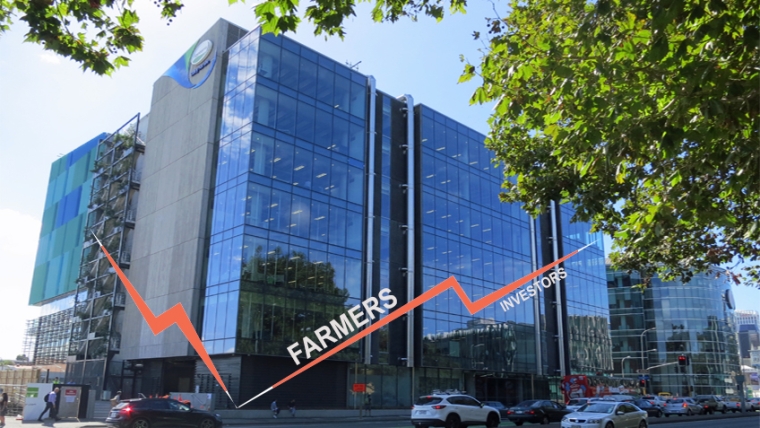
Fonterra’s delay in announcing its results, driven by Fonterra’s need for discussions with its auditors about appropriate asset values, provides an opportunity to reflect on Fonterra’s capital structure and whether it is still fit for purpose. The simple answer is that it is not.
The value destruction that has occurred and which is now coming to light means that inherent conflicts between the interests of farmer shareholders and investor unitholders have become too great to be papered over. Co-operatives do not survive long-term unless everyone’s interests align.
Two former directors of Fonterra, Colin Armer and Nicola Shadbolt, have both come out recently and said that reworking Fonterra’s capital structure is not the immediate priority. I agree with them. The immediate and urgent priority is to sell assets and create a new slimmed-down and financially-efficient organisational structure, with many fewer high-paid executives.
However, asset sales and creation of the new slimmed-down and non-bloated operating structure can only be the first stages of traumatic overall restructuring. Fundamental flaws in the current hybrid structure of farmer shareholders and non-farmer unit investors mean that a new capital structure will also be needed.
Fonterra’s current structure was created in 2012 following at least five years of angst searching for a new structural pathway. The leader of that journey was Chairman Henry van der Heyden, now Sir Henry.
The key argument was that Fonterra needed to have permanent capital, whereas in a traditional co-operative the farmer shareholdings are not guaranteed as permanent.
If a farmer leaves a traditional co-operative, the shares owned by that farmer have to be redeemed, although the redemption can be delayed. Hence, the argument was that there needed to be a mechanism to allow cash outflows from share redemptions to be balanced by new cash inflows from non-farmer investors.
The challenge in finding such a mechanism was that farmers were not willing to let non-farmers have a vote in regard to company policy. The supposed solution was to create a structure where non-farmer investors could buy units in a new structure listed on the NZX and called the Fonterra Shareholders’ Fund. These units would have the same economic rights as shares but no voting rights. If farmers departed, then the number of units would be correspondingly increased, and hence the redemption risk would be solved.
The name ‘Fonterra Shareholders’ Fund’ is an inappropriate name. In fact, it is aimed at non-farmer investors.
The legal structure of the Fonterra Shareholder Fund (hereafter the ‘Fund’) is complex. I won’t go into the details here. The overarching principle is that the Fonterra-nominated Custodian can hold shares to Fonterra and sell units to their economic rights. The shares themselves stay with the Custodian but hold no voting rights for anyone.
The Fund is a key part of the overall capital structure called ‘Trading Among Farmers’ (TAF). This too is an inappropriate name as much of the trading actually occurs between farmers and non-farmer investors.
It can be useful to think of the Fund as a balloon, with a two-way umbilical cord through to Fonterra itself that is managed by the Custodian.
If farmers sell their shares, then new balancing investor units are created in the Fund. In this way, the number of units in the Fund get pumped up. Also, a payment passes via the Custodian through the umbilical cord from the purchasers of the units to the departing Fonterra farmers.
Conversely, if farmers are buying shares from Fonterra, then the Custodian can sell shares to the farmers and buy units from the Fund at the same price. These units are then cancelled. The money that the farmers have paid the Custodian is shovelled on to the departing unit-holders and the size of the Fund shrivels.
It sounds complex and it is complex. However, the system has now been working for close on seven years and it has indeed worked, at least until recently, largely as intended.
Over these years, farmers have been able to buy and sell shares, unitholders have bought and sold units, and the Custodian has managed the process such that the price of shares and units is always within a cent or two of each other.
Two other outcomes have been that Fonterra has received no new capital when farmers bought shares, and Fonterra has not had to pay out money when farmers departed.
A key insight relevant to how the Fund works in practice is that the size of the Fund is largely determined by farmer decisions to buy and sell shares. These decisions are largely driven by their need to hold one share for each unit of production, measured as one kilogram per annum of ‘milksolids’ (fat plus protein).
Another key insight is that although the number of units in the fund is largely determined by farmer decisions, the price of units and hence also the price of Fonterra shares, is determined by willingness of non-farmer investors to buy and sell units.
Once the Fund had been bedded down at the end of the July 2013 financial year, the Fund had 108 million shares, valued at $7.30 and the total Fund value was $788 million.
Fast forward to 1 January 2018, the fund had ballooned to 139.7 million shares valued at $6.38 with a total value of $891.6 million. This reflects that farmers were predominantly selling shares, unit-holders were predominantly buying units, and prices were holding up reasonably.
Fast forward again to 1 September 2019, the Fund had shrivelled to 102.1 million shares, each valued at $3.18 and the Fund value was $325 million. This reflected that farmers had predominantly been buying shares, allowing unit holders to exit and hence the fund to shrivel, but still the price of units had tanked.
It may seem surprising that farmers have continued to buy shares despite Fonterra’s total production no longer increasing. The reason is that many farmers were using a Fonterra scheme called MyMilk that allowed them to delay the purchase of shares for five years. There are still some farmers who need to buy shares because of this scheme.
The longer-term problem going forward is that Fonterra is now likely to lose production, in part because of competition for milk from other processors who can afford to outbid Fonterra, and in part because of farmers exiting the industry linked to compliance problems. The key question is who will buy the units that will then flow across the umbilical cord from the Fonterra Custodian to the Fund?
Over the past 18 months, the dominant perspective of non-farmer investors has been a wish to exit the fund, not enter it. Most of the major institutional investors have now achieved this.
Most of the unit-holders are now retail investors who, operating generally with weaker information, did not see the bad-news tsunami coming along. Now, with Fonterra’s aura so badly damaged, they too will be looking to exit.
What this means is that the redemption backstop is no longer reliable. Hence, Fonterra’s problems have now got a whole lot bigger.
So how is it that Fonterra’s leaders and its high-priced consultants did not see this scenario back at the start when the new structure was introduced in 2012? That is Part 2 of this story.
*Keith Woodford was Professor of Farm Management and Agribusiness at Lincoln University for 15 years through to 2015. He is now Principal Consultant at AgriFood Systems Ltd. Previous article on Fonterra’s challenges can be found at https://keithwoodford.wordpress.com/category/fonterra. You can contact him directly here.
We welcome your comments below. If you are not already registered, please register to comment
Remember we welcome robust, respectful and insightful debate. We don't welcome abusive or defamatory comments and will de-register those repeatedly making such comments. Our current comment policy is here.