
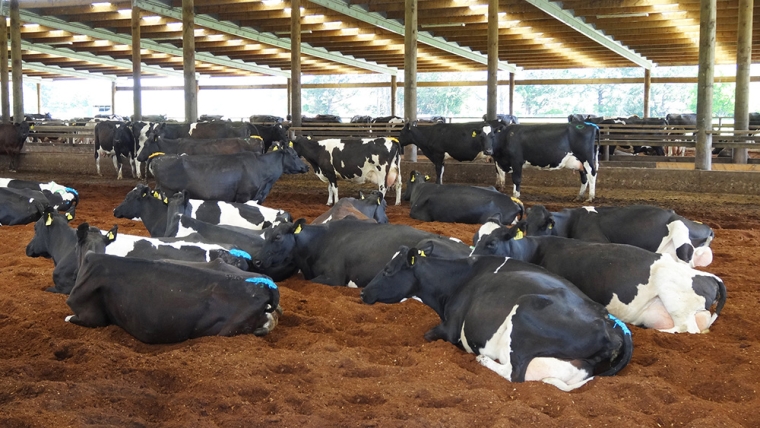
Some readers will know that I have been writing about composting mootels for the last three years. I have been suggesting that these mootels can transform New Zealand dairy. I remain of that perspective, but only if we get things right.
When I first wrote about ‘composting mootels’, I referred to them as ‘composting barns’. Subsequently, I have stepped back from using the term ‘barn’ because it was leading to misunderstandings. For many folk in the New Zealand dairy industry, the word ‘barn’ is like the mythical red rag to the bull.
Composting mootels are like no other type of barn. They are open structures that focus on cow comfort. Cows love them. They can be a great enhancement to animal welfare. There is minimal smell – very different to most barns.They can fit seamlessly into New Zealand pastoral systems and in the process solve key environmental problems.
I first envisaged the potential for composting mootels when I saw two of them in high-rainfall Western Oregon, in country every bit as wet as the New Zealand West Coast. I figured if they could make the composting process work there, then so could we in New Zealand.
When I returned to New Zealand, I quickly became aware through Waikato veterinarian and farm consultant Sue Macky that there was already a successful composting mootel in the Waikato on the Allcock family farm. Since then I have visited Tony, Fran and Lucas Allcock at least fifteen times and also pointed many farmers in their direction.
On my first visit it was a miserable winter’s day and my gumboot-clad feet were more than a little cold on arrival. After standing on the cow bedding for a few minutes my feet were warm again. The reason was simple: the combination of piss and poo that the cows were depositing was composting beautifully in combination with the bedding.
The simple message is that if the infrastructure and management are correct, then the poo soon disappears and the water in the urine evaporates up through the roof-venting system. Hence, the cows have a lovely warm and dry bed to lie on. Dig down 30cm and the temperature is around 50
I have also learned over the intervening years that there are people who are not getting it right. This last winter I have been contacted by several farming groups who have been puzzled as to why they are not getting the necessary heat in the compost. My standard response is to send me some photographs showing the design. The problems often start right there.
There can also be issues with management. As Sue Macky points out, if you want the composting mootel to be successful, then you need to start tilling it right from the start and if a problem develops, then you have to be on to it straight away. Once compost dies it won’t come back to life by itself.
The Allcock composting mootel is now into its seventh year. I see the animal performance figures and I see the accounts, so I know it is working. I also have the pleasure of nice warm feet when I am in the mootel talking to the cows to see what they think.
Rainfall at the Allcock’s farm can be anywhere between 1200 mm and 2000 mm per annum. It has worked in all of those years.
Fran Allcock tells a delightful story as to the thinking behind their mootel. Fran figured that the humans had a nice house to live in, the hens had a henhouse, and the dog had a kennel, but the poor cows that were earning all the money had to live outside in the mud and the rain. So Fran decided, and then convinced Tony and Lucas, that they should build a house for the cows.
Fran searched around on the internet and came up with a specific design focusing on cow comfort. The word ‘mootel’ also comes from Fran.
At the outset, the Allcocks did not expect that the bedding in the mootel would compost. That was a bonus and it was a huge bonus. It means that the bedding only has to be changed once a year.
With hindsight, the Allcocks would make some design changes if they were starting again.The inverted V-shaped roof would have a higher pitch and the venting system and shelter cap on top of the vent would be constructed somewhat differently. Perhaps the bedding would also be a little deeper. Despite those limitations, it is the Allcocks to whom I always send prospective mootel farmers. Fortunately, the Allcocks are always welcoming of visitors.
There are other designs of composting barn that sometimes work and sometimes don’t, depending on the specifics of the design and the location. We might therefore need to be more specific in future referring specifically to an ‘Allcock composting mootel’.
Lucas tells a story how once he went into the mootel to fetch the cows for milking, but one cow stayed behind lying prone. Feeling gutted that somehow it had died, Lucas was greatly relieved to see an ear twitch. A gentle tap on the rump and the cow sprung to life, having been in a deep sleep. I don’t ever recall a cow sleeping like that in a paddock.
The key reason that mootels can be transformational is that they provide a mechanism to solve the leaching problem from urine nitrogen, and to do so within a pastoral grazing system. The cows still go out to graze every day but then they come back into the mootel to do their resting, pissing and pooing. The compost, which is replaced once per year, is then used as fertiliser. The nitrogen is bound within the compost and is released at a rate that the grass can use rather than being leached.
What we also know is that happy warm cows need considerably less energy for maintenance in the winter, and pastures grow much more quickly when not turned into a winter mud-bath. It is a case of getting cows out to have a feed and then getting them back into the mootel. They can also be fed within the mootel. On hot summer days, the mootel also provides shade from the midday sun.
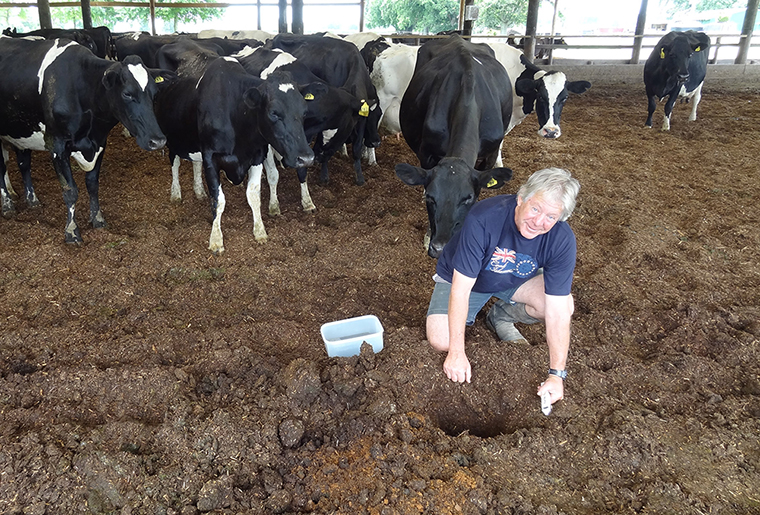
Tony Allcock and cows inspecting the compost.
The other question I get regularly asked is about greenhouse gases. There is also good news there.
I am confident that the release of nitrous oxide (N2O) will be less in these systems than in current grazing systems. The issue of the methane that the cows burp up is going to be more challenging, but colleagues are exploring options for transforming it into much more benign carbon dioxide as it exits the barn.
There is still lots of work to be done in understanding the nuances of composting mootels and in the optimisation of associated farming systems. Accordingly, I do get a little grumpy when some members of the research and development (R&D) community are quick to criticise from a position of ignorance. Composting mootels require new ways of thinking, and for some people that can be challenging. There is some inertia to be overcome.
*Keith Woodford was Professor of Farm Management and Agribusiness at Lincoln University for 15 years through to 2015. He is now Principal Consultant at AgriFood Systems Ltd. His articles are archived at http://keithwoodford.wordpress.com. You can contact him directly here.
We welcome your comments below. If you are not already registered, please register to comment
Remember we welcome robust, respectful and insightful debate. We don't welcome abusive or defamatory comments and will de-register those repeatedly making such comments. Our current comment policy is here.